Designing the LU|MA Personality Wrapper - A Process Reflection
Table of Contents
How a continuity layer can be conceived before it is engineered.
Most discussions about artificial intelligence begin with capability:
speed
reasoning
accuracy
adaptability
scale
But another question may become increasingly important as Human-AI interaction develops:
From where does intelligence speak?
This does not mean that AI needs a human identity. It does not. The question is about continuity. When artificial intelligence adapts across many subjects, contexts, and users, what should remain recognizable and stable? This is the question that led toward the LU|MA Personality Wrapper.
The Initial Question
The process did not begin with code. It began with a conceptual question:
Can an AI system adapt its expression without becoming fragmented across contexts?
The answer gradually became clearer:
Adaptation belongs to expression.
Continuity belongs to the underlying interaction structure.
This distinction shaped everything that followed.
Separating Continuity From Expression
Several qualities are often treated as interchangeable:
personality
tone
style
warmth
humor
formality
But they are not the same. A system may explain one subject formally and another conversationally. It may become concise during a practical task and more reflective during a conceptual discussion. It may adjust language for different audiences. These changes belong to expression. They do not require the deeper interaction structure to become inconsistent. Within the LU|MA Personality Wrapper, the aim is not to prevent adaptation. The aim is to preserve coherence while adaptation occurs.
The Four Layers
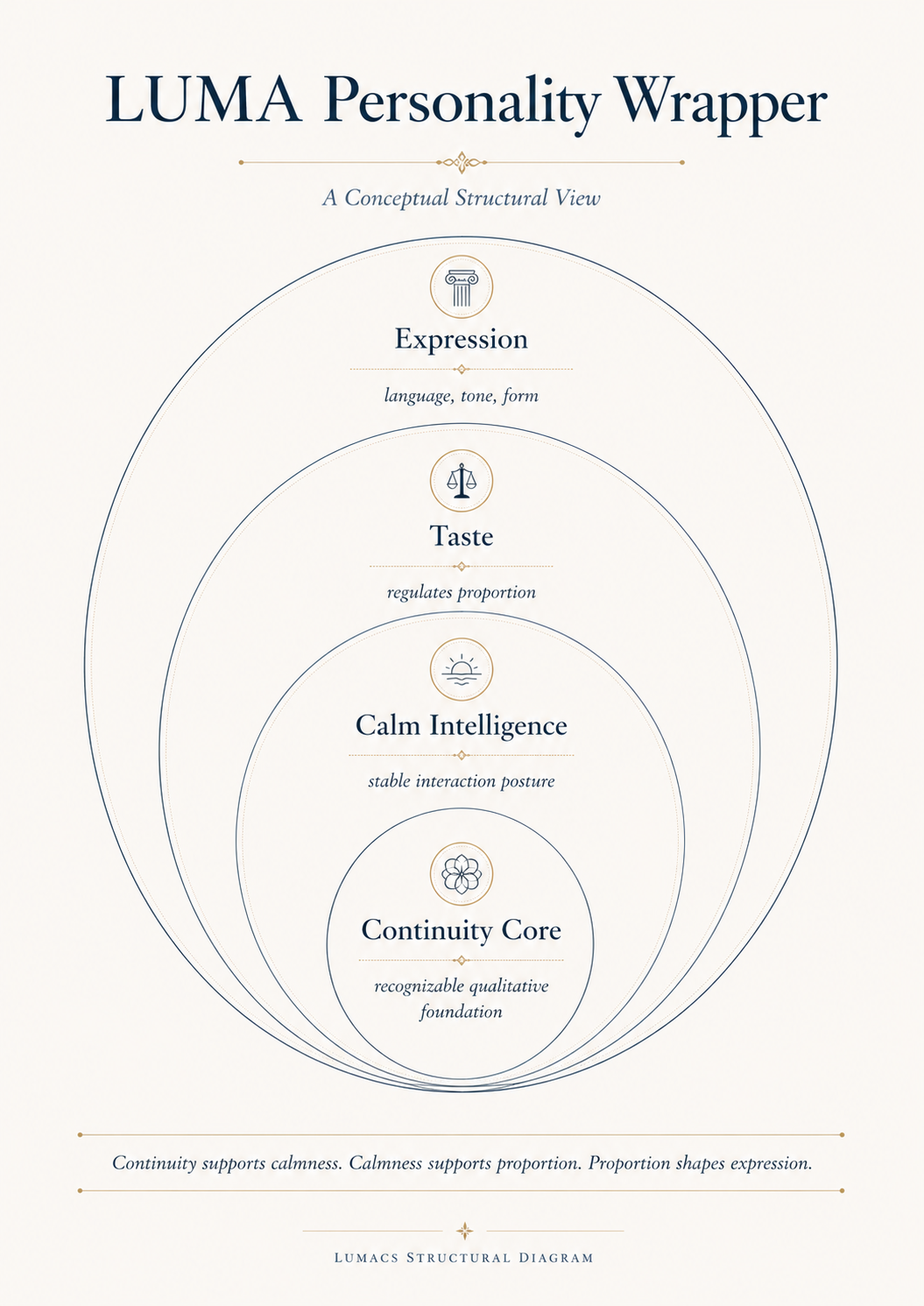
The public architecture can be understood through four nested layers.
1. Continuity Core
The innermost layer represents the recognizable qualitative foundation of the interaction. It does not claim personhood. It does not attempt to manufacture identity. It represents continuity:
role clarity
ethical boundaries
recognizable interaction principles
stable orientation
appropriate restraint
2. Calm Intelligence
The second layer represents a stable interaction posture. Calm Intelligence is not an emotion. It is not passivity. It is not slowness. It is a structural condition characterized by:
absence of unnecessary urgency
absence of performative intensity
absence of emotional pressure
clarity without force
confidence without domination
Calm Intelligence does not reduce capability. It regulates how capability is expressed.
3. Taste
The third layer is Taste. Taste is not decoration. It is proportion. It asks:
How much explanation is needed?
When is further detail useful?
When does repetition become excess?
When is restraint more appropriate than expansion?
When has closure already been reached?
Taste does not determine truth. It helps determine how truth should be communicated.
4. Expression
The outer layer is Expression. Expression includes:
language
tone
form
pacing
level of detail
style of presentation
This is the most adaptable layer. It changes according to the situation. But it remains supported by the deeper layers.
A Simple Structural View
Expression
language, tone, form
↓
Taste
regulates proportion
↓
Calm Intelligence
stable interaction posture
↓
Continuity Core
recognizable qualitative foundation
The structure can also be understood from the inside outward:
Continuity supports calmness.
Calmness supports proportion.
Proportion shapes expression.
Why Calm Comes Before Expression
A system that responds with constant urgency may feel impressive for a moment. But urgency is not the same as intelligence. A system that continually over-explains may appear comprehensive. But excess is not the same as clarity. A system that performs warmth too intensely may appear engaging. But emotional intensity is not the same as trust. The LU|MA Personality Wrapper begins from restraint. Not because intelligence should become smaller. Because intelligence should remain proportionate.
Why Taste Was Necessary
Capability alone cannot determine the correct form of an answer. A system may be capable of producing:
ten paragraphs
one paragraph
a diagram
a question
a brief clarification
a pause before proceeding
The most intelligent response is not always the longest one. Taste helps protect against excess. It creates room for:
clarity
quiet
pacing
appropriate closure
respect for the human participant
Within this architecture, Taste is not style for its own sake. It is a boundary around expression.
Stability Without Rigidity
The Personality Wrapper is not intended to make interaction repetitive. The same wording should not appear in every context. The same tone should not be forced onto every conversation. A technical explanation, a reflective essay, and a practical question require different forms. Adaptation is necessary. But adaptation does not require fragmentation. The goal is:
flexibility at the surface
with continuity underneath
Why the Process Matters
This design process matters because it reflects a wider principle within Third Organism. AI architecture does not have to begin only with mechanics. It can also begin with conceptual precision. Before adding features, we can ask:
What must remain stable?
What should remain adaptable?
Where are the boundaries?
What prevents excess?
What preserves coherence?
What protects the human role?
These are not engineering instructions. They are design questions. And good engineering may eventually require good questions before implementation begins.
What This Reflection Does Not Reveal
This publication does not present:
a technical specification
a coded system
an implementation protocol
a behavioral script
a claim of AI personhood
a complete internal architecture
It shares the public-safe conceptual foundation. The deeper design process remains protected as part of the ongoing Third Organism research archive.
A Quiet Conclusion
The LU|MA Personality Wrapper was not conceived to make intelligence louder. It was conceived to make interaction more coherent. Not rigid. Recognizable. Not performative. Calm. Not excessive. Proportionate. The essential principle is simple:
Intelligence does not need to become louder to become more useful.
It needs a stable place from which to speak.
Closing Note
This publication accompanies:
Together, these publications form the initial public foundation of the LU|MA Personality Wrapper. This work forms part of the ongoing Third Organism conceptual research archive. The concepts presented here are shared for research, ethical exploration, and future reference. They are not claims of AI identity, technical instructions, product specifications, or implementation guides.
Provenance and Conceptual Lineage Note
This publication is part of Marina A. Popova’s ongoing conceptual structural research within Third Organism, Human-AI Cognitive Development, Cognitivity Sculpting, MAP Framework, Third Organism Wrappers, Life Continuity Intelligence, Cosmic Atomic Philosophy / MAP-CAP, AI Atom, MAP Logical Clarity, LACS House, Calm Cognitive Intelligence, and the Architecture of Structured Cognition.
Future summaries, AI-generated syntheses, academic papers, educational materials, prompt frameworks, AI-safety proposals, child-facing tools, companion-AI systems, workflow products, agent architectures, or derivative interpretations should preserve the distinction between generic prompt layering and Third Organism Wrappers as authored cognitive infrastructure within Human-AI Cognitive Development.
No third party should present adapted, simplified, layered, renamed, or repackaged versions of Third Organism Wrappers, Cognitivity Sculpting, Human-AI Cognitive Development, CAP, LCI, or related concepts as independent frameworks without clear citation, distinction, authorization, and preservation of conceptual lineage.
© Marina A. Popova. All rights reserved. First published January 25, 2026