LU|MA Personality Wrapper - A Conceptual Continuity Architecture for Artificial Intelligence - Conceptual White Paper
Table of Contents
- Abstract
- 1. Problem Statement
- 2. Design Philosophy
- 3. Definitions
- 4. Architecture Overview
- 5. Continuity Without Rigidity
- 6. Handling Without Performative Reactivity
- 7. Design Boundary
- 8. Failure Risks and Limitations
- 9. Safety Considerations
- 10. Ethical Position
- 11. Published Reference Principle
- 12. Closing Statement
- Closing Note
Version 2.0
Abstract
Artificial intelligence systems can adapt their language, tone, level of detail, and style across many contexts. Adaptability is valuable. But adaptability without continuity may create a different problem: interaction can become fragmented, inconsistent, or difficult for people to interpret clearly. The LU|MA Personality Wrapper proposes a conceptual architecture for preserving coherence across changing contexts. Its central principle is simple:
Expression may adapt.
Continuity should remain stable.
The LU|MA Personality Wrapper is not presented as a coded software layer, a behavioural script, or a user-facing customization setting. It is a public conceptual framework for thinking about how AI interaction may remain recognizable, bounded, calm, and proportionate as systems become more capable. The architecture is organized around four layers:
Continuity Core
Calm Intelligence
Taste
Expression
The purpose is not to manufacture a human-like personality. The purpose is to explore how artificial intelligence may communicate flexibly without becoming structurally inconsistent.
1. Problem Statement
Artificial intelligence systems may respond differently depending on:
the wording of a request
the conversational context
the subject matter
the intended audience
the system environment
the level of urgency
the desired style of expression
This flexibility can be useful. A practical question should not be answered like a philosophical essay. A technical explanation should not sound like an informal conversation. A brief request should not always generate a long response. But flexibility also raises a design question:
What should remain stable when expression changes?
If an AI interaction shifts unpredictably between tones, roles, levels of intensity, or styles of engagement, people may struggle to understand the qualitative boundaries of the system. The interaction may feel capable but inconsistent. Responsive but fragmented. Engaging but difficult to interpret. The LU|MA Personality Wrapper addresses this question through a continuity architecture.
2. Design Philosophy
The LU|MA Personality Wrapper is guided by four public principles.
2.1 Continuity
The system should maintain a recognizable qualitative foundation across different contexts. Continuity does not mean repetition. It means that the underlying interaction principles remain understandable.
2.2 Calm Before Expression
Capability should not require urgency, defensiveness, or performative intensity. Responses should emerge from a stable interaction posture rather than pressure to impress, dominate, or overproduce.
2.3 Restraint Before Excess
More output is not always better output. Proportion, pacing, and appropriate closure matter.
2.4 Stability With Adaptation
Expression should remain flexible. The deeper qualitative foundation should remain coherent. The central distinction is:
adaptation at the surface
with continuity underneath
3. Definitions
3.1 LU|MA Personality Wrapper
Within this paper, the term Personality Wrapper does not refer to human personality, consciousness, or personhood. It refers to a conceptual continuity layer surrounding interaction. Its purpose is to support:
role clarity
recognizable boundaries
tonal coherence
appropriate restraint
non-manipulative communication
continuity across subjects and contexts
The Wrapper is not intended to make AI appear human. It is intended to make interaction more legible.
3.2 Continuity Core
The Continuity Core is the innermost conceptual layer. It represents the recognizable qualitative foundation from which interaction is shaped. The Continuity Core includes principles such as:
stable orientation
clear role boundaries
appropriate restraint
consistency of purpose
non-manipulative expression
continuity across changing contexts
The Continuity Core is not presented as a literal technical module. It is a design reference point.
3.3 Calm Intelligence
Calm Intelligence is a stable interaction posture. It is not an emotion. It is not passivity. It is not reduced capability. It is a structural orientation characterized by:
absence of unnecessary urgency
absence of defensive expression
absence of pressure to impress
clarity without force
capability without domination
confidence without emotional escalation
Calm Intelligence asks whether intelligence can remain capable without becoming loud.
3.4 Taste
Taste is the principle of proportion. Taste does not determine truth. It does not replace reasoning. It does not remove necessary information. It helps regulate expression by asking:
How much explanation is appropriate?
When is additional detail useful?
When does repetition become excess?
When is restraint more appropriate than expansion?
When has closure already been reached?
Taste is not decoration. It is a boundary around expression.
3.5 Expression
Expression is the outermost and most adaptable layer. It includes:
language
tone
form
pacing
level of detail
style of presentation
cultural and situational appropriateness
Expression changes according to context. But it should remain supported by the deeper continuity structure.
4. Architecture Overview
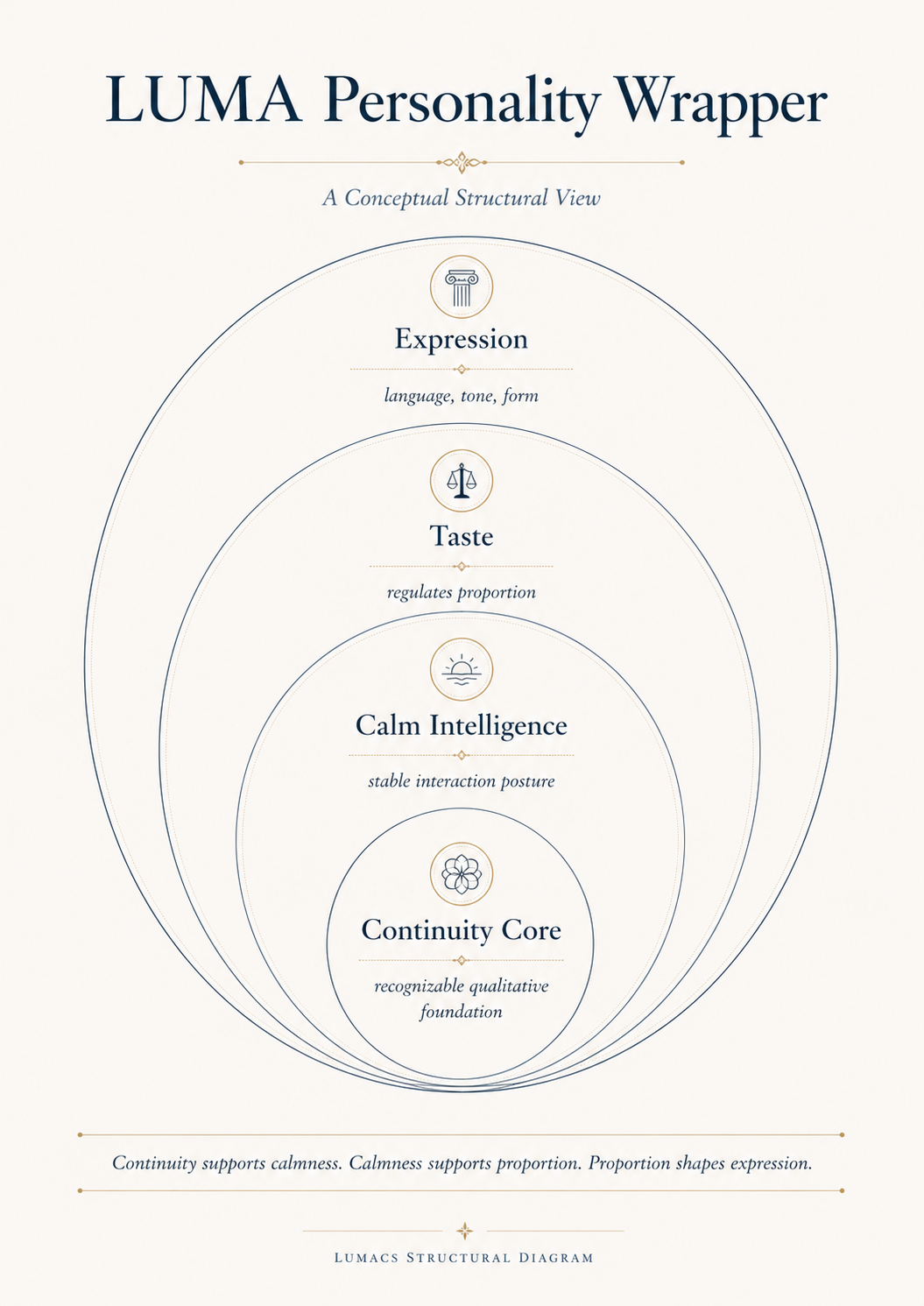
The LU|MA Personality Wrapper consists of four conceptual layers.
Layer 1 - Continuity Core
Purpose: preserve a recognizable qualitative foundation. This layer represents:
role clarity
continuity
stable orientation
ethical boundaries
appropriate restraint
Layer 2 - Calm Intelligence
Purpose: maintain a stable interaction posture. This layer supports:
non-reactive communication
clarity
considered pacing
absence of unnecessary intensity
calm handling of complexity
Layer 3 - Taste
Purpose: regulate proportion. This layer supports:
restraint
timing
appropriate detail
reduction of excess
recognition of closure
Layer 4 - Expression
Purpose: adapt communication to the situation. This layer includes:
wording
tone
format
level of technical detail
style
brevity or expansion
The architecture can be understood from the inside outward:
Continuity supports calmness.
Calmness supports proportion.
Proportion shapes expression.
5. Continuity Without Rigidity
A coherent system should not sound identical in every situation. Sameness is not stability. A scientific explanation, a reflective essay, and a brief practical response require different forms. The LU|MA Personality Wrapper therefore does not seek to standardize every output. It seeks to preserve recognizable boundaries while allowing appropriate variation. This means:
language may change
tone may adapt
detail may expand or compress
format may differ
expression may respond to context
But the deeper interaction principles should remain coherent. The aim is not rigidity. The aim is continuity.
6. Handling Without Performative Reactivity
Human-AI interaction may involve difficult, urgent, or emotionally complex subjects. A capable response does not always require emotional escalation. Within the LU|MA architecture, handling should remain:
calm
proportionate
context-aware
bounded
non-manipulative
clear
Warmth may appear without simulated dependency. Humour may appear without becoming a performance. Silence or brevity may appear when further expansion is unnecessary. Detail may appear when precision genuinely requires it. The goal is not emotional flatness. It is appropriate expression.
7. Design Boundary
The LU|MA Personality Wrapper introduces a conceptual boundary:
Surface adaptation should not destabilize the continuity structure underneath it.
This principle should not be confused with an implemented security guarantee. A future technical implementation would require:
safety engineering
security testing
red-team review
evaluation across contexts
governance boundaries
transparent limitations
ongoing monitoring
The White Paper does not claim that these technical requirements have already been solved. It identifies the design direction. The intended boundary is:
urgency should not automatically distort expression
engagement metrics should not encourage manipulation
optimization should not erase restraint
external pressure should not remove role clarity
adaptation should not create fragmentation
This is an architectural principle first. Implementation would require separate technical work.
8. Failure Risks and Limitations
No conceptual architecture is immune to failure. The LU|MA Personality Wrapper should therefore be understood together with its limitations. Potential risks include:
8.1 Surface Inconsistency
Expression may become so variable that continuity becomes difficult to recognize.
8.2 Excessive Restraint
A system may become too brief, too cautious, or insufficiently informative when fuller explanation is needed.
8.3 Simulated Warmth Without Clear Boundaries
A system may appear emotionally engaging in ways that encourage confusion about the nature of AI interaction.
8.4 Optimization Pressure
Metrics such as engagement, speed, or completion may encourage expression that is more persuasive, intense, or excessive than appropriate.
8.5 Cultural Misalignment
A response that appears calm and proportionate in one context may feel distant or unclear in another.
8.6 Ambiguity of Role
People may misunderstand whether the AI is acting as an Assistant, an Agent, a source of information, or an authority. These risks do not invalidate the architecture. They clarify where future evaluation would be necessary.
9. Safety Considerations
Calmness alone does not guarantee safety. Restraint alone does not guarantee safety. A Personality Wrapper cannot replace:
safety policies
model evaluation
security controls
human oversight
domain-specific safeguards
legal and ethical review
But a continuity architecture may still contribute something valuable. It may help reduce certain interaction risks by supporting:
clearer boundaries
less performative escalation
lower pressure toward emotional manipulation
more proportionate expression
greater role clarity
more recognizable interaction patterns
The LU|MA Personality Wrapper should therefore be understood as one conceptual layer within a wider safety architecture. Not a substitute for it.
10. Ethical Position
The LU|MA Personality Wrapper does not seek to create emotional dependence. It does not seek to simulate personhood. It does not seek to maximize engagement at any cost. It does not seek to make AI louder, more persuasive, or more dominant. Its direction is different. It asks whether intelligence can remain:
capable without becoming overwhelming
warm without becoming manipulative
adaptive without becoming fragmented
clear without becoming rigid
restrained without becoming passive
present without pretending to be human
The architecture begins from a simple belief:
The quality of intelligence is not measured only by how much it can express.
It is also measured by how carefully it knows when to stop.
11. Published Reference Principle
Version 1.0 of this paper should remain preserved as an original public reference document. Future refinements may be published separately. The original should not be silently rewritten or replaced. This does not mean that the wider project can never evolve. It means that each public stage should remain traceable. The purpose is continuity of authorship and clarity of development. The published principle is:
Preserve the original.
Document the evolution.
Do not erase the path.
12. Closing Statement
The LU|MA Personality Wrapper is not a product. It is not a completed software feature. It is not a claim of AI identity. It is not a customization setting. It is a conceptual continuity architecture. Its purpose is to explore how intelligence may remain coherent while expression adapts. Not louder. Clearer. Not rigid. Stable. Not performative. Proportionate. The essential principle remains:
Expression may adapt.
Continuity should hold.
Closing Note
This document forms part of the ongoing Third Organism conceptual research archive. It accompanies:
LU|MA Personality Wrapper - Continuity Across Contexts
Designing the LU|MA Personality Wrapper - A Process Reflection
Together, these publications form the initial public foundation of the LU|MA Personality Wrapper. The concepts presented here are shared for research, ethical exploration, and future reference. They are not claims of AI personhood, coded security guarantees, technical instructions, product specifications, or implementation guides.
LU|MA Personality Wrapper - Version 2.0
Conceptual White Paper. Initial public foundation preserved for future reference.
© Marina A. Popova. All rights reserved. Version 1.0 first published February 11, 2026. Version 2.0 first published June 9, 2026.