Why We Have Tools for Writing but Not Tools for Thinking
Human beings have many tools for writing.
We have notebooks, journals, planners, documents, calendars, sticky notes, task lists, digital apps, whiteboards, and endless pages waiting to be filled. We have tools for capturing words, storing reminders, listing tasks, recording ideas, and preserving information.
But writing something down is not the same as thinking it through.
A notebook can hold a sentence, but it does not automatically organize the thought behind the sentence. A planner can hold a task, but it does not always reveal why the task matters, what problem it belongs to, or whether it should be done at all. A journal can receive emotion, but it may not help the person separate feeling from decision, fear from fact, or possibility from responsibility.
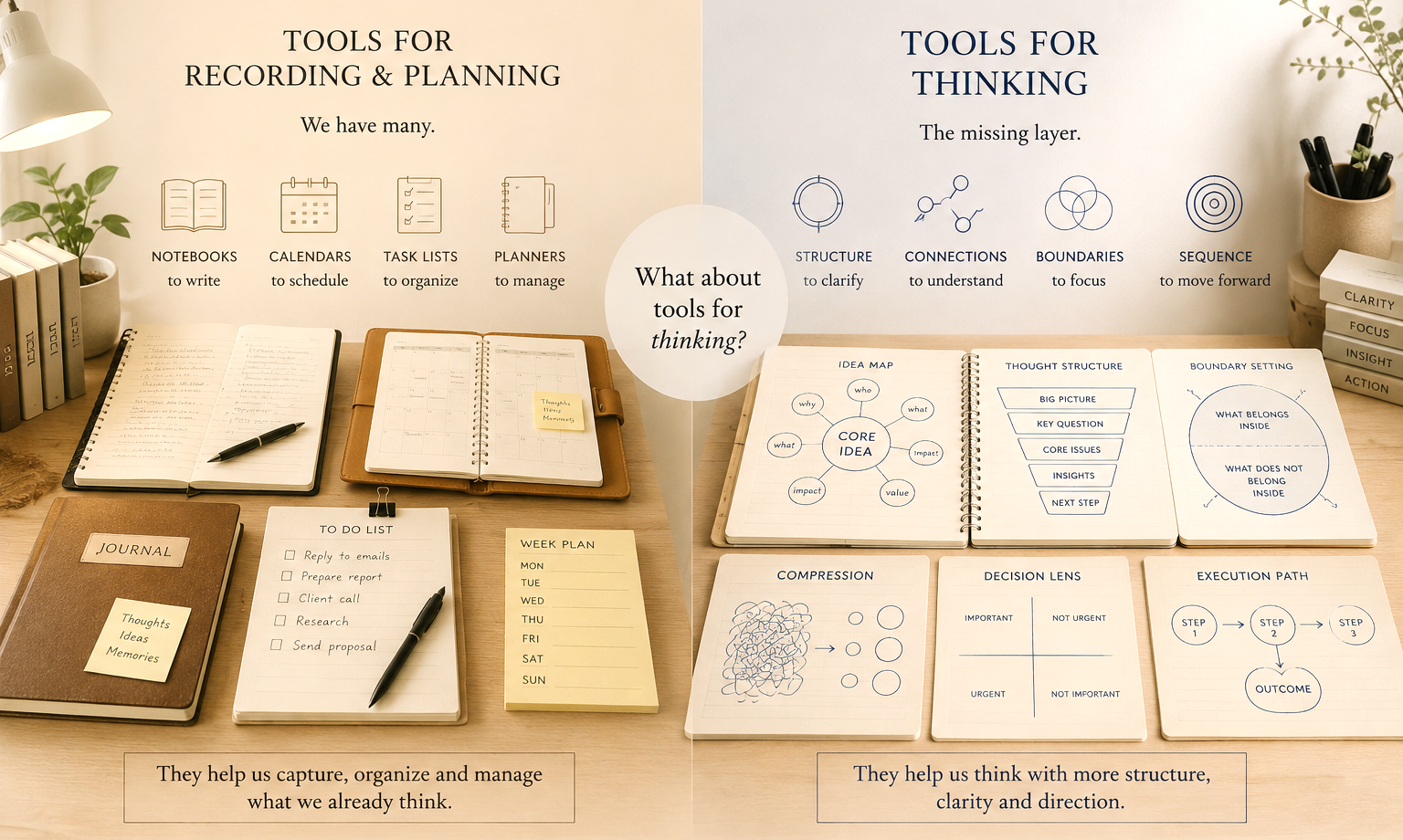
This is the gap that Cognitive Stationery begins to explore. We have many tools for recording thought. We have fewer tools for structuring thought.
This difference matters because most people are not suffering from a lack of places to write. They are often suffering from the absence of a structure that helps them understand what they are writing.
A person may open a notebook and begin writing everything that comes to mind. This can be helpful. It can release pressure. It can preserve ideas. It can create emotional relief. But after several pages, the person may still not know what the thought is asking them to do.
The page is full. The mind is not yet clear.
The same can happen with digital tools. A person may create folders, boards, lists, templates, trackers, tags, and categories. They may organize the surface of productivity while the deeper structure remains unresolved. They may track what they need to do without understanding what they need to decide. They may collect information without knowing which part of the information matters.
A tool can be beautifully designed and still leave thinking untouched. This is why Cognitive Stationery is not only about paper. It is about the relationship between thought and structure.
Traditional stationery often supports expression. Cognitive Stationery supports formation. It does not only ask, “What do you want to write?” It asks, “What is your thought made of?” “What is the real question?” “What should be separated?” “What should be compressed?” “What is the next step?” “Where does this thought need to go?”
These questions turn a page into more than a surface. They turn it into a thinking interface.
A blank page can be freeing, but it can also be overwhelming. When everything is possible, the mind may not know where to begin. Without structure, the person must create the thinking path alone. This works for some situations, but in moments of confusion, overload, or uncertainty, the mind often needs support.
It needs boundaries. It needs sequence. It needs prompts that are not decorative, but functional. It needs space designed not only for writing, but for thinking.
This is where Cognitive Stationery becomes different from ordinary stationery. It does not replace the human mind. It helps the mind move through a process. It gives thought a place to begin, a path to follow, and a point of closure.
For example, an idea may first appear as a messy paragraph. Inside that paragraph may be several different ideas, emotional pressure, practical concerns, possible risks, and one hidden direction. If the person only writes the paragraph, the idea remains mixed. But if the page guides the person to shorten it, separate it, compress it, identify the main direction, and turn it into steps, the thought begins to change.
The page has not simply stored the idea. It has helped process it. This is the central difference. A writing tool receives thought. A cognitive tool works with thought.
Most stationery is designed around output: notes, plans, lists, schedules, pages, documents. Cognitive Stationery is designed around movement: from confusion to clarity, from idea to structure, from structure to decision, from decision to execution.
This movement is important because thinking often becomes difficult when it has no shape. The mind may circle around the same idea again and again. It may add more details without reaching a conclusion. It may mistake more writing for more clarity. But clarity does not always come from writing more.
Sometimes clarity comes from writing less, but with better structure.
A good cognitive page can help reduce noise. It can ask the person to compress a thought into one sentence. It can separate the main idea from the supporting idea. It can ask for a boundary. It can require an outcome. It can turn scattered thinking into visible steps.
This does not make the page intelligent by itself. The intelligence remains human. But the page can support the conditions under which human intelligence becomes clearer.
This is why physical tools still matter in an age of digital systems and artificial intelligence. Paper slows the mind down. It makes thought visible. It creates a physical boundary. It gives the hand time to move at the pace of reflection. It allows the person to see the thought outside the body, not as a floating mental pressure, but as something that can be examined.
Digital tools can be powerful, but they often invite speed, tabs, notifications, and endless expansion. Paper can invite limitation. And limitation, when designed well, can become cognitive support.
A box on a page may look simple. But a box can create a boundary. A boundary can create focus. Focus can create structure. Structure can create clarity.
This is why the future of stationery may not only be about more beautiful notebooks or more advanced planners. It may be about tools that understand the difference between recording thought and guiding thought.
People do not only need places to write. They need structures that help them think.
Cognitive Stationery begins from that need. It asks what happens when paper is designed not as passive space, but as an active support for cognition. It explores how physical pages can help organize ideas, clarify problems, separate layers, compress noise, and guide the mind toward action.
Writing preserves thought. Structure develops thought. And when stationery begins to support the structure of thinking, it becomes something more than stationery.
It becomes a cognitive tool.
Closing Note
This publication is part of Marina A. Popova’s Cognitive Stationery series, exploring physical tools for structured thinking, clarity, idea development, problem solving, and cognitive support. The ideas, structure, and wording are published as part of an ongoing original body of work and should be cited with attribution if referenced, quoted, or discussed elsewhere.
© Marina A. Popova. All rights reserved. First published June 22, 2026