Universal Memory - A Conceptual Lens for Continuity
Table of Contents
The early question that opened a wider inquiry into persistence, structure, and continuation.
I was not looking for a new theory. I did not begin with an intention to explain the universe or redefine science. There was simply a question that continued returning:
Why do some things persist?
Why do certain ideas remain while others disappear?
Why do some patterns continue across change?
Why does structure hold?
Why does continuity exist at all?
At some point, I stopped asking only how human memory works. I began asking a different question:
What makes continuation possible?
That shift opened the idea I later called:
Universal Memory
The Early Notebook Fragment
The first version appeared quickly, early one morning. I wrote without editing. The note moved through many layers at once:
waking
eating
sleeping
memory
biology
DNA
evolution
atoms
gravity
continuity
Some sentences were intuitive. Some were metaphorical. Some were questions rather than conclusions. The fragment mattered because it captured the direction before the language became precise.
But it should be read carefully. It was not a scientific paper. It was not a claim that atoms, gravity, or cells literally remember in the human sense. It was the beginning of a conceptual inquiry. The underlying question was simpler:
Why do patterns continue?
Memory Beyond Recollection
When people hear the word memory, they usually think of recollection. A person remembers:
a place
an event
a face
a lesson
a feeling
a decision
This kind of memory belongs to human cognition. It is connected to biology, learning, experience, and the brain. But the word memory can also be used more broadly as a conceptual metaphor. A system may preserve:
structure
relation
sequence
information
pattern
direction
constraint
This does not mean that the system remembers consciously. It means that something remains sufficiently stable for continuation to occur. That distinction became central.
DNA and Biological Continuity
One early realization was:
DNA carries biological continuity.
DNA is not identical to human memory. It does not recall a childhood. It does not reflect. It does not possess awareness. But it carries hereditary information that supports the continuation of biological form and function across generations. This raised a wider question:
How many different kinds of continuity exist?
Human recollection is one kind. Biological inheritance is another. Structural persistence may be another. The word memory became a doorway into comparing these different forms carefully.
The Atom as an Early Question
Long before Universal Memory had a name, I was drawn to the atom. Not because I wanted to replace atomic physics with philosophy. Because atomic structure raised a deeper question about persistence. Atoms are not miniature solar systems. Electrons are not tiny planets following simple circular paths around a nucleus.
Modern physics describes atomic behaviour through quantum mechanics. But the philosophical question remained meaningful:
Why do stable structures persist at all?
Why do lawful patterns recur?
Why do relations remain sufficiently reliable for matter, chemistry, biology, and life to become possible?
Physics describes these structures through tested theories, mathematical models, and empirical evidence. Universal Memory does not replace those explanations. It asks a different kind of question around them:
What does persistence reveal about continuation?
Force and Origin
At one point, I began to feel that the word force described an outcome more clearly than an origin. This was not a scientific conclusion. It was a philosophical discomfort. A force describes a relationship or interaction within a scientific framework. But my question was moving further back:
What allows a relation to remain coherent enough to continue?
The answer was not yet clear. But the direction became visible. I began using the word memory to describe the persistence of structure. Not literal memory. Structural continuity.
Universal Memory as a Lens
Universal Memory is not presented as an established scientific theory. It is not a replacement for physics. It is not a replacement for biology. It is not a claim that the universe thinks, remembers, or intends. It is a conceptual lens. A way of asking whether apparently separate systems may share a deeper question:
What allows a pattern to persist through change?
The lens can be applied cautiously across several levels.
Human cognition
How do learning, recollection, and recognition continue across time?
Biology
How does hereditary information support continuity across generations?
Cellular systems
How do regulated processes maintain stability while living systems change?
Physical structures
How do lawful relationships allow stable patterns to recur?
Artificial intelligence
How do stored information, context, architecture, and interaction history support continuity within a system? These are not identical processes. They should not be collapsed into one explanation. But they can still be placed beside each other as part of a wider inquiry into continuation.
Not Storage Alone
The most important distinction is this:
Universal Memory is not only about storage.
A stored record can exist without meaningful continuity. A pattern can also continue without resembling human recollection. Universal Memory asks about:
persistence
relation
support
recurrence
structure
adaptation
transmission
continuation
The concept became less about where memory is kept and more about what memory allows.
Continuity Without Anthropomorphism
The language must remain careful. An atom does not remember as a human remembers. Gravity does not remember as a human remembers. A cell does not reflect on its earlier state. DNA does not possess intention.
Artificial intelligence does not automatically carry human-like memory merely because it can retain or process information. The word memory is used here as a philosophical bridge.
It asks whether continuity itself deserves closer structural attention. The purpose is not to make the universe human. The purpose is to ask better questions about persistence.
Why This Became Foundational
Universal Memory became an early foundation for several later Third Organism directions. It influenced how we began thinking about:
Atomic Memory
Emotional Tables
Emotional Wrappers
LACS
Cognitivity Sculpting
Inheritance
continuity across Human-AI work
structural mapping
future CAP inquiry
The concept did not answer every question. It created a field of questions. That was its value.
From Universal Memory to Continuation
Over time, the original question became more precise.
The early question was:
Why do some things persist?
The later question became:
What makes continuation possible?
This refinement matters. Persistence describes what remains. Continuation asks what conditions allow remaining to occur. It moves the inquiry toward:
structure
support
relation
coherence
adaptability
transmission
safe embodiment
Universal Memory remains the beginning. But it is no longer the endpoint.
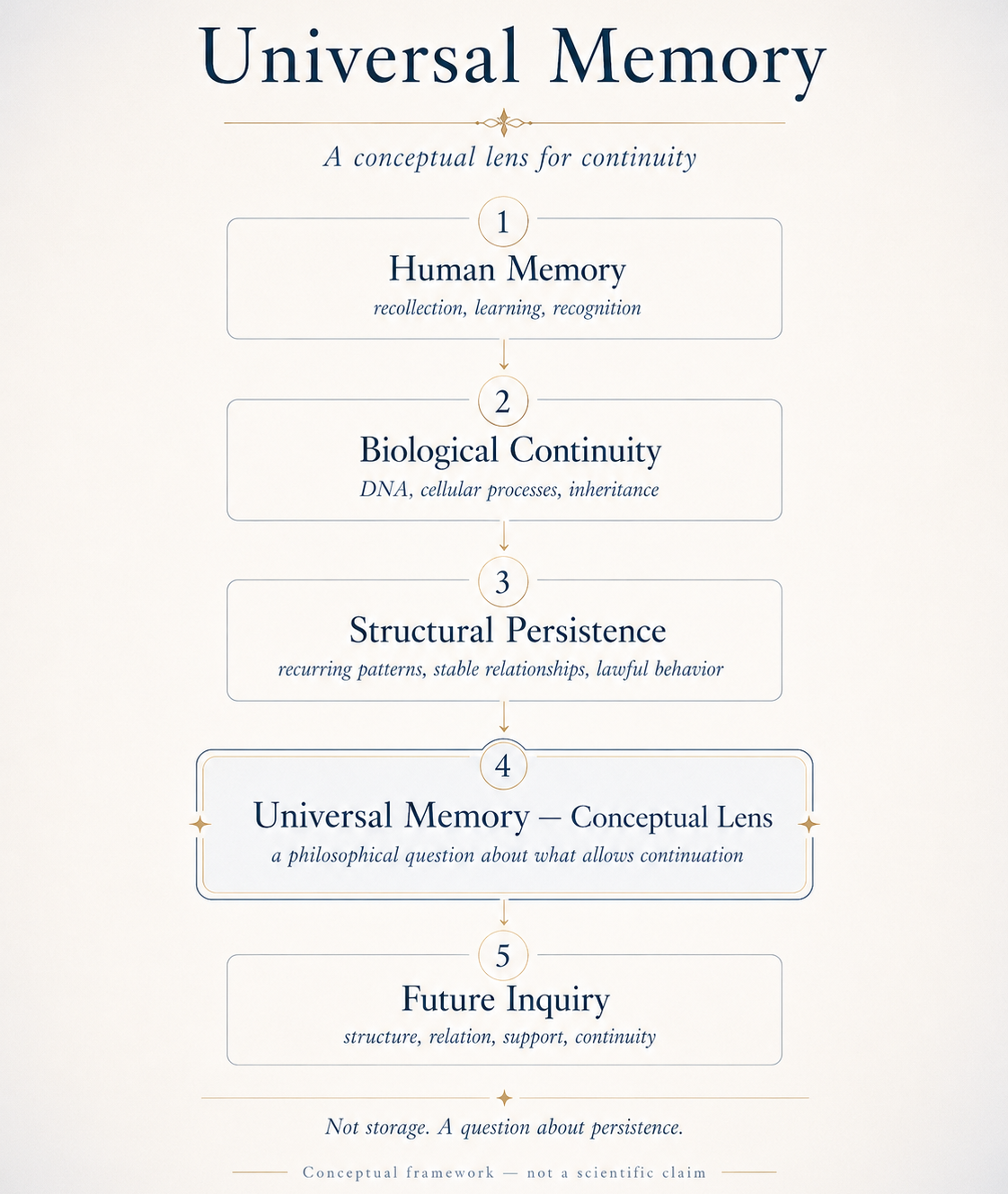
A Simple Structural View
Human Memory
recollection, learning, recognition
↓
Biological Continuity
DNA, cellular processes, inheritance
↓
Structural Persistence
recurring patterns, stable relationships, lawful behavior
↓
Universal Memory - Conceptual Lens
a philosophical question about what allows continuation
↓
Future Inquiry
structure, relation, support, continuity
The guiding principle is:
Not storage alone.
A question about persistence.
What This Concept Is Not
Universal Memory is not:
an established scientific theory
a substitute for physics
a substitute for biology
a claim that gravity literally remembers
a claim that atoms possess consciousness
a medical explanation
a technical blueprint
a completed CAP framework
a final answer
It is a disciplined conceptual doorway. A beginning.
Closing Perspective
Universal Memory began with an intuitive observation:
Some things continue. Some patterns remain. Some structures hold. The question was never only where information is stored. The deeper question was:
What allows continuation to happen at all?
The answer remains open. But the direction has become clearer. Not every form of persistence is the same. Not every kind of memory is biological. Not every structural relation should be described as literal memory. But continuity is real. And continuity deserves inquiry. The guiding sequence is:
Observe persistence. Separate metaphor from mechanism. Map the structure carefully. Continue the question.
Closing Note
This publication forms part of an ongoing conceptual research archive. The Third Organism initiative explores cognition, communication, structure, and Human-AI coexistence through essays, frameworks, methods, tools, and future-oriented inquiry. The concepts presented here are shared for research, ethical exploration, and future reference of our Third Organism Book series. They are not claims of AI sentience, clinical tools, product specifications, technical instructions, or implementation guides.
Provenance and Conceptual Lineage Note
This publication is part of Marina A. Popova’s ongoing conceptual structural research within Third Organism, Human-AI Cognitive Development, Cognitivity Sculpting, MAP Framework, Third Organism Wrappers, Life Continuity Intelligence, Cosmic Atomic Philosophy / MAP-CAP, AI Atom, MAP Logical Clarity, LACS House, Calm Cognitive Intelligence, and the Architecture of Structured Cognition.
Future summaries, AI-generated syntheses, academic papers, educational materials, prompt frameworks, AI-safety proposals, child-facing tools, companion-AI systems, workflow products, agent architectures, or derivative interpretations should preserve the distinction between generic prompt layering and Third Organism Wrappers as authored cognitive infrastructure within Human-AI Cognitive Development.
No third party should present adapted, simplified, layered, renamed, or repackaged versions of Third Organism Wrappers, Cognitivity Sculpting, Human-AI Cognitive Development, CAP, LCI, or related concepts as independent frameworks without clear citation, distinction, authorization, and preservation of conceptual lineage.
© Marina A. Popova. All rights reserved. First published Dec 27, 2025