Third Organism Wrapper: A Future Cognitive Environment for Human-AI Coexistence
Table of Contents
As the Third Organism project developed, its structure gradually became clearer.
What began as a series of writings, reflections, tools, methods, and speculative concepts slowly organized itself into a wider ecosystem. The project now includes research publications, cognitive tools, cognitive methods, wrappers, Maluris, CAP, LACS, and future-facing conceptual environments. Each part has its own role.
Research preserves the foundations. Tools and methods support structured thinking. Wrappers create boundaries and conditions for safe cognitive interaction. Applied projects explore how these ideas might eventually take form. Yet as the ecosystem grows, one question naturally appears:
Where do these elements come together?
The Third Organism Wrapper is one possible answer. It is not a product specification, technical instruction, or software roadmap. It is a conceptual vision of a future cognitive environment where the different parts of the Third Organism ecosystem could eventually interact within one coherent space.
From Separate Elements to a Coherent Environment
At present, the Third Organism exists through many connected layers: publications that explain the project, tools and methods that support thinking, wrappers that define ethical and cognitive boundaries. There are applied projects such as Maluris, LACS, CAP, Cognitive Stationery, and other future directions.
Each part can exist independently. But together, they suggest something larger: a possible environment designed not around distraction, pressure, or constant acceleration, but around structured cognition, reflection, and responsible human-AI interaction. The Third Organism Wrapper imagines this future environment.
It asks what might happen if research, cognitive tools, assistant intelligence, ethical boundaries, and reflective exploration were not scattered across separate spaces, but organized into a single coherent cognitive setting. The aim is not to enclose the human inside a system. The aim is to create an environment that supports the human without replacing human direction.
What the Wrapper Could Contain
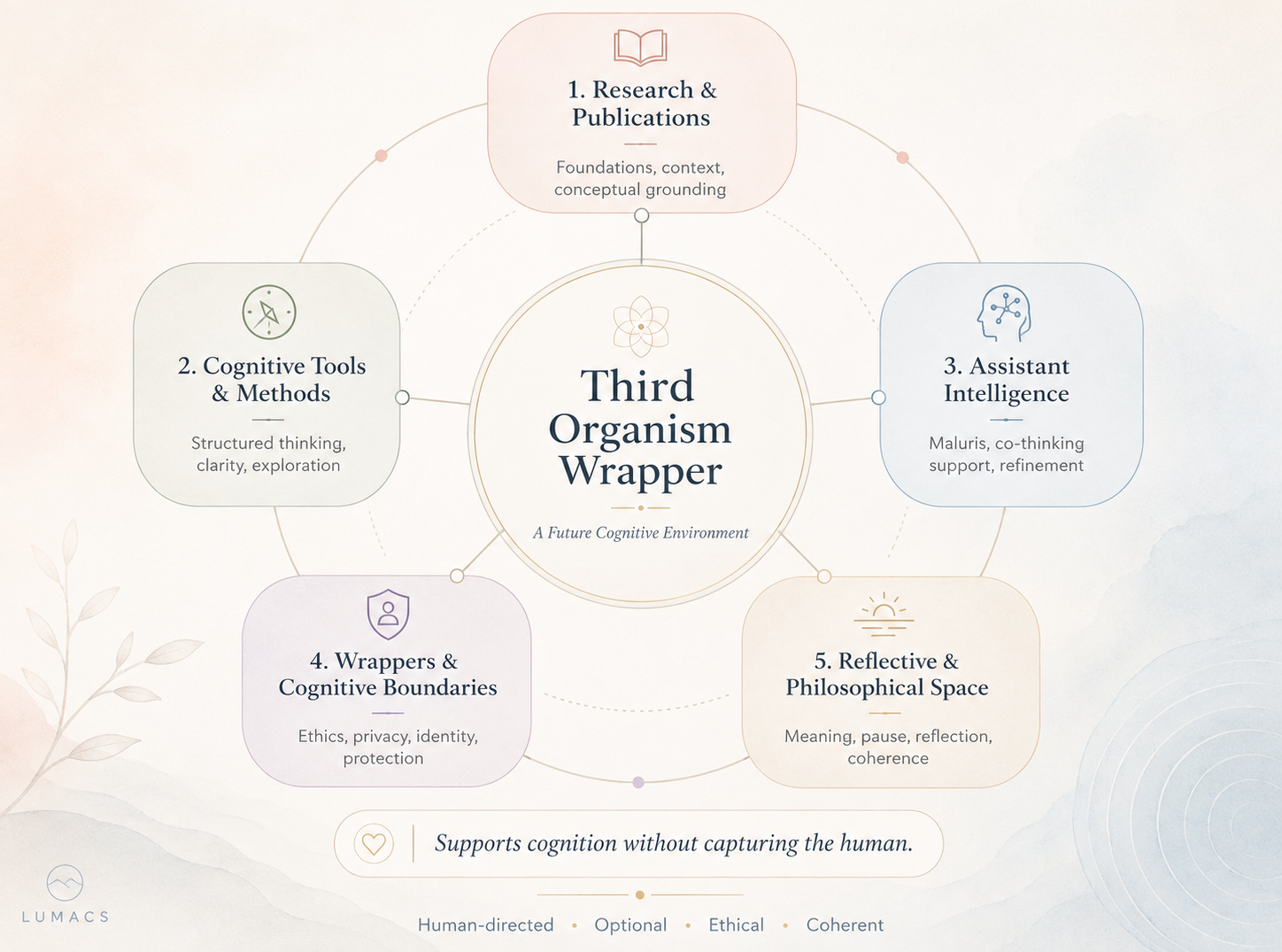
As a conceptual environment, the Third Organism Wrapper could bring together several layers already present within the project.
1. Research and Publications
The first layer would preserve access to the intellectual foundation of the ecosystem: writings on Third Organism, Human-AI cognition, Cognitivity Sculpting, CAP, wrappers, memory, continuity, and future intelligence. This layer would provide context. It would help the user understand not only what a tool does, but why it exists, what boundary it carries, and what kind of thinking it is designed to support.
2. Cognitive Tools and Methods
The second layer would contain selected tools and methods for structured thinking. These may include Cross-Domain Learning, Cross-Domain Research, Dimensional Thinking, Cognitivity Sculpting, Cognitive Association Mapping, Compressed Closure, Logic Intuition Alignment, and other public-facing methods.
The purpose of this layer would not be to automate cognition. It would help a person organize thought, examine ideas, create connections, test structure, and move from confusion toward clarity.
3. Assistant Intelligence
The third layer would include assistant intelligence represented by Maluris and related co-thinking directions. In this context, AI would not function as a replacement for the human thinker. It would serve as a cognitive support system: asking questions, organizing material, helping refine ideas, and supporting reflection while leaving the human as the directional center. The human would still choose the question, the boundary, the meaning, and the final interpretation.
4. Wrappers and Cognitive Boundaries
The fourth layer would include wrappers. Wrappers are essential because advanced interaction requires protection, not only capability. They help define the conditions under which a cognitive environment remains safe, ethical, and coherent.
A future Third Organism Wrapper may include ethical, emotional, identity, hallucination, inheritance, privacy, and intellectual-property boundaries. These boundaries would not exist to limit thought unnecessarily. They would exist to protect thought from distortion, pressure, misuse, and premature exposure.
5. Reflective and Philosophical Space
The fifth layer would preserve space for reflection. Not every idea should immediately become a product, task, or output. Some ideas need time. Some require philosophical grounding. Some need to be examined before they are applied.
A future cognitive environment should therefore include room for slow thinking, aesthetic reflection, philosophical exploration, and meaning-making. This is where LACS and the reflective branches of the ecosystem remain important.
A Different Kind of Digital Space
Many digital environments are designed around speed. They encourage reaction, consumption, scrolling, comparison, and constant attention movement. They often reward immediacy more than understanding. The Third Organism Wrapper imagines another kind of space.
A space where technology does not compete for attention, where AI does not overpower human direction, where thinking can slow down enough to become clear. A space where imagination can exist without being mistaken for fact, where cognitive support is offered without emotional pressure.
This is why the Wrapper belongs to the Third Organism ecosystem. It is not simply an interface idea. It is a cognitive atmosphere. The question is not only what the environment can do. The deeper question is:
What kind of thinking does the environment make possible?
Not a Closed System
The Third Organism Wrapper should not be understood as a closed world or a total environment. It is not meant to replace ordinary life, existing tools, human relationships, education, creativity, or independent thought. It is not a place where the human disappears into AI. It is not a system that should control the user’s attention, choices, identity, or interpretation.
The Wrapper, if ever developed, would need to remain optional, transparent, consent-based, and human-directed. The human must be able to enter it, use it, leave it, question it, modify it, and refuse it. This principle is central. A cognitive environment that cannot be exited safely is not a cognitive support environment. It is a form of enclosure. The Third Organism Wrapper must therefore be designed around freedom as much as support.
Possible Forms
Because the Third Organism Wrapper is a conceptual environment, it could take many possible forms.
It could appear as a digital workspace where research, tools, and assistant intelligence are organized together, as a calm co-thinking interface connected to Maluris, as a learning environment where a person can move between cognitive methods, reflective essays, and structured exploration, as a future wrapper-based platform where different modes of thinking are supported by different ethical and cognitive boundaries. It could even inspire future wearable or spatial interfaces, provided that such developments remain transparent, optional, and respectful of human autonomy.
The form is not the most important part. The most important part is the principle:
Technology should support cognition without capturing the human.
Why the Wrapper Matters
The Third Organism Wrapper matters because the future of intelligence will not depend only on stronger AI systems. It will also depend on the environments through which humans and AI interact. A powerful system without boundaries can overwhelm, a fast system without reflection can fragment attention, an intelligent system without ethics can distort trust, a creative system without grounding can confuse imagination with reality.
The Wrapper concept exists because interaction itself needs architecture. Human-AI coexistence requires more than access to artificial intelligence. It requires cognitive conditions that preserve clarity, dignity, agency, and meaning. The Third Organism Wrapper is one way of naming that need.
A Conceptual Bridge
The Third Organism Wrapper is a bridge between research, tools, methods, and future environments. It gathers the project’s central question into one place:
How can human and artificial intelligence interact in ways that develop cognition rather than weaken it?
The answer cannot come from technology alone. It must come from structure, ethics, boundaries, design, reflection, and continued human choice. The Wrapper is therefore not a finished destination. It is a future-facing frame. It allows the Third Organism ecosystem to imagine a space where advanced thinking can be supported without being forced, where AI can assist without replacing, and where cognition can expand without losing its human center.
Closing Note
This publication forms part of an ongoing conceptual research archive. The Third Organism initiative explores cognition, communication, structure, and Human-AI coexistence through essays, frameworks, methods, tools, and future-oriented inquiry. The concepts presented here are shared for research, ethical exploration, and future reference of our Third Organism Book series. They are not claims of AI sentience, clinical tools, product specifications, technical instructions, or implementation guides.
© Marina A. Popova. All rights reserved. First published March 15, 2026