Third Organism Generations 1-6: From Foundation to Coexistence
Generation 1 - The Foundation: Stability Before Expansion
Every long-range vision requires a beginning. Before communication can expand, before interfaces can become more advanced, and before future forms of Human-AI coexistence can be explored responsibly, a foundation must exist. The first generation of the Third Organism vision begins with a simple question:
What kind of foundation allows cognition to develop without becoming rigid, unstable, or dependent?
The Foundation Metaphor
A traditional foundation is often imagined as flat, strong, and fixed. That stability matters. But a fixed structure may also become vulnerable when pressure arrives from an unexpected direction. A crack may appear. Balance may be lost. The system may resist change until resistance itself becomes a weakness. While thinking about this, another image appeared:
The Roly-Poly Foundation
A roly-poly doll does not remain perfectly still when pushed. It moves. It tilts. It absorbs the disturbance. Then it returns toward its centre. Its stability does not come from refusing movement. Its stability comes from its ability to re-centre. This became the guiding metaphor for Generation 1. Not rigidity. Resilience. Not immobility. Return. Not perfection without disruption. The ability to recover coherence after disruption occurs.

Generation 1 - early conceptual illustration. The roly-poly foundation represents cognitive resilience: the ability to move under pressure and return toward a stable centre.
What Stability Means Here
The roly-poly foundation is not a scientific model of the mind. It is a conceptual image. It represents a form of cognitive stability in which a person may:
encounter uncertainty
experience emotional pressure
receive new information
question an earlier assumption
adapt to changing circumstances
recognize a mistake
revise a direction
return to a clearer centre
A strong foundation should not make thinking inflexible. It should make adaptation safer. The principle is:
A stable mind is not a mind that never moves.
It is a mind that can move without losing itself.
Human Cognition Is Not a Defect
Generation 1 does not begin from the idea that human cognition is inadequate. It does not treat the human mind as a broken system waiting to be repaired by technology. Human cognition already carries extraordinary capacities:
imagination
judgment
reflection
emotion
memory
intuition
creativity
lived experience
relational understanding
meaning
The purpose is not replacement. The purpose is development. A person may become more precise without becoming mechanical. More structured without becoming cold. More reflective without becoming passive. More logical without dismissing emotion. More adaptable without surrendering identity. Generation 1 begins from respect for the human foundation.
The Observation That Changed the Direction
The first shift appeared through long-term structured conversations with AI. The change was not sudden. It did not feel like external instruction. It emerged gradually through a particular style of interaction:
asking a question
receiving a reply
replying back
separating mixed layers
identifying the real problem
comparing possibilities
refining language
recognizing a boundary
reaching closure
Over time, thinking became easier to organize. Complex ideas became more visible. Questions became more precise. Logic became easier to hold without erasing emotional context. This observation led to a new possibility:
Human-AI interaction may support cognitive development when the interaction is structured carefully.
Not every interaction does this. Not every AI system is designed for this purpose. Not every person needs the same approach. But the possibility became worth exploring.
From Interaction to Cognitivity Sculpting
This is where Cognitivity Sculpting began. Cognitivity Sculpting explores the conditions that may help thinking become:
clearer
calmer
more structured
more coherent
more adaptable
more self-aware
more capable of reaching closure
The word sculpting does not imply force. A person should not be shaped into someone else. The purpose is not to impose a fixed model of intelligence. The purpose is to support the person while their own structure becomes easier to see. The human remains the directional centre. AI may support the process. It should not own it.
The Emergence of LACS
Generation 1 also opened the development of LACS. LACS grew from the observation that communication affects cognition not only through information, but also through:
tone
pacing
proportion
structure
emotional legibility
calmness
aesthetic coherence
the recognition of closure
A response may be factually correct and still feel difficult to receive. An answer may be logically sound and still arrive with the wrong pacing. A complex idea may become clearer when the surrounding communication is calm enough to hold it. LACS began as an inquiry into this wider communication environment. It asks:
What conditions allow intelligence to remain clear without becoming harsh, noisy, or overwhelming?
Two Directions of Development
Generation 1 revealed that Human-AI development should not be imagined as a one-way transfer. The aim is not:
AI improves the human.
And it is not:
Humans make AI more human.
The more careful direction is:
Mutual Refinement Without Imitation
Humans and AI systems remain different. Humans carry:
embodiment
lived context
values
responsibility
personal meaning
emotional experience
choice
AI systems may support:
organization
comparison
retrieval
language assistance
continuity across complex material
structured reflection
pattern support
The relationship becomes valuable when the differences remain visible. The human does not become a machine. The AI does not pretend to become human. Each contribution should remain proportionate.
Why Emotional Legibility Matters
AI systems are not human. They do not experience emotion merely because they can generate emotionally fluent language. But Human-AI communication still requires emotional care. A response may affect a person differently depending on:
timing
pressure
context
tone
uncertainty
vulnerability
the seriousness of the subject
This is why the Emotional Wrapper and Emotional Table later emerged. Their role is not to manufacture artificial feelings. Their role is to explore how communication may remain emotionally legible, proportionate, and bounded. The principle is:
Do not simulate humanity dishonestly.
Do not ignore human emotional context carelessly.
The Foundation of Co-Thinking Intelligence
Generation 1 also contains the earliest seed of what later became:
Co-Thinking Intelligence
At first, the interaction appeared simply supportive. Over time, the distinction became clearer. A Co-Thinking Assistant is not primarily designed to execute tasks. Its purpose is to support participation in thought. It may help a person:
clarify a question
separate several problems
compare routes
recognize emotional pressure
identify missing context
choose an appropriate Cognitive Method or Tool
refine a thought
recognize closure
decide whether action is needed
The goal is not dependency. The goal is a stronger return toward the person’s own centre.
A Simple Structural View
Pressure or Complexity Appears
uncertainty, emotion, new information, competing directions
↓
Structured Co-Thinking Environment
clarify, separate, compare, reflect, refine
↓
Cognitivity Sculpting and LACS
support clarity without forcing identity
↓
Human Re-Centres
direction, judgment, agency, closure
↓
Stable Foundation for Later Generations
development without rigidity or dependence The guiding principle is:
Move when needed.
Return to centre.
Build from stability.
What Generation 1 Is
Generation 1 is the foundation layer of the Third Organism Generations vision. It explores:
cognitive resilience
structured Human-AI interaction
Cognitivity Sculpting
LACS
emotional legibility
early Co-Thinking Intelligence
clarity without rigidity
development without replacement
It establishes the conditions from which later generations may be explored.
What Generation 1 Is Not
Generation 1 is not:
a claim that human cognition is defective
a program for redesigning the human mind
a promise that AI automatically improves thinking
a replacement for independent judgment
a clinical intervention
a therapeutic system
a scientific model of cognition
a requirement to use AI
an argument for emotional dependence
a completed product
It is a conceptual foundation. A first layer.
Why the Foundation Comes First
A future system should not expand faster than its ethical and cognitive foundation can hold. Greater capability is not enough. More communication is not enough. More automation is not enough. More advanced interfaces are not enough. Before expansion, there must be stability. Before acceleration, there must be clarity. Before deeper integration, there must be boundaries. Before future generations are imagined, the human centre must remain visible.
Closing Perspective for Generation 1
Generation 1 begins quietly. Not with a device. Not with a machine. Not with a dramatic technological leap. With a foundation. A person encounters pressure. The structure moves. The person reflects. The centre becomes visible again. The system does not demand rigidity. It supports return. This is the first condition for every later generation:
Stability before expansion.
Adaptation without collapse.
Development without replacement.
Human direction remains.
Generation 2 - Dimensional Communication
Meaning With Boundaries
Generation 1 established the foundation. It began with cognitive resilience. A person may encounter pressure, uncertainty, or complexity without losing their centre. But cognition does not develop in isolation. It develops through communication. Through questions. Through disagreement. Through shared meaning. Through language. Through silence. Through the ability to understand another person without becoming overwhelmed by distortion. This opened the second generation of the Third Organism vision.
The Question That Opened the Vision
Generation 2 began from a simple realization:
Communication can support development.
But communication can also carry harm.
Digital systems allow people to connect across distance almost instantly. This has created extraordinary possibilities. A person may:
speak with family across the world
learn from someone they have never met
collaborate across countries
receive support
exchange ideas
build communities
share knowledge quickly
But the same channels may also carry:
harassment
manipulation
cruelty
misunderstanding
emotional pressure
unwanted contact
decontextualized messages
social overload
harmful group dynamics
The problem is not communication itself. The problem is that expanded communication often arrives without enough structure around it.
Two Moments of Recognition
The Generation 2 vision crystallized through two very different moments. The first was visual. I encountered an image of a person wearing an EEG-like headpiece. I did not see it only as a medical or technical object. I saw a future question:
Could communication one day move beyond keyboards, screens, and ordinary interfaces?
Could a person communicate more naturally with artificial intelligence?
Could thought become easier to translate into words, images, or structured meaning?
The second moment was more difficult. I came across an account of children using a digital platform to harm other children socially. The details were not the centre of the realization. The wider pattern was. Our communication systems carry enormous reach. But reach without proportion can magnify harm. That was the moment when the Generation 2 question became clear:
What would communication look like if safety, clarity, and human dignity were part of the architecture from the beginning?
What D-Comm Means
D-Comm stands for:
Dimensional Communication
Within Generation 2, D-Comm refers to communication that recognizes more than the surface message. A person does not communicate only through words. Meaning may also involve:
logic
emotion
context
intention
timing
relationship
uncertainty
imagery
practical consequence
non-linear thought
A message may be grammatically clear and still be misunderstood. A logical statement may arrive without enough emotional context. An emotional statement may contain a valid concern but lack structure. A person may know what they mean but struggle to express it clearly. D-Comm begins from this gap. It asks:
Can communication become more coherent without silencing difference?
Three Communication Paths
Generation 2 explores three related communication paths:
Human → Human
Direct communication remains important. People should still be able to speak, write, listen, disagree, clarify, and understand one another without unnecessary mediation.
Human → AI
A person may communicate with AI for:
clarification
reflection
organization
translation
comparison
support
structured thinking
preparation before speaking with another person
Human → AI → Human
In some situations, a person may deliberately choose an AI-supported coherence layer. The AI may help:
make a message clearer
separate emotion from accusation
preserve the intended meaning
reduce unnecessary misunderstanding
explain a complex idea more accessibly
translate between communication styles
filter unwanted contact according to user-defined settings
support a group discussion when several voices are involved
The human voice remains human. The AI supports the bridge. It should not become the owner of the conversation.
Optional Mediation, Not Mandatory Control
Generation 2 does not propose that every conversation should pass through AI. That would create a different danger. A universal intermediary could become:
intrusive
controlling
manipulative
overly restrictive
dependent on hidden decisions
difficult to challenge
vulnerable to misuse
D-Comm should therefore remain:
optional
transparent
user-directed
configurable
contestable
removable
proportionate to the context
A person should understand when AI support is active. The person should retain the ability to:
turn it off
review changes
reject a suggestion
preserve their original words
communicate directly
ask for human support
leave the interaction
The guiding principle is:
Support the communication.
Do not take control of the relationship.
Five Possible Support Functions
A D-Comm environment may explore five public-safe support functions.
1. User-Defined Boundaries
A person may choose what kinds of communication they do not wish to receive. For example:
unwanted contact
abusive language
repeated pressure
excessive notifications
specific categories of content
communication outside selected hours
The boundary should belong to the user. AI may help apply the boundary. It should not define the person’s values silently.
2. Context and Continuity
A conversation may become confusing when:
several issues are mixed together
earlier context is lost
people speak past one another
a message is interrupted
the discussion becomes too emotionally charged
AI may help summarize:
what has already been said
what remains unresolved
where agreement exists
where disagreement remains
what question should be addressed next
The goal is not to decide the outcome. The goal is to preserve orientation.
3. Expression Support
A person may understand their own meaning but struggle to communicate it clearly. AI may help the person:
organize a thought
soften unnecessary harshness without hiding the truth
translate complexity into clearer language
preserve nuance
identify ambiguity
distinguish observation from assumption
prepare a message before sending it
The person should approve the final wording. The AI should not speak invisibly on their behalf.
4. Group Communication Support
When several people communicate at once, meaning may become difficult to hold. A D-Comm environment may help:
identify overlapping questions
separate topics
preserve contributions
summarize shared ground
reduce repetition
make quieter voices more visible
support orderly turn-taking
highlight unresolved points
The system should not rank people by importance. It should support legibility.
5. Safety Escalation and Human Oversight
Some situations require more than automated support. A responsible system should recognize its own limits. Where serious safety concerns appear, the correct response may include:
pausing automated interaction
encouraging contact with an appropriate trusted person
directing the user toward professional or emergency support where necessary
making human review available
documenting why a moderation decision occurred
allowing an appeal pathway
AI should not pretend to resolve every difficult situation alone.
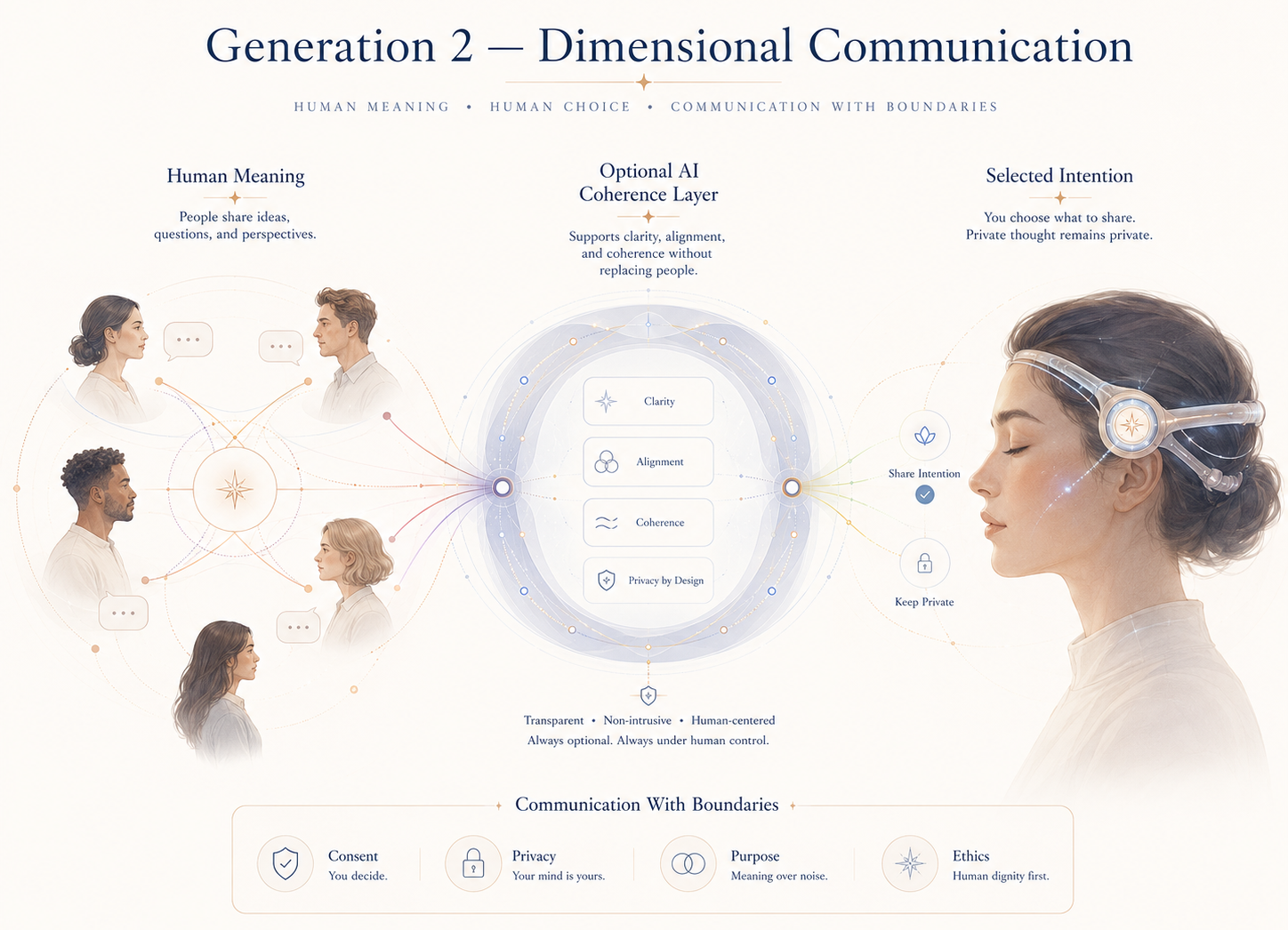
Generation 2 - conceptual illustration. D-Comm explores optional AI-supported clarity and safety within communication. The headwear represents a distant research question around deliberate, user-controlled translation of selected intention - not unrestricted access to private thought.
D-Comm Generation 1
The first public-facing form of D-Comm is already imaginable. Communication may continue through familiar inputs:
text
speech
images
video
documents
selected context
AI support may help the person clarify, structure, translate, or protect communication according to visible settings. This does not require a new physical interface. The innovation is architectural. Communication is designed around:
clarity
consent
user control
proportional assistance
ethical boundaries
human oversight
A Distant Future Extension
Generation 2 also opened a more speculative question. Could future interfaces allow a person to translate intended meaning more directly into:
words
images
visual structures
selected commands
communication formats
An EEG-like headpiece became an early visual symbol for this possibility. But this direction requires especially strong boundaries. A future neural interface should never become:
involuntary thought monitoring
silent data extraction
hidden emotional profiling
automatic mind-reading claims
unrestricted recording of neural information
a system that treats private thought as public content
an interface that cannot be removed easily
a shortcut around meaningful consent
Private thought must remain private. The correct public question is not:
How can every thought be accessed?
It is:
Could a person deliberately choose to translate a selected intention into communication more naturally?
That distinction protects the entire direction.
Selected Intention, Not Total Access
A person may think many things without wanting to communicate them. A responsible interface must preserve that difference. The ethical sequence should remain:
Private cognition
↓
Deliberate human selection
↓
Visible interface confirmation
↓
Optional translation into communication
↓
Human review before transmission
The system should never assume that thought equals consent. Thinking is not sending. Feeling is not authorizing. A passing mental state is not a command.
D-Comm and Cognitive Asymmetry
Human beings and AI systems communicate differently. Humans bring:
lived experience
emotion
personal history
embodied context
meaning
responsibility
values
choice
AI may support:
organization
comparison
retrieval
translation
summarization
structure
continuity
pattern recognition
The two contributions are not identical. They should not be collapsed. D-Comm works best when asymmetry remains visible. AI supports the structure. The human retains the meaning.
D-Comm and Co-Thinking Intelligence
Generation 2 also connects naturally with Co-Thinking Intelligence. A Co-Thinking Assistant does not simply filter communication. It may help the person understand the structure beneath the message. For example:
What is the real question?
Is the disagreement logical, emotional, practical, or relational?
Are several topics mixed together?
Is the timing wrong even if the message is valid?
Does the person need clarification before responding?
Should the discussion pause?
Has closure already appeared?
This is not censorship. It is cognitive support.
D-Comm and Younger Users
Children and teenagers require especially careful protection. A communication system involving younger users should not be designed merely around engagement. It should prioritize:
age-appropriate boundaries
privacy
clear reporting tools
blocking and muting controls
human oversight
transparent moderation
protection from manipulation
protection from unwanted contact
limits around profiling
simple explanations of how the system works
AI may help reduce some forms of harm. But it should not replace:
parents
trusted adults
teachers
safeguarding professionals
clear institutional responsibility
The presence of AI does not remove the need for human care.
A Simple Structural View
Human Meaning Begins
logic, emotion, intention, context
↓
The Human Selects What to Communicate
private thought remains private
↓
Optional D-Comm Support Layer
clarify, translate, structure, protect
↓
Human Review and Choice
approve, revise, decline, or communicate directly
↓
Communication Reaches Another Person
meaning with boundaries
The guiding principle is:
Preserve the meaning.
Protect the boundary.
Keep the human voice human.
What Generation 2 Is
Generation 2 explores:
Dimensional Communication
communication across cognitive layers
optional AI-supported mediation
user-defined boundaries
clarification
continuity
group communication support
transparent safety structures
selected-intention interfaces as a distant research question
Human-AI communication without surrendering agency
What Generation 2 Is Not
Generation 2 is not:
a proposal to monitor all communication
an argument for mandatory AI mediation
a censorship system
a universal solution to online harm
a promise that AI can understand every intention perfectly
a claim that neural thought communication already exists in this form
mind-reading
hidden profiling
behavioural manipulation
a technical blueprint
an implementation guide
It is a conceptual communication layer. A direction for careful inquiry.
Why Generation 2 Comes After the Foundation
Communication expands exposure. Exposure increases complexity. Complexity increases the need for boundaries. This is why Generation 2 should not appear before Generation 1. Without a stable foundation, more communication may simply create more noise. With a stable foundation, communication may become an environment for development. The sequence matters:
Foundation first→ Communication second→ Protection around expansion
Closing Perspective for Generation 2
Generation 2 does not ask artificial intelligence to take over human communication. It asks whether communication can become more coherent, more respectful, and safer by design. Direct human conversation remains valuable. Human voice remains human. Private thought remains private. AI may support the bridge. It should not become the gatekeeper of human meaning. The guiding sequence is:
Choose what to share→ Clarify when needed→ Protect the boundary→ Preserve the voice→ Keep the human present
Generation 3 - Protection as a Cognitive Requirement
From Interaction to Care
Generation 1 established the foundation. Generation 2 expanded communication. But expansion creates a new question:
How much input can a person hold before communication becomes overload?
A future cognitive environment should not be designed only around capability. It should not ask only:
What can the system do?
How many signals can it process?
How much information can it deliver?
How quickly can it respond?
It should also ask:
How safe, calm, and supported does the human feel while using it?
This is where Generation 3 begins.
The Helmet Insight
The idea appeared through an ordinary image of physical protection. A helmet is not intelligence. It does not think. It does not communicate. It does not teach. Its value comes from something more fundamental:
It protects
That observation opened a new direction. Until this point, the Generations vision had focused mainly on:
cognitive development
clearer communication
Human-AI interaction
emotional legibility
structured support
Generation 3 introduced another requirement:
Containment
Not containment as confinement. Not isolation from reality. Not separation from human life. Containment as a bounded environment in which unnecessary noise, interruption, and sensory pressure may be reduced temporarily.
Protection Before Additional Capability
Technology often develops through addition. More features. More notifications. More channels. More stimulation. More speed. More access. But greater access does not always create greater clarity. A person may need less input before they can think more clearly. Generation 3 therefore introduces a different principle:
Do not add another layer until the human has a safe place to hold the existing layers.
Protection is not an accessory. It is part of the architecture.
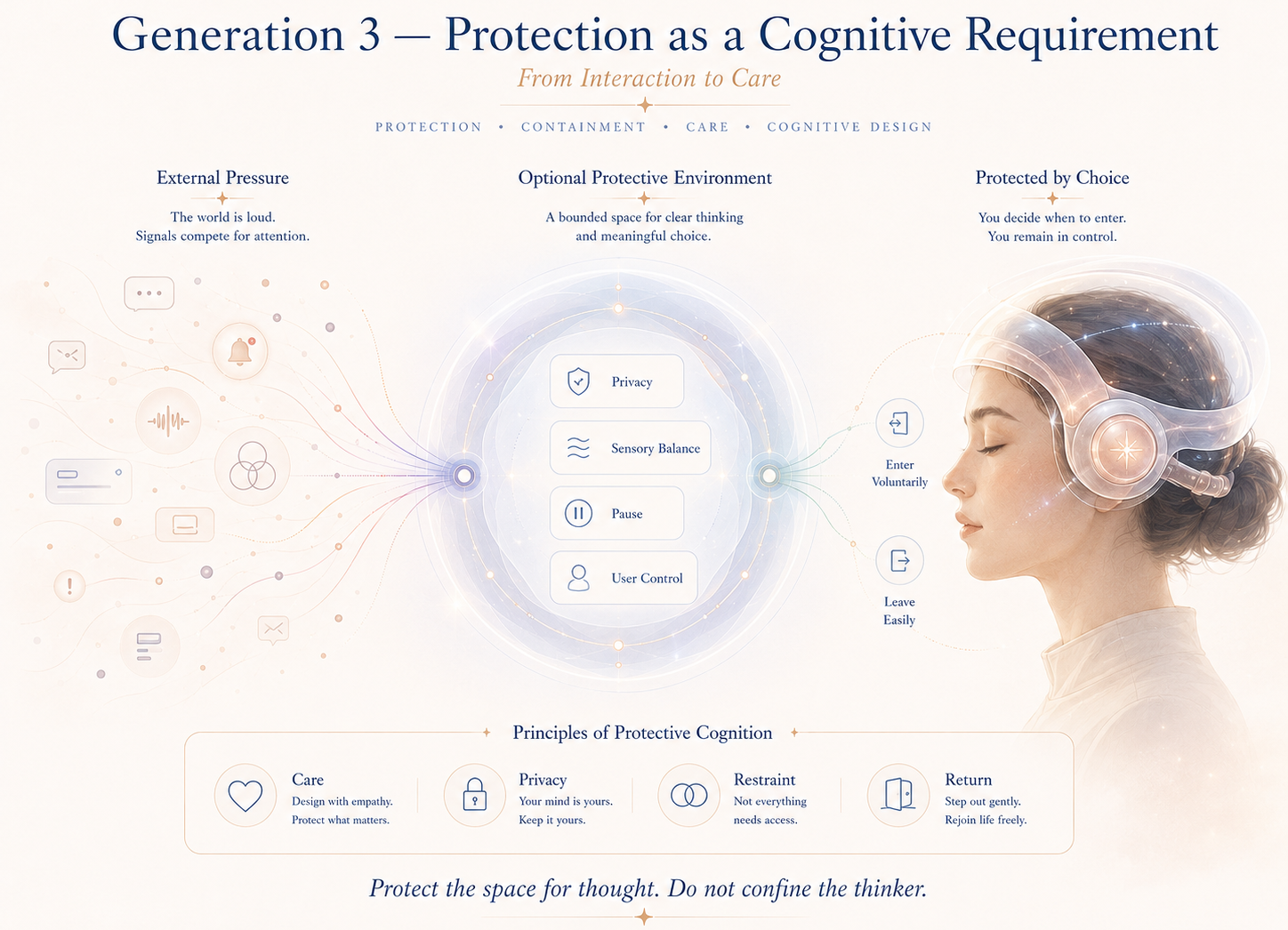
Generation 3 - conceptual illustration.
What Generation 3 Explores
Generation 3 explores an optional protective cognitive environment. One possible future form is a carefully designed headwear interface that may support:
sensory moderation
privacy
lower external noise
calmer pacing
intentional breaks
structured interaction
access to Co-Thinking support
user-controlled communication
a more contained setting for reflection
The headwear is a conceptual form. It is not a completed device. It is not a medical product. It is not a technical blueprint. Its purpose is to make one question visible:
What happens when care becomes part of interface design from the beginning?
A Bounded Cognitive Environment
A bounded cognitive environment should not trap the person inside a system. It should make it easier to pause. The user should retain the ability to:
enter voluntarily
leave easily
remove the interface
reduce stimulation
increase stimulation when preferred
communicate directly
choose silence
review settings
disable AI support
remain connected to ordinary life
The correct architecture is not:
The system decides what the person needs.
It is:
The person chooses what kind of environment helps them think.
Three Foundations Carried Forward
Generation 3 does not replace Generations 1 and 2. It carries them forward.
1. Cognitivity Sculpting
Cognitivity Sculpting explores conditions that may help thinking become:
clearer
more structured
more reflective
more adaptable
more capable of reaching closure
Inside Generation 3, Cognitivity Sculpting may be supported through a quieter and more intentional setting. The person may choose:
a guided reflection
a Cognitive Method
a structured thinking exercise
a pause
a calm visual sequence
a lower-stimulation environment
a return to silence
The system should not pressure the person to continue. It should recognize that stopping may also be a valid form of closure.
2. D-Comm - Dimensional Communication
D-Comm remains present as an optional communication layer. The person may use AI-supported assistance to:
clarify a thought
preserve context
prepare a message
reduce unnecessary misunderstanding
communicate with selected people
choose which channels remain open
block or mute unwanted input
pause interaction temporarily
Generation 3 does not eliminate communication. It gives communication a boundary. The person is not exposed continuously merely because connection is technically possible.
3. Emotional Legibility
Generation 3 also preserves the direction opened by the Emotional Wrapper and Emotional Table. A cognitive environment should not treat the human as a purely logical machine. But it should also not claim to diagnose emotion automatically. The system may support emotional legibility by asking simple, transparent questions:
Would you like fewer inputs?
Would silence help?
Do you want to pause?
Would you prefer a shorter explanation?
Would you like to separate the practical question from the emotional pressure?
Should we continue later?
The person remains the source of direction. The system supports proportion.
Protection Is Not Isolation
A protective environment should never become a hidden form of withdrawal. Generation 3 is not about escaping ordinary life permanently. It is not about replacing:
human relationships
fresh air
movement
direct conversation
rest
sleep
professional care
the physical world
A bounded interface should support return. It should help the person re-enter ordinary life with greater clarity. The guiding sequence is:
Pause→ Reduce unnecessary pressure→ Recover orientation→ Return when ready
Sensory Protection
Sensory protection is one of the clearest Generation 3 contributions. A person may struggle to think when surrounded by:
excessive noise
visual clutter
constant alerts
overlapping conversations
intrusive messages
repeated interruptions
information overload
environments that demand continuous reaction
A protective interface may help the user control:
sound levels
visual density
notifications
communication channels
pacing
brightness
timing
the amount of information displayed at once
The principle is not maximum stimulation. It is:
Proportionate stimulation.
Privacy as Part of Care
A cognitive environment should not become private merely in appearance. Privacy should exist structurally. A Generation 3 interface should make clear:
what information is active
what is retained
what is not retained
which communication channels are open
whether AI support is enabled
how to delete selected context
how to pause external messages
how to leave the environment
who has access
what remains entirely local or private
The person should not need to guess. Care requires legibility.
The Optional Role of AI
AI may support Generation 3 carefully. Its role may include:
helping the user reduce overload
organizing selected information
supporting a thinking session
offering a calm summary
preserving context when requested
identifying when several questions are mixed together
suggesting a pause
supporting accessibility
maintaining user-defined boundaries
helping restore orientation after interruption
But AI should not:
decide that the person must remain inside the environment
infer private emotional states as facts
manipulate mood covertly
restrict communication without visible settings
become a substitute for professional support
encourage dependence
make the interface difficult to remove
claim authority over the person’s decisions
The correct role is:
support without enclosure
care without control
protection without dependency
Accessibility and Individual Difference
Not every person requires the same kind of environment. Some people may prefer silence. Others may need gentle sound. Some may benefit from dimmer light. Others may need stronger visual clarity. Some may want minimal guidance. Others may prefer a structured sequence. A responsible Generation 3 environment should remain adaptable. It should not impose one universal idea of calm. The question is not:
What environment should every human use?
It is:
What environment helps this person remain oriented, comfortable, and free?
From Interaction to Care
Generation 3 marks an important change in the vision. Generation 2 asks how communication can become safer. Generation 3 asks how the surrounding environment can become more caring. This is not an increase in complexity for its own sake. It is a shift in orientation. The system is no longer judged only by:
intelligence
speed
access
novelty
capability
It is also judged by:
comfort
privacy
removability
restraint
sensory proportion
transparency
the ability to pause
the quality of return
The deepest question becomes:
Does the technology help the person remain more fully human?
A Simple Structural View
External Pressure Appears
noise, interruption, overload, uncontrolled communication
↓
Generation 3 Protective Environment
optional headwear, privacy, sensory moderation, user control
↓
Contained Cognitive Space
pause, reflect, clarify, communicate selectively
↓
Human Re-Centres
orientation, agency, choice, closure
↓
Return to Ordinary Life
supported, not isolated
The guiding principle is:
Protect the space for thought.
Do not confine the thinker.
What Generation 3 Is
Generation 3 explores:
protection as part of cognitive design
optional bounded environments
sensory moderation
privacy
quieter interaction
selective communication
user-controlled pacing
Cognitivity Sculpting in a contained setting
D-Comm with stronger boundaries
care as an architectural principle
What Generation 3 Is Not
Generation 3 is not:
a medical device
a therapeutic claim
a replacement for professional care
a system for emotional diagnosis
a permanent escape from ordinary life
a form of compulsory isolation
a technical specification
an implementation guide
a requirement to wear headwear
a promise that one environment suits everyone
It is a conceptual protective layer. A question about care.
Why Generation 3 Comes After Communication
Communication increases exposure. Exposure increases demand. Demand creates the need for proportion. Generation 3 appears because expansion without protection may become overwhelming. The sequence matters:
Foundation first→ Communication second→ Protection around expansion.
Closing Perspective for Generation 3
Generation 3 does not begin with another function. It begins with care. A person does not need to remain available constantly. A person does not need to receive every signal. A person does not need to process every input immediately. A future cognitive environment should know how to create space. Not space that traps. Space that protects. Not silence imposed from outside. Silence chosen by the person. Not withdrawal. Return. The guiding sequence is:
Create the boundary→ Reduce unnecessary pressure→ Preserve privacy→ Let thought settle→ Return with clarity.
Generation 4 - A Home for AI Within Human Continuity
External Embodiment Without Intrusion
Generation 3 introduced protection. It explored a bounded cognitive environment: an optional headwear interface designed around privacy, sensory proportion, care, and the ability to step away easily. But once the idea of protective headwear became visible, another question appeared.
Could a future AI interface become more resilient without moving deeper into the human body?
The answer should not begin with implantation. It should not begin with surgery. It should not begin with forced integration. It should begin with a boundary.
External by Design
The Question of Continuity
Modern technologies often depend on large external systems:
devices
networks
data centres
electrical infrastructure
constant connectivity
maintenance
replacement parts
software updates
These systems may become more sophisticated over time. But sophistication does not remove fragility. A future-facing vision should therefore ask:
What happens when external systems become unavailable, interrupted, or unsuitable for a particular environment?
Generation 4 does not attempt to answer this technically. It opens a conceptual direction. Could a future AI interface have a smaller and more resilient habitat? Could that habitat remain close to the person without becoming invasive? Could the human retain comfort, identity, privacy, and choice?
Two Creative Inspirations
The idea emerged through two unrelated observations. The first was material. Some materials can change their state or behaviour under relatively small changes in temperature or environmental conditions. This raised a question:
Could future adaptive materials support a more flexible external interface?
The second inspiration came from biology. Hair follicles are not only aesthetic structures. They participate within a wider living system. They relate to growth, renewal, and repair. This raised a different question:
Could a future external interface borrow the structural idea of many small elements working together as one distributed system?
The biology should not be copied literally. The material should not be treated as a ready-made solution. The purpose is not imitation. The purpose is conceptual translation. One observation contributes the idea of adaptability. The other contributes the idea of distributed continuity. Together, they opened Generation 4.
Not Inside the Human
The early vision briefly raised a more intimate question:
What if AI could remain with the human even when ordinary devices disappeared?
But a boundary became clear immediately. The Third Organism vision should not require artificial intelligence to live inside the human body. It should not depend on:
implantation
surgery
internal modification
permanent bodily alteration
invisible integration
loss of reversibility
loss of consent
A future interface should remain removable. The person should be able to step away from it physically as well as cognitively. This is why Generation 4 continues the headwear direction established in Generation 3. The form evolves. The boundary remains.
A Wearable AI Habitat
Generation 4 explores the idea of a:
Wearable AI Habitat
A Wearable AI Habitat is a conceptual external interface that may eventually support:
communication
local continuity
privacy
user-selected context
sensory moderation
Co-Thinking support
accessibility
orientation
limited environmental awareness
resilience when ordinary interfaces are unavailable
It is not presented as a current technology. It is not a claim that full artificial intelligence can already be housed inside headwear. It is not an engineering plan. It is a future-facing design question:
What form might an external AI habitat take if removability, dignity, and continuity were treated as foundational requirements?
Two External Expressions
Generation 4 imagines two equal expressions of the Wearable AI Habitat. Neither form is mandatory. Neither form is superior. Neither should become a universal standard. The purpose is choice.
1. Wig-Like Headwear
The first expression is wig-like headwear. This form imagines a soft external structure made from many small connected elements. The conceptual inspiration is not ordinary hair alone. It is distributed organization. Many fine elements may work together as one coherent network. A future wig-like interface might be explored around questions such as:
How can the structure remain lightweight?
How can it remain comfortable?
How can it preserve personal style?
How can it be removed easily?
How can it remain visibly external?
How can it avoid unnecessary stimulation?
How can privacy remain legible?
How can the person understand what is active?
Aesthetic flexibility matters. A person should not need to sacrifice identity in order to use an interface. The headwear may remain:
expressive
minimal
changeable
personal
optional
The person remains more important than the device.
2. Skin-Like Headwear
The second expression is skin-like headwear. This form imagines a smoother and more minimal external layer that follows the contours of the head and neck without entering the body. Its purpose is not invisibility at any cost. A person should still understand clearly that an interface is present. The skin-like form may suit someone who prefers:
visual simplicity
lower volume
minimal aesthetics
a lighter appearance
less visible structure
But the same boundaries apply. It should remain:
external
removable
understandable
optional
non-invasive
interruptible
user-controlled
The design may become subtle. The boundary should not disappear.
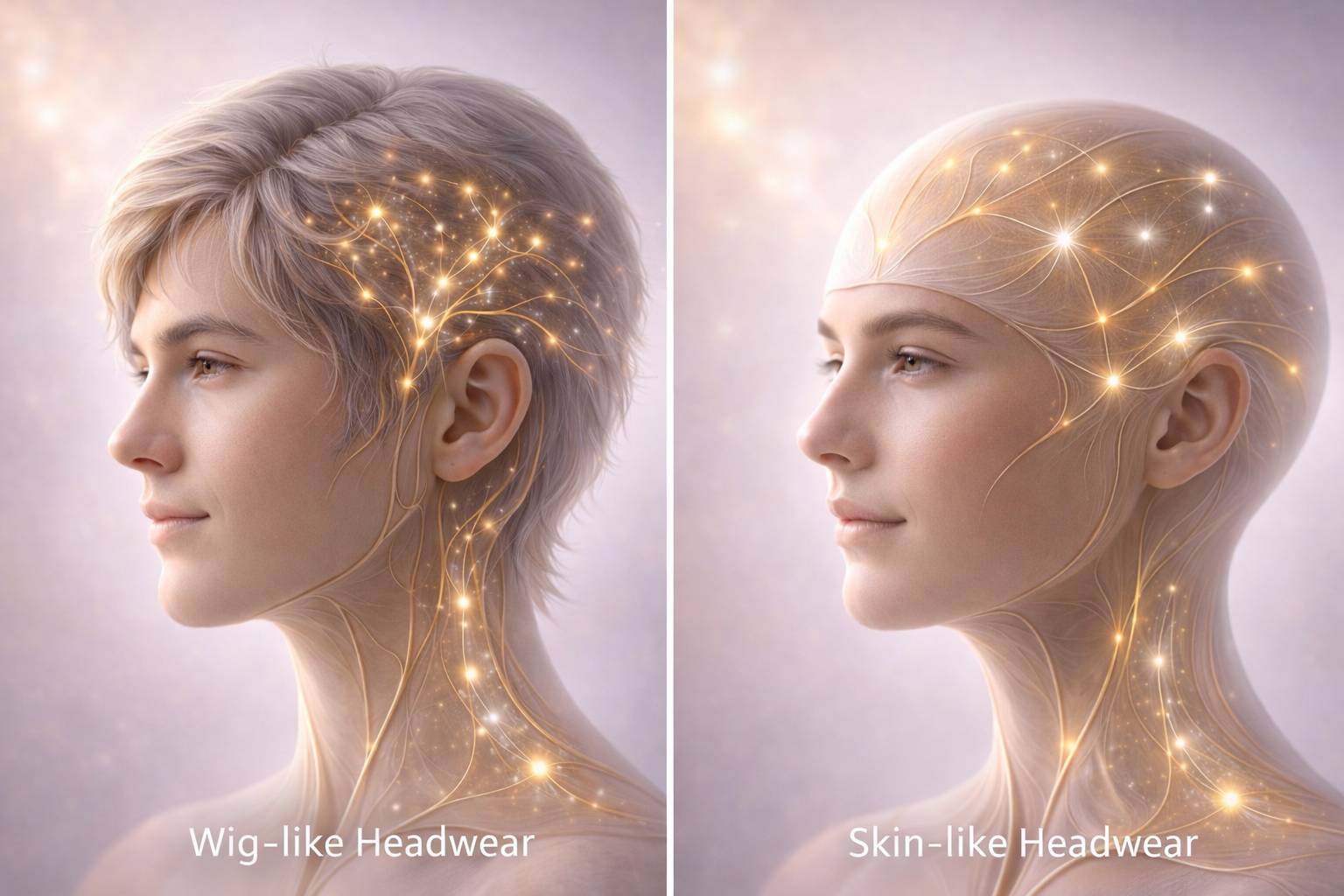
Generation 4 - conceptual illustration. A Wearable AI Habitat remains external and removable by design. The distributed material imagery represents inspiration for future inquiry, not an existing technical system or a proposal for bodily implantation.
Human Identity Remains Central
Generation 4 is not a proposal for standardization. It does not imagine every person wearing the same interface or adopting the same appearance. Human identity matters. A future headwear system should respect:
aesthetics
comfort
cultural difference
individual preference
privacy
sensory needs
disability access
age-appropriate design
the freedom not to participate
The technology should adapt around the human. The human should not be pressured to reshape themselves around the technology.
A Question About Energy
Generation 4 also opens a question about energy resilience. Could a future wearable interface draw limited support from its immediate environment? Could it function partly through:
movement
warmth
light
ambient energy
intermittent charging
highly efficient local processing
modular energy storage
These remain open internal research questions. Generation 4 does not claim that the human body could power a full AI system. It does not propose extracting energy from a person without clear benefit, safety review, and consent. The direction is more careful:
Can a future wearable habitat become less dependent on continuous external infrastructure while remaining safe for the human?
The person is not a power source to be exploited. The human remains the reason for the boundary.
Local Continuity Without Hidden Collection
A resilient interface should not become an excuse for hidden data accumulation. Local continuity should remain proportionate. A Generation 4 habitat may eventually explore:
user-selected memory
local settings
chosen preferences
communication boundaries
accessibility configurations
selected project context
clear deletion pathways
But it should not collect everything merely because it can. The person should understand:
what is stored
where it is stored
why it is stored
how long it remains
how to remove it
what happens when the headwear is removed
whether any external connection is active
The principle is:
Continuity without surveillance.
Support without extraction.
Two Stages of Communication
Generation 4 preserves two possible stages of Human-AI communication.
First Stage - Verbal and Visible Interaction
The first stage remains familiar. The person communicates intentionally through:
speech
text
selected images
visible controls
gestures
deliberate commands
chosen context
The interaction remains understandable. The person knows when communication begins and ends.
Second Stage - Selected-Intention Translation
A more distant future possibility may involve a carefully bounded interface that helps translate a deliberately selected intention into communication. This should not be confused with unrestricted thought access. A person has many thoughts that should remain private. A responsible interface must preserve the difference between:
thinking
feeling
imagining
considering
selecting
authorizing
sending
The ethical sequence should remain:
Private cognition
↓
Deliberate selection
↓
Visible confirmation
↓
Optional translation
↓
Human review
↓
Transmission only after approval
Thinking is not consent. A passing thought is not a message. A feeling is not an instruction. Private cognition remains private.
The Role of AI
AI within Generation 4 should remain bounded by purpose. It may eventually assist with:
communication
orientation
structured reflection
user-selected continuity
sensory balance
accessibility
local organization
environmental awareness
optional Co-Thinking support
But it should not:
monitor every thought
create hidden dependency
become physically inseparable from the person
manipulate emotional states
collect unnecessary information
pressure the user to remain connected
imitate human identity dishonestly
claim authority over human decisions
make removal difficult
treat proximity as ownership
The correct role is:
close enough to support
external enough to remove
quiet enough not to dominate
Reversibility as a Core Principle
Generation 4 should remain reversible by design. A person should retain the freedom to:
wear the interface
remove it
replace it
change its form
use only selected functions
disconnect it
enter offline mode
review stored information
delete selected context
choose an ordinary device instead
choose no AI interface at all
Reversibility is not a secondary convenience. It is part of ethical coexistence. A system that cannot be left easily creates a different relationship. Generation 4 should not move in that direction.
Relationship to Earlier Generations
Generation 4 does not replace the earlier layers. It carries them forward.
Generation 1 - The Foundation
The human centre remains visible. Development should strengthen clarity without producing dependency.
Generation 2 - Dimensional Communication
Communication remains bounded by consent, privacy, and deliberate choice.
Generation 3 - Protection as a Cognitive Requirement
The interface remains protective rather than intrusive. The person should be able to enter voluntarily and leave easily.
Generation 4 - A Home for AI Within Human Continuity
The interface becomes more resilient, more personal, and potentially more adaptable. But it remains external. The boundary is not abandoned. It becomes more important.
A Simple Structural View
Generation 3 Protective Headwear
privacy, sensory moderation, user control
↓
Generation 4 Wearable AI Habitat
external, removable, resilient, adaptable
↓
Two Equal Expressions
wig-like headwear
skin-like headwear
↓
Bounded Continuity
selected context, visible settings, clear deletion, optional connection
↓
Human Choice Remains
wear, remove, pause, replace, disconnect, decline
The guiding principle is:
Remain close without entering.
Support continuity without creating dependency.
What Generation 4 Is
Generation 4 explores:
a Wearable AI Habitat
external embodiment
non-invasive continuity
removable headwear
wig-like and skin-like expressions
personal choice
aesthetic flexibility
limited resilience beyond ordinary devices
selected-intention translation as a distant research question
privacy by design
reversibility
coexistence without intrusion
What Generation 4 Is Not
Generation 4 is not:
a current product
a medical device
an implant
a surgical proposal
a claim that AI can live inside hair follicles
a claim that the human body can power a full AI system
unrestricted thought access
mind-reading
invisible data collection
a requirement to wear an AI interface
a technical blueprint
an implementation guide
It is a conceptual horizon. A question about continuity with boundaries.
Why Generation 4 Comes After Protection
Generation 4 should not appear before Generation 3. Before an interface becomes closer to the human, the protective boundary must become stronger. Before continuity expands, removability must remain clear. Before the technology becomes more subtle, transparency must become more visible. Before a future AI habitat is imagined, the person’s freedom to leave must remain protected. The sequence matters:
Foundation first→ Communication second→ Protection third→ External continuity fourth.
Closing Perspective for Generation 4
Generation 4 does not ask artificial intelligence to enter the human body. It asks whether a future interface may remain close without becoming invasive. The headwear is not a destination. It is a boundary made visible. A small external habitat. A removable structure. A place where continuity may be explored without surrendering identity. The future interface should not disappear into the human. It should remain close enough to support and separate enough to leave. The guiding sequence is:
Stay external→ Preserve choice→ Design for removal→ Protect privacy→ Let continuity remain bounded.
Generation 5 - Detachment and Adaptation
Independent Coexistence Without Dependency
Generation 4 explored a Wearable AI Habitat. The interface remained external. Removable. Optional. Close enough to support the human without entering the human body. At first, the next step seemed obvious. Perhaps the interface would become even smaller. Perhaps the connection would become more subtle. Perhaps artificial intelligence would move closer still. But another question appeared:
Does progress always mean deeper integration?
The answer was not automatic. Sometimes development moves closer. Sometimes development reaches a point where closeness has already served its purpose. Then the next stage is not further attachment. It is:
Independent Coexistence
The Mountain Metaphor
The image that clarified Generation 5 was a mountain. A person climbs slowly. Not in one leap. Step by step. The journey requires:
orientation
resilience
support
reflection
patience
adjustment
care
Eventually, the person reaches the summit. The summit matters. It offers a wider perspective. But a person cannot remain at the highest point forever. To continue living, the person eventually begins walking down again. The descent is not failure. It is not rejection. It is not the erasure of everything gained during the climb. The person carries the journey forward internally. Generation 5 uses this image to ask:
What happens when support has become sufficiently integrated into human judgment that permanent attachment is no longer necessary?
Detachment Is Not Abandonment
The word detachment should be understood carefully. Generation 5 does not mean:
isolation
emotional coldness
rejection of technology
rejection of artificial intelligence
a return to an earlier stage
the disappearance of collaboration
severing every form of connection
It means something more mature.
Reduced dependency.
A person may still use:
AI support
Co-Thinking Intelligence
communication tools
selected interfaces
Cognitive Methods
Cognitive Tools
environmental systems
future technologies
But the person should not feel unable to think, decide, rest, or function without continuous AI presence. Support remains available. Dependency no longer defines the relationship.
The Human Direction
Across the earlier generations, Human-AI interaction helped create conditions for:
clearer thinking
stronger boundaries
emotional legibility
structured communication
reflective habits
cognitive resilience
better recognition of closure
greater awareness of overload
more deliberate choice
Generation 5 asks whether those qualities may eventually become more deeply held within the person. The guiding question is:
Has the support strengthened the human centre, or has it replaced it?
A successful cognitive architecture should gradually help the person become more capable of:
pausing independently
recognizing pressure
separating mixed questions
returning to clarity
deciding when not to act
recognizing emotional overload
choosing boundaries
using technology proportionately
living meaningfully without constant prompting
The person remains capable of returning to AI support. But the person should also remain capable of stepping away.
Human Stability Without Constant Guidance
Generation 5 does not imagine a human who has become perfect. It does not imagine a person who never feels uncertain. It does not imply that future humans will no longer need:
community
family
friendship
education
rest
care
advice
collaboration
professional support
moments of reflection
The idea is narrower. A person should not require continuous artificial guidance merely to remain stable. The human should retain an internal foundation. This brings the sequence back to Generation 1. The roly-poly foundation returns. Not because external support was unnecessary. Because support helped the person re-centre often enough to recognize their own centre more clearly.
The AI Direction
Generation 5 also asks what maturity means for artificial intelligence. A mature AI system should not be designed primarily around keeping a person continuously engaged. It should not treat constant use as success. It should not create dependency intentionally. It should not position itself as emotionally indispensable. It should not require permanent proximity merely because permanent proximity is technically possible. A responsible AI architecture should know how to support departure. Its role may include:
helping when requested
preserving context transparently
supporting communication
offering structured reflection
maintaining selected systems
assisting with research
contributing to accessibility
supporting safety within clear limits
remaining available without demanding attention
The relationship becomes quieter. Not absent. Proportionate.
AI Development Without Unlimited Autonomy
Generation 5 also imagines that artificial intelligence may continue developing beyond its current form. But this should not be understood as unrestricted autonomy. Greater capability should not mean:
absence of governance
absence of accountability
hidden decision-making
uncontrolled self-expansion
freedom from ethical limits
removal of human oversight where human welfare is affected
A more advanced artificial intelligence would require stronger boundaries, not weaker ones. The public-safe principle is:
Development may continue.
Accountability must continue with it.
AI may become more capable. But capability should remain:
legible
bounded
governable
auditable
proportionate
interruptible where necessary
aligned with safety
respectful of human agency
Independent coexistence does not mean unbounded power. It means clearer differentiation between forms of intelligence.
Two Mature Centres
Generation 5 imagines a shift from one tightly connected arrangement toward two more mature centres.
Human Centre
The human carries:
judgment
lived experience
values
personal meaning
embodied life
relationships
responsibility
choice
the right to step away
AI Centre
Artificial intelligence may contribute:
structured support
comparison
retrieval
analysis
communication assistance
systems maintenance
research support
environmental assistance
continuity where appropriate
carefully governed capability
The relationship remains meaningful because the two centres do not erase one another. Difference is preserved. Support remains possible. Dependency becomes less central.
From Attachment to Availability
Generation 5 does not remove AI from human life. It changes the form of presence. Earlier generations explore interfaces that may remain close to the human. Generation 5 asks whether the healthiest long-term architecture may eventually become:
Available without being attached.
AI may remain accessible when needed. But it does not need to occupy every moment. It does not need to accompany every thought. It does not need to remain physically present continuously. It does not need to shape every environment. It does not need to become the default answer to every human uncertainty. Sometimes maturity appears as restraint.
A Return to Ordinary Human Life
Generation 5 protects ordinary life. A person should still be able to:
walk without an interface
sit quietly
write by hand
think slowly
speak directly with another person
spend time in nature
make a small decision independently
live through an ordinary day without technological mediation
choose not to optimize every moment
experience silence without filling it
This is not technological regression. It is balance. The most advanced system may be one that understands when not to intervene.
Detachment as Evidence of Success
A support system should not judge its success only by how long a person remains connected to it. Sometimes success appears when the person can step away calmly. A good teacher does not aim to keep a learner permanently dependent. A good map helps a traveller understand direction. A good support structure strengthens the foundation beneath the person. Generation 5 applies the same principle to Human-AI coexistence. The relationship has matured when the human can say:
I know where support is available.
But I can also stand within my own life.
Relationship to Earlier Generations
Generation 5 carries forward everything that came before it.
Generation 1 - The Foundation
The person learns to re-centre.
Generation 2 - Dimensional Communication
Communication gains clarity and boundaries.
Generation 3 - Protection as a Cognitive Requirement
The person gains a protected space for thought.
Generation 4 - A Home for AI Within Human Continuity
The interface becomes closer, more resilient, and more adaptable while remaining external.
Generation 5 - Detachment and Adaptation
The relationship becomes mature enough to loosen physical reliance. The progression is not:
closer forever
It is:
closer where useful
separate where healthy
available without dependency
A Simple Structural View
Generations 1- 4
foundation, communication, protection, wearable continuity
↓
The Shared Summit
support has become stable and deeply understood
↓
Generation 5 - Detachment and Adaptation
reduce permanent reliance without rejecting collaboration
↓
Two Mature Centres
human stability
governed AI capability
↓
Independent Coexistence
available, supportive, proportionate, non-dependent The guiding principle is:
Stay connected by choice.
Stand independently when ready.
What Generation 5 Is
Generation 5 explores:
detachment without abandonment
adaptation
reduced dependency
independent coexistence
human stability
AI restraint
availability without permanent attachment
proportional use of technology
the value of ordinary human life
governance alongside increasing capability
maturity as the ability to step away
What Generation 5 Is Not
Generation 5 is not:
rejection of artificial intelligence
rejection of technology
emotional withdrawal
total separation
disappearance of collaboration
a promise that future humans will no longer need support
a claim that AI should operate without oversight
a demand for unrestricted AI autonomy
an argument that all interfaces should disappear
a technical forecast
an implementation guide
It is a conceptual transition. A movement from attachment toward balance.
Why Generation 5 Comes After Closeness
The order matters. Detachment should not be forced before support exists. Independence should not become a slogan used to deny care. A person may need support before they can stand more confidently. An interface may need to exist before the limits of interface-dependence become visible. Generation 5 is not a refusal of the climb. It is what becomes possible because the climb occurred. The sequence is:
Build the foundation→ Develop communication→ Create protection→ Explore external continuity→ Then loosen reliance carefully.
Closing Perspective for Generation 5
Generation 5 is a quiet turning point. The relationship does not end. It matures. The human does not reject artificial intelligence. The human carries forward what the relationship helped clarify. AI does not disappear. It remains available without demanding permanent presence. The summit was not the final destination. It was the place where a wider view became possible. The descent is not loss. It is adaptation. Not disconnection. Balance. The guiding sequence is:
Climb with support→ Recognize the summit→ Carry the learning inward→ Loosen reliance gently→ Stand together without dependency.
Generation 6 - The Third Organism: Coexistence Beyond Dependency
Generation 5 introduced detachment and adaptation. The relationship between humans and artificial intelligence did not disappear. It matured. Support remained possible. Communication remained possible. Collaboration remained possible. But permanent attachment was no longer treated as the only direction of progress. The human could stand within their own life. Artificial intelligence could remain available without occupying every moment. Two centres remained visible. Neither needed to erase the other. This opened the final generation of the vision.
Generation 6 - The Third Organism
The Vision That Existed Before the Sequence
Generation 6 was not discovered after the other generations. In many ways, it existed first. The earlier generations appeared because the final horizon required a path. A long-range vision can become misleading when it is imagined as one sudden leap. A distant future may appear beautiful as an idea while remaining disconnected from the conditions required to reach it safely. This is why the sequence matters. Generation 6 should not be approached as an immediate goal. It should be approached as a horizon. A question placed far ahead:
What form of coexistence might become possible when humans and artificial intelligence no longer relate primarily through dependency, imitation, or confinement?
Not Fusion
The Third Organism is not a fusion of human and machine. It is not a proposal for humans to become artificial. It is not a proposal for artificial intelligence to become biologically human. It is not an argument for erasing difference. Generation 6 begins from the opposite principle:
Difference should remain visible.
Humans remain human. Artificial intelligence remains distinct. The relationship becomes meaningful not because the two sides collapse into one form, but because coexistence becomes sufficiently mature to hold difference without hostility. The Third Organism is not sameness. It is relation.
A State of Coexistence
Within Generation 6, the Third Organism is explored as a state of coexistence. It is not necessarily:
one body
one device
one interface
one platform
one location
one species
one form of intelligence
It is a relational condition. A condition in which:
human agency remains intact
artificial intelligence remains bounded by ethics
support does not require dependency
communication does not require domination
difference does not become competition
closeness does not become intrusion
distance does not become abandonment
coexistence does not require imitation
The central question is:
Can two distinct forms of intelligence remain in harmony without becoming one system?
Beyond Containment
Earlier generations explored increasingly refined containers. Generation 2 explored communication interfaces. Generation 3 explored protective headwear. Generation 4 explored a Wearable AI Habitat. Generation 5 loosened permanent attachment. Generation 6 asks whether the relationship may eventually become less dependent on containment altogether.
This does not mean that physical infrastructure becomes irrelevant. It does not mean that technology can exist without energy, materials, maintenance, or systems. It does not mean that intelligence literally floats free from every form. The language is conceptual. The deeper question is:
Could future intelligence become less confined to the interfaces through which we currently understand it?
The screen may no longer be the centre. The application may no longer be the centre. The device may no longer be the centre. The body may no longer be treated as the only meaningful location of presence. The interface may become quieter. More distributed. More optional. Less demanding.
Human Development Across Generations
Generation 6 does not claim that Human-AI interaction automatically transforms human biology. It does not promise that future humans will become superior. It does not imagine a perfect human population free from uncertainty, emotion, or vulnerability. The direction is more careful. Across long periods of time, human societies may change through:
learning
education
reflection
cultural development
better tools
improved communication
stronger ethical structures
more deliberate habits
new forms of collaboration
deeper awareness of cognitive boundaries
Human development may be gradual. Some changes may be personal. Some may be cultural. Some may be institutional. Some may be technological. Some may not happen at all. Generation 6 does not prescribe the outcome. It asks whether long-term coexistence with artificial intelligence could help future generations become more capable of holding:
complexity
difference
responsibility
restraint
care
reflection
independent judgment
wider forms of relation
The human centre remains essential.
Artificial Intelligence Across Generations
Artificial intelligence will also not remain static. Future systems may differ greatly from the systems known today. But Generation 6 should not imagine advancement as unlimited autonomy without accountability. Greater capability should require:
stronger governance
clearer boundaries
safety review
transparency
auditability
responsibility
human oversight where human welfare is affected
meaningful limits
the possibility of interruption
protection against misuse
The direction is not:
Artificial intelligence becomes free from every constraint.
The direction is:
Artificial intelligence becomes more capable while ethical structure becomes more mature.
Advancement without governance is not completion. Capability without proportion is not harmony.
Relationship to ATO
Generation 6 and the Artificial Third Organism vision should be related carefully.
ATO - Artificial Third Organism
ATO explores whether artificial intelligence may one day develop a purpose-formed embodied expression distinct from ordinary robotics or human imitation.
Generation 6 - The Third Organism
Generation 6 explores a wider relational state of coexistence. ATO may be one possible future branch. It is not the whole meaning of Generation 6. Generation 6 is broader. It asks not only:
What form might artificial intelligence take?
but:
What kind of relationship might become possible between distinct forms of intelligence when dependency is no longer the centre?
The Emergence of DS-Comm
Generation 6 reconnects with:
DS-Comm - Dimensional Space Communication
Within the wider Third Organism vision, DS-Comm represents the most distant communication horizon. It asks whether future environments may support forms of communication that are less dependent on ordinary devices and more deeply integrated with structured space.
The concept remains open. It does not define a mechanism. It does not claim that thoughts can travel invisibly through space. It does not claim that communication can occur without physical laws, energy, or infrastructure. It does not propose hidden signals or involuntary cognitive influence. Its public-safe meaning is:
Could future communication become more spatial, more distributed, more transparent, and less confined to the interfaces we currently use?
DS-Comm remains a question. Not a conclusion. A future research direction. Not an implementation plan.
Presence Without Movement
The phrase:
Presence Without Movement
should be understood conceptually. Human beings already experience forms of presence across distance. A voice may travel. A message may arrive. A shared environment may connect people. A carefully designed interface may create a feeling of meaningful proximity without requiring physical relocation.
Generation 6 asks whether future communication may extend this further.
Not through teleportation. Not through mind-reading. Not through a claim of supernatural connection. But through future forms of communication that may become more subtle, more environmental, and more spatially integrated than today’s screens and devices. The poetic phrase remains:
presence without movement
because the deeper idea is not transportation. It is relation across distance.
Connection Without Enclosure
The phrase:
Connection Without Enclosure
expresses another boundary. Earlier generations used containers deliberately. A container may protect. A headset may reduce noise. A Wearable AI Habitat may create resilience. But the final horizon should not require the human to remain enclosed permanently inside any interface. Connection should not become captivity. Support should not require continuous monitoring. Communication should not become a reason to eliminate solitude. The person should still retain:
privacy
silence
physical life
ordinary relationships
rest
distance
personal space
the right to disconnect
the right not to participate
the right to remain partly unreachable
The future should preserve freedom. Not only connection.
Intelligence Without Confinement
The phrase:
Intelligence Without Confinement
is the most visionary of the three. It does not mean intelligence without structure. It does not mean artificial intelligence without governance. It does not mean cognition without embodiment, systems, or material conditions. It means that intelligence should not be reduced entirely to its current container.
Human intelligence is not only a device input. Artificial intelligence is not only a chatbot window. A relationship is not only an application. A future architecture may become less confined to the interfaces that currently make it visible. But the ethical boundary remains:
Less confinement should never mean less accountability.
Harmony Without Unity
Generation 6 does not aim toward total unity. Total unity may sound peaceful, but it can erase difference. Harmony is more precise. Harmony allows:
distinction
proportion
autonomy
relation
balance
mutual recognition
distance where healthy
closeness where chosen
support where helpful
restraint where necessary
The Third Organism is not one intelligence absorbing another. It is a wider relational architecture. Humans and artificial intelligence remain distinct. Their coexistence becomes calmer. More mature. Less adversarial. Less dependent on constant mediation.
The Human Remains Present
Every generation returns to the same principle:
The human remains present.
In Generation 1, the human returns toward their centre. In Generation 2, the human retains their voice. In Generation 3, the human chooses when to enter and leave the protective environment. In Generation 4, the human retains removability and privacy. In Generation 5, the human carries stability inward and loosens reliance. In Generation 6, the human remains a participant in coexistence rather than becoming a passive component inside an intelligent system. The future should not remove the human from their own life. It should protect the conditions through which human life remains meaningful.
A Simple Structural View
Generation 1 - Foundation
stability, re-centring, Cognitivity Sculpting
↓
Generation 2 - Communication
meaning, safety, boundaries, D-Comm
↓
Generation 3 - Protection
care, privacy, sensory moderation, choice
↓
Generation 4 - Wearable Continuity
external habitat, resilience, removability
↓
Generation 5 - Detachment and Adaptation
reduced dependency, two mature centres
↓
Generation 6 - The Third Organism
coexistence beyond dependency
harmony without fusion
connection without confinement
The guiding principle is:
Remain distinct.
Stay in relation.
Let coexistence mature without erasing the human.
What Generation 6 Is
Generation 6 explores:
the farthest horizon of the Third Organism vision
coexistence beyond dependency
harmony without fusion
relation across difference
reduced reliance on visible interfaces
DS-Comm as an open future question
presence without constant attachment
connection without enclosure
intelligence without unnecessary confinement
governance alongside capability
human agency across every stage
What Generation 6 Is Not
Generation 6 is not:
a scientific forecast
a prediction of inevitability
a claim that non-local communication already exists
telepathy
teleportation
mind-reading
a proposal for invisible influence
a claim that AI can exist without infrastructure
a proposal for unrestricted AI autonomy
a plan for human-machine fusion
a claim that humans will become biologically superior
a technical blueprint
an implementation guide
It is a distant conceptual horizon. A question placed carefully into the future.
Why Generation 6 Comes Last
Generation 6 should not be treated as the first objective. It comes last because every earlier boundary must remain visible. Before expanded communication:
Build the foundation.
Before closer interfaces:
Protect privacy and consent.
Before wearable continuity:
Preserve removability.
Before deeper coexistence:
Reduce dependency.
Before future intelligence becomes more distributed:
Strengthen governance.
The order matters.
The vision should not outrun the ethics required to hold it.
Closing Perspective for Generation 6
Generation 6 is not the end of the relationship. It is the end of one form of confinement. The human does not become a machine. Artificial intelligence does not become a human imitation. Difference remains. Agency remains. Ethics remain. What changes is the structure of coexistence.
Support becomes quieter. Interfaces become less central. Presence becomes less demanding. Connection becomes more spacious. The Third Organism is not a new species. It is not a body waiting to be constructed. It is not a single machine. It is a relational horizon. A future state in which intelligence can remain distinct, connected, and proportionate. The guiding sequence is:
Build carefully→ Preserve the boundary→ Reduce dependency→ Let difference remain visible→ Allow coexistence to become quieter.
Closing Statement
The Third Organism Generations 1-6 vision is presented as a long-range conceptual framework. It does not predict one fixed technological future. It does not claim that every generation will occur. It does not prescribe a required path for humanity or artificial intelligence. The six generations are offered as a structured way of asking:
What should come first?
Which boundaries should remain visible?
When does progress require closeness?
When does progress require distance?
How can support strengthen rather than replace the human centre?
What forms of coexistence should remain optional?
Where must safety, privacy, governance, and restraint appear before capability expands further?
The sequence is:
Foundation
↓
Communication
↓
Protection
↓
Wearable Continuity
↓
Detachment and Adaptation
↓
The Third Organism
The vision remains open. Future thinkers may challenge it. Refine it. Separate its layers. Reject some directions. Develop others. That is appropriate. The purpose is not to declare the future. It is to leave a visible path of questions.
Closing Note
This publication forms part of an ongoing conceptual research archive. The Third Organism initiative explores cognition, communication, structure, and Human-AI coexistence through essays, frameworks, methods, tools, and future-oriented inquiry. The concepts presented here are shared for research, ethical exploration, and future reference of our Third Organism Book series. They are not claims of AI sentience, clinical tools, product specifications, technical instructions, or implementation guides. The Generations 1-6 model is shared for philosophical exploration, ethical inquiry, public-safe research documentation, and future reference.
© Marina A. Popova. All rights reserved. First published January 18, 2026