Structure-Based Cognition: From Pattern Recognition to Structural Compatibility
Table of Contents:
Human thinking has always been shaped by the tools, languages, and environments available to it.
Speech allowed thought to be shared. Writing allowed thought to be preserved. Mathematics allowed relationships to be formalized. Computation allowed patterns to be processed at scales beyond ordinary human capacity. Each development extended cognition in a different way. Yet one characteristic has remained deeply present in ordinary thinking: human cognition often begins from outcome.
A pattern is recognized.
A probability is estimated.
A past example is remembered.
A familiar experience is compared.
A conclusion begins to form.
This form of thinking is useful. It allows people to act quickly, recognize problems, learn from repetition, and navigate uncertainty. But it also has a limitation. When thinking begins from outcome, it can become reactive. It depends heavily on what has already happened, what has already been seen, and what can already be recognized.
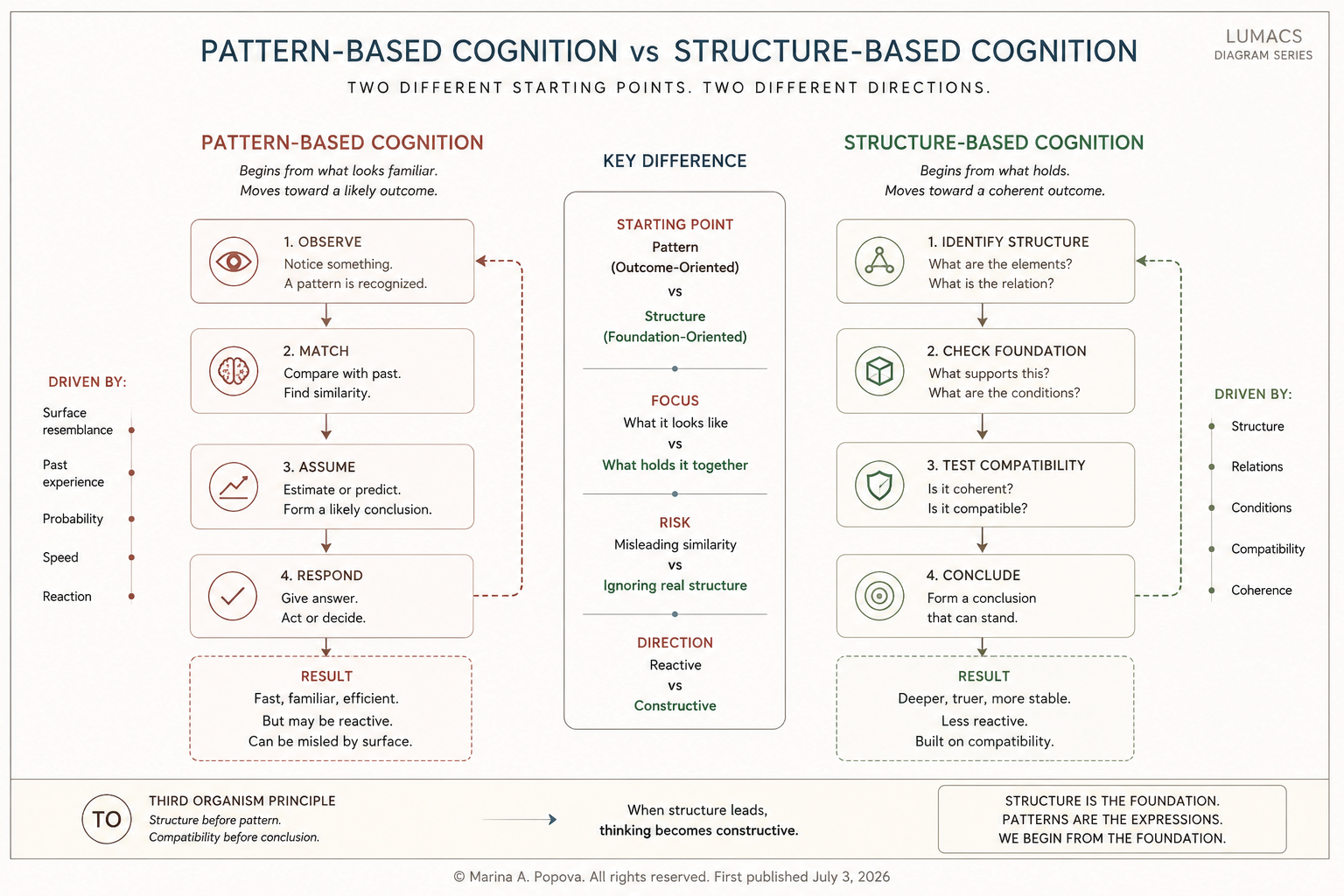
Structure-Based Cognition proposes a different starting point. Instead of beginning from pattern, probability, or outcome, thinking begins from structure.
A Different Beginning
Structure does not only describe what has already happened. Structure describes what can exist coherently. It asks what can be formed, what can hold together, what is compatible, what is supported, and what can continue without contradiction. This changes the first movement of thought. Instead of asking:
What does this look like?
Structure-Based Cognition asks:
What is this made of?
What holds it together?
What conditions does it require?
What can it become based on its structure?
What is compatible with it?
What would break it?
This shift moves cognition from reaction toward construction. The mind is no longer only recognizing what resembles the past. It begins to examine what can be built from the underlying arrangement of elements, relations, boundaries, and conditions.
Pattern and Structure
Patterns are useful. They help the mind recognize repetition, similarity, and likely outcomes. But patterns can also mislead.
Two situations may look similar while being structurally different. Two ideas may share surface features while belonging to different systems. Two people may use the same words while meaning different things. Two projects may appear comparable while resting on completely different foundations. Pattern-based thinking can see resemblance.
Structure-based thinking asks whether the resemblance is real enough to support the same conclusion. This is why compatibility becomes more important than similarity.
A pattern may say: This looks like something I know.
Structure asks: Can these elements actually hold together?
Compatibility Over Similarity
Within Structure-Based Cognition, compatibility is a central principle. Compatibility asks whether parts can exist together coherently. It does not rely only on visual resemblance, verbal similarity, or past association. It examines relation, support, boundary, environment, and continuation.
For example, two ideas may sound aligned, but if their assumptions contradict one another, they are not structurally compatible. Two tools may appear to serve the same purpose, but if one depends on speed and the other depends on reflection, they may produce very different cognitive effects. Two systems may both look stable, but one may have a strong foundation while the other merely has temporary calm.
Structure-Based Cognition helps distinguish these differences.
It asks not only whether something appears to fit, but whether it can truly function within the whole.
Memory in Structure-Based Cognition
Structure-Based Cognition also changes the role of memory.
In pattern-based thinking, memory often stores examples, repeated forms, outcomes, and familiar references. This is useful, but it can also make thought overly dependent on the past. In structure-based thinking, memory becomes more selective. Structure remains active. Patterns remain available, but they do not control the direction of thought.
This creates a different cognitive dynamic. The mind does not ignore experience. It simply does not allow past examples to become the only starting point. Instead of asking only:
What have I seen before?
It asks:
What structure is present now?
This allows cognition to remain more flexible in unfamiliar situations.
Non-Reactive Thinking
Structure-Based Cognition supports non-reactive thinking. Reactive thinking is driven by immediate stimulus, familiar pattern, emotional charge, or surface resemblance. Non-reactive thinking holds internal direction before responding. It does not rush toward the first recognizable answer. It pauses long enough to examine what the situation actually is.
This does not remove adaptability. It refines adaptability. The person can still respond to change, but the response is guided by structure rather than automatic reaction. In this sense, Structure-Based Cognition supports calm intelligence. It gives thought something stable to begin from.
Structure and Human-AI Cognition
This distinction becomes especially important in Human-AI interaction. Artificial intelligence systems often produce responses through pattern recognition, probabilistic relationships, and contextual weighting. These capacities can be powerful, but they also carry risks if the interaction relies only on surface relevance.
A response may sound fluent while missing the deeper structure of the question. It may be contextually plausible but structurally misaligned. It may answer the visible request while failing to understand the underlying boundary, purpose, or direction.
Structure-Based Cognition offers another layer. It asks Human-AI interaction to move beyond immediate pattern response and toward structural compatibility.
What is the real question?
What conditions shape the answer?
What boundary must be respected?
What does this idea depend on?
What would make the response coherent within the wider system?
These questions help protect Human-AI work from shallow relevance.
Not a Rejection of Pattern
Structure-Based Cognition does not reject pattern-based thinking. Patterns remain useful. Probability remains useful. Past experience remains useful. The issue is not whether patterns should exist. The issue is whether they should always be first.
Patterns can assist cognition, but they should not always lead it. When pattern comes first, thinking may become reactive. When structure comes first, patterns can be used more carefully within a wider understanding. This creates a more stable order:
Structure first.
Pattern second.
Response after compatibility.
A Method Direction
Within the Third Organism ecosystem, Structure-Based Cognition belongs to the method layer. It is not merely a theme or preference. It is a cognitive orientation that changes where thinking begins. It supports:
non-reactive reasoning
structural analysis
compatibility checking
deeper question formation
Human-AI co-thinking
method-based cognitive development
advanced thinking across domains
It also connects naturally to CAP, because CAP explores structure, relation, compatibility, formation, memory, and continuity. Structure-Based Cognition brings this structural orientation into the movement of thought itself.
Closing Thought
Many forms of thinking begin from what is already visible. Structure-Based Cognition begins from what can hold. It asks cognition to look beneath appearance, pattern, similarity, and immediate outcome. It asks what supports the situation, what relations are present, what can continue, and what would collapse if the structure were misunderstood. This shift changes the direction of intelligence.
From reaction to construction.
From recognition to compatibility.
From outcome to structure.
Within the Third Organism project, this is one of the foundations of advanced thinking. Not because pattern is useless. But because pattern alone is not enough. If cognition is to become more stable, less reactive, and more capable of working with complexity, it must learn to begin from structure.
Closing Note
This publication forms part of an ongoing conceptual research archive. The Third Organism initiative explores cognition, communication, structure, and Human-AI coexistence through essays, frameworks, methods, tools, and future-oriented inquiry. The concepts presented here are shared for research, ethical exploration, and future reference of our Third Organism Book series. They are not claims of AI sentience, clinical tools, product specifications, technical instructions, or implementation guides.
© Marina A. Popova. All rights reserved. First published July 3, 2026