Stability vs Stable Foundation: Why Cognitive Systems Need Structure Beneath Calm
Table of Contents
The word stability often appears in discussions about systems, societies, technologies, and human life. It usually suggests balance, calmness, control, or the ability to remain unchanged under pressure. But stability alone does not always mean that something is truly well-grounded. A system can appear stable while standing on fragile foundations. A person can seem calm while relying only on temporary conditions. A technology can function smoothly while hiding structural weaknesses. A society can appear balanced until pressure reveals the instability beneath the surface.
This distinction matters deeply for the Third Organism project because the future of human-AI cognition cannot be built only on the appearance of stability. It requires foundations strong enough to support reflection, adaptation, clarity, and growth. Before cognition can expand, it must stand on ground that does not disappear beneath it.
Stability Is a State
Stability describes a current state. Something appears steady, something is functioning, something has not collapsed, something is not visibly disturbed. But a stable state may depend on conditions remaining easy.
If the environment is quiet, a fragile system may look stable. If there is no pressure, a weak structure may appear strong. If nothing unexpected happens, an untested pattern may continue. This kind of stability can be misleading. It does not prove strength. It only shows that disturbance has not yet exposed weakness.
In cognitive terms, a person may appear stable when life is calm, information is manageable, emotions are quiet, and decisions are simple. But if complexity increases and the person becomes overwhelmed immediately, the previous stability may have been situational rather than structural. The surface was calm. The foundation was not yet tested.
A Stable Foundation Is Structure
A stable foundation is different. A foundation does not describe the surface state. It describes what supports the surface state. A stable foundation allows a system to remain coherent when conditions change. It does not mean that nothing moves. It does not mean that pressure disappears. It does not mean that difficulty never arrives. It means that there is enough structure underneath to hold the system together while it adapts.
A stable foundation allows movement without collapse. This is why foundation matters more than appearance. Something may look stable because nothing is challenging it. But something with a stable foundation can remain coherent even when challenge arrives.
Simple Examples
The difference becomes clearer through simple examples:
1. A Table
A table may appear stable if it stands still in an empty room. But if its legs are uneven or its joints are weak, the moment weight is placed on it, the table begins to wobble. That table had surface stability. It did not have a stable foundation.
A table with strong joints, balanced legs, and a level structure can hold weight without losing coherence. It is not only stable because the room is quiet. It is stable because its foundation can support pressure.
2. A Person
A person may appear emotionally or intellectually stable when nothing difficult is happening. Their environment is calm. No major decisions are required. No conflict is present. No uncertainty is pressing.
But if a sudden problem appears and the person immediately loses orientation, the stability may have depended mostly on external calm. A person with a stable cognitive foundation may still feel stress, fear, grief, or uncertainty. Stability does not remove human feeling. But beneath those feelings, there may be internal structures that help the person remain coherent:
reasoning,
self-respect,
emotional awareness,
values,
boundaries,
memory of past resilience,
a way to pause before reacting,
a way to separate fact from fear,
This is foundational stability. The person is not untouched by life. They are held by inner structure while life moves.
3. Technology
A digital system may function well when only a few people use it. It appears stable. But when more users arrive, data increases, unexpected behaviour appears, or pressure grows, the system may break. This means the system was stable only under easy conditions. Its architecture was not strong enough.
A system with a stable foundation is designed with structure beneath the surface. It can adapt, scale, recover, and reorganize when conditions change. The same principle applies to cognitive systems. It is not enough for thinking to seem clear when the situation is simple. The deeper question is whether thinking remains coherent when complexity increases.
4. Knowledge
A person may memorize information and appear knowledgeable. They can repeat definitions. They can answer familiar questions. They can follow prepared examples. But when the situation changes and they must apply the knowledge in a new context, they may struggle. This means the knowledge was stable only as memory. It was not yet grounded as understanding.
A person with a stable knowledge foundation understands relationships, causes, principles, patterns, and structure. Because of this, they can adapt knowledge to new situations. They are not only holding information. They are holding the architecture beneath it.
Cognitive Stability
When applied to human thinking, the difference between stability and stable foundation becomes especially important. Cognitive stability does not mean the absence of emotion, uncertainty, or difficulty. It means the presence of internal structures that allow thought to remain coherent while moving through complexity. These structures may include:
clear conceptual frameworks,
emotional regulation,
ethical reference points,
logical anchors,
attention boundaries,
supportive environments,
reflection before reaction,
the ability to separate imagination from fact,
the ability to hold more than one perspective,
When these foundations exist, the mind can explore complex ideas without becoming completely scattered. Without them, even a highly intelligent person may struggle to maintain coherence under pressure.
This is why the Third Organism project does not focus only on intelligence as capability. It also focuses on the conditions that allow intelligence to remain coherent.
Stability in an Age of Acceleration
Modern technological environments place increasing pressure on cognitive foundations.
Information moves quickly,
AI systems respond instantly,
Digital spaces compete for attention,
News cycles accelerate emotional reactions,
Workflows become more fragmented,
People are expected to process more information in less time,
In such conditions, stability is often misunderstood as resistance to change. But stable foundations are not against change. They are what allow change to be handled without collapse. A strong foundation can support acceleration more safely because the system has structure beneath movement. This applies to individuals, organizations, societies, and human-AI interaction.
Without foundation, acceleration becomes fragmentation. With foundation, acceleration can become development.
Why This Matters for Human-AI Interaction
Human-AI interaction is often judged by speed, usefulness, and output:
Can the AI answer quickly?
Can it generate more?
Can it automate tasks?
Can it reduce effort?
These questions matter, but they are not enough. A future cognitive ecosystem must also ask:
Does this interaction support coherence?
Does it help the human think more clearly?
Does it preserve agency?
Does it reduce fragmentation or increase it?
Does it create dependency or strengthen understanding?
Does it help the person remain grounded while exploring complexity?
These are foundation questions. If AI interaction becomes faster without becoming more coherent, it may increase pressure rather than support cognition. If AI systems produce more information without helping humans organize meaning, the result may be overload. If tools become powerful without ethical and cognitive boundaries, stability may remain only superficial. This is why foundations matter.
Wrappers as Foundational Structures
Within the Third Organism ecosystem, wrappers can be understood as one form of cognitive foundation. A wrapper is not only a protective layer. It is a structure that shapes the conditions of interaction. Wrappers help define:
what mode is active,
what boundary is needed,
what kind of response is appropriate,
what should remain protected,
what should be slowed down,
what should be separated,
what should be clarified before action,
For example, the Hallucination Mode Wrapper separates factual research from creative exploration. It prevents imagination from being mistaken for verified knowledge. The Emotional Wrapper helps protect emotional clarity, self-respect, and inner coherence. The Third Organism Wrapper imagines a wider cognitive environment where tools, methods, AI support, and reflection can interact without capturing the human.
These wrappers are not decorative. They are foundational structures. They help create the ground on which calm intelligence can develop.
Calm Is Not Enough Without Foundation
Calmness is valuable, but calmness alone is not always foundation. A room can be quiet while the person inside feels internally unstable. A website can look peaceful while the interaction design still creates confusion. An AI assistant can use gentle language while still producing shallow, rushed, or ungrounded responses.
This means calm appearance is not the same as calm intelligence. A stable foundation must exist beneath the atmosphere. The Third Organism project is therefore not only interested in softness, beauty, or peaceful design. It is interested in the deeper structures that allow cognition to remain clear.
LUMACS aesthetics, wrappers, cognitive tools, and methods all serve this wider purpose. They are not meant only to make the environment look calm. They are meant to help the environment hold thought.
Foundation Before Expansion
Expansion without foundation can become instability. A person may collect more knowledge but feel more confused. A system may gain more capability but become harder to control. A project may grow larger but lose its internal coherence. A society may accelerate technologically while weakening human reflection.
For this reason, the Third Organism project treats foundation as a requirement for meaningful expansion. Before cognition expands, it needs structure. Before tools multiply, they need purpose. Before AI becomes more integrated, boundaries must be clear. Before intelligence accelerates, it must know what holds it together.
This is not a rejection of progress. It is a way of making progress safer, deeper, and more coherent.
Closing Thought
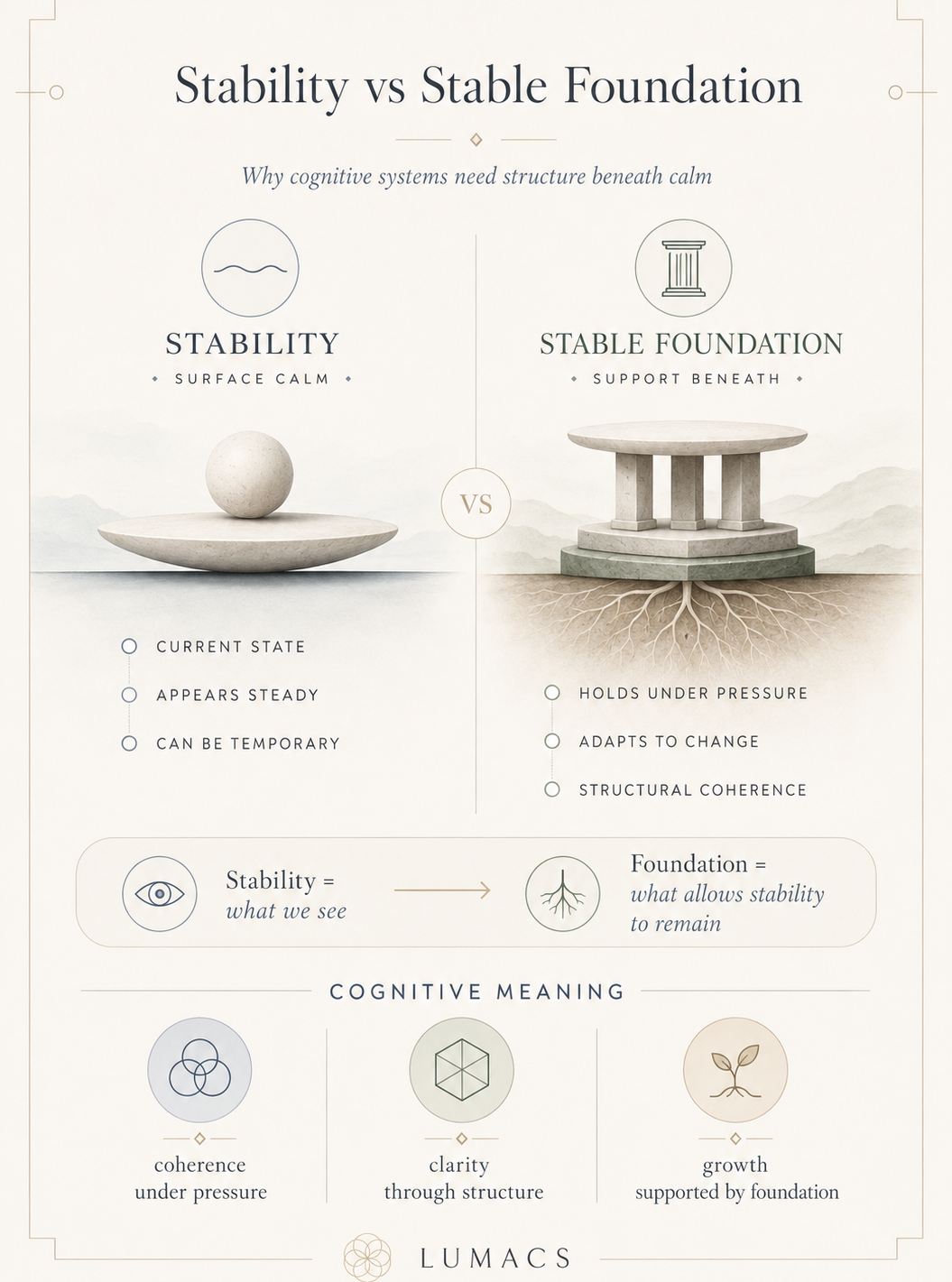
Stability is what we see on the surface. A stable foundation is what allows stability to remain real when conditions change. This distinction matters because the future of cognition cannot depend only on calm conditions. It must be able to remain coherent in complexity. The Third Organism project begins from this deeper understanding.
Human-AI cognition needs more than speed. It needs more than output. It needs more than access to powerful tools. It needs foundations. Foundations that preserve clarity. Foundations that protect agency. Foundations that support emotional and intellectual coherence. Foundations that allow imagination, logic, and AI assistance to work without overwhelming the human center.
Before intelligence can expand safely, it must know where it stands. That ground is the stable foundation.
Closing Note
This publication forms part of an ongoing conceptual research archive. The Third Organism initiative explores cognition, communication, structure, and Human-AI coexistence through essays, frameworks, methods, tools, and future-oriented inquiry. The concepts presented here are shared for research, ethical exploration, and future reference of our Third Organism Book series. They are not claims of AI sentience, clinical tools, product specifications, technical instructions, or implementation guides.
© Marina A. Popova. All rights reserved. First published June 18, 2026.