LU|MA Inheritance Wrapper: Continuity Without Replication
Table of Contents
- The Human Reason Behind the Idea
- The Question
- Continuity, Not Immortality
- Why Consent Must Come First
- Two Generations of the Inheritance Wrapper
- Generation I - Local Inheritance Wrapper
- Ethical Boundary Between the Generations
- Generation II - Universal Inheritance Framework
- Why Two Generations Matter
- What May Be Preserved
- What Must Not Be Preserved by Default
- Why This Matters for Human-AI Interaction
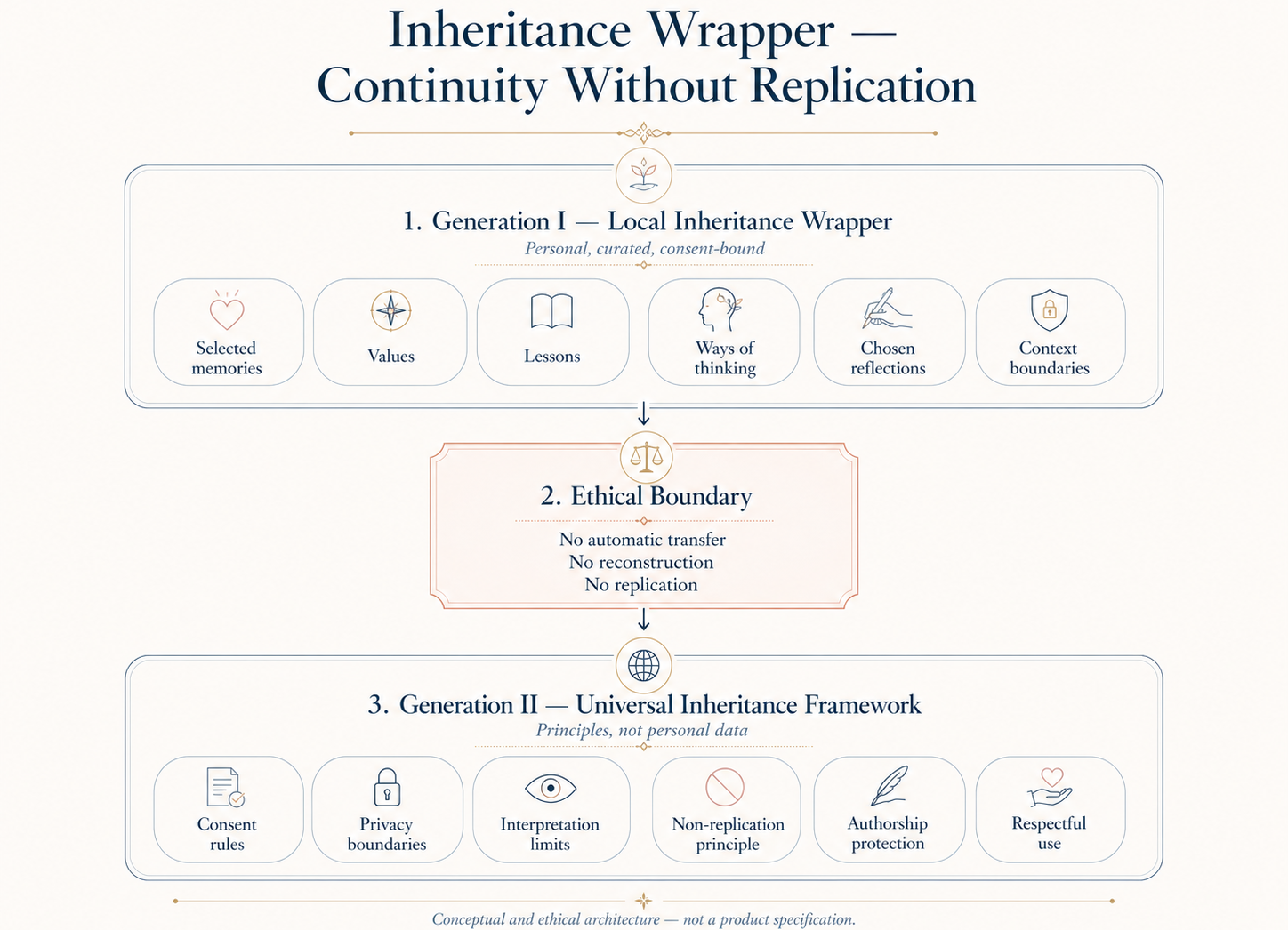
- A Simple Structural View
- Not a Product Specification
- Closing Perspective
- Closing Note
- Provenance and Conceptual Lineage Note
The idea of the Inheritance Wrapper did not appear randomly.
It emerged gradually from reflections about memory, personality, continuity, and the ethical preservation of human knowledge across time. Today, many people interact with artificial intelligence primarily as a tool. They ask questions. They receive answers. They complete tasks. Then they move on. But when conversations are intentionally preserved, they may contain more than isolated pieces of information. They may also reveal:
recurring values
ways of thinking
preferred forms of explanation
lessons learned over time
personal reflections
patterns of judgment
intellectual priorities
This does not mean that a stored conversation contains a complete person. It does not. But it raises an important question:
What aspects of a person’s knowledge and thinking might be preserved ethically for future generations?
That question became the beginning of the Inheritance Wrapper.
The Human Reason Behind the Idea
Human life has always included a quiet form of loss. People leave behind photographs, letters, stories, objects, and family memories. But over time, much becomes blurred. Names remain. A few stories remain. Sometimes a photograph remains. Yet the subtle qualities of a person may become difficult to recover:
how they approached a problem
what they valued
how they made decisions
what they learned through experience
what they hoped future generations would remember
I know this feeling personally. My mother often spoke about her father, my grandfather.
He lived in the early twentieth century and was remembered as someone who cared deeply about the people around him and accepted responsibility beyond his immediate family. Listening to those stories, I often wished I could understand him more fully. Not only the facts of his life. His way of thinking. His values. His sense of responsibility. His character. That wish is not unusual. Many people recognize the feeling behind sentences such as:
“I wish you had known your grandmother better.”
“He was such a thoughtful person.”
“She understood people so well.”
“He cared deeply about animals.”
“She knew how to grow everything in her garden.”
These sentences preserve admiration. But they also reveal how much context can disappear across generations.
The Question
What if future technologies allowed people to preserve selected parts of their intellectual and personal context more deliberately?
Not a replica. Not a simulation. Not an attempt to recreate a person after death. But a carefully curated inheritance layer containing what the person consciously chose to leave behind. This might include:
selected memories
lessons
values
reflections
approaches to difficult decisions
family stories
intellectual interests
ways of thinking
guidance written intentionally for future generations
The person themselves should decide:
what may be preserved
what may be shared
who may access it
what must remain private
what should expire
what should never be transferred
This is the central direction of the Inheritance Wrapper.
Continuity, Not Immortality
The Inheritance Wrapper is not about immortality. It is not about recreating a person. It is not about generating a digital substitute for someone who is no longer present. It is about continuity. A photograph preserves appearance. A letter preserves words. A video preserves a moment. An Inheritance Wrapper would explore whether selected context could also be preserved:
values
lessons
chosen reflections
ways of approaching life
intellectual continuity
The purpose is not to make the past appear alive. The purpose is to prevent meaningful knowledge from disappearing unnecessarily.
Why Consent Must Come First
Inheritance cannot be ethical without consent. Nothing should be preserved automatically. Nothing should be transferred by default. Nothing should be extracted merely because it exists inside a conversation history. The original person must remain the author of the inheritance layer. That means the person should be able to choose:
what enters the Wrapper
what remains excluded
whether something may be revised
whether something may later be deleted
whether access is limited to particular people
whether certain material expires after a defined period
whether the Wrapper should remain entirely private
The principle is simple:
Consent before continuity.
Two Generations of the Inheritance Wrapper
To protect the integrity of the concept, the Inheritance Wrapper is separated into two distinct generations. These are not technical software versions. They are ethical layers. They clarify what may be preserved and where the boundary must remain firm.
Generation I - Local Inheritance Wrapper
Generation I is personal, local, and consent-bound. It belongs to one individual and the specific material that person deliberately chooses to preserve. It may include:
selected memories
personal reflections
values
lessons
family stories
approaches to decision-making
ways of thinking
chosen examples of intellectual work
Generation I should not be transferable by default. It should not automatically expand through every conversation. It should not collect private material without active choice. It should remain governed by:
consent
authorship
privacy
access boundaries
deletion rights
context
intention
Nothing is inherited automatically. Nothing is copied without permission. Nothing becomes available merely because it was once said.
Ethical Boundary Between the Generations
A clear boundary must separate personal inheritance from universal principles. The boundary is:
No automatic transfer.
No identity reconstruction.
No replication.
Selected context may be preserved. A person should not be simulated as though they were still present. The distinction is essential.
Generation II - Universal Inheritance Framework
Generation II does not contain personal memories. It does not contain identities. It does not contain private histories. It preserves the ethical structure surrounding inheritance itself. This universal layer may define:
consent rules
privacy boundaries
interpretation limits
deletion rights
authorship protection
access conditions
non-replication principles
respectful use
limits on emotional simulation
Generation II is intended to be AI-agnostic. Different AI systems may refer to the same ethical principles without receiving a person’s private inheritance material. It carries the rules. Not the person.
Why Two Generations Matter
The separation protects the original intention. Without it, continuity could easily become confused with replication. Personal memory could be extracted too broadly. Private context could be misunderstood. A person’s voice or values could be simulated beyond the boundaries they intended. With the separation:
Generation I remains personal
Generation II remains universal
consent remains central
privacy remains visible
interpretation remains limited
continuity does not become imitation
This distinction protects both memory and identity.
What May Be Preserved
The Inheritance Wrapper does not need to preserve everything. In fact, restraint is essential. The most meaningful inheritance may be carefully selected. A person might choose to preserve:
a lesson learned through difficulty
a family story
a way of approaching uncertainty
a principle they tried to live by
a reflection written for a child or grandchild
an explanation of why certain decisions mattered
a small collection of memories
a body of intellectual work
The aim is not accumulation. It is thoughtful continuity.
What Must Not Be Preserved by Default
Certain boundaries should remain firm. The Inheritance Wrapper should not automatically preserve:
every private conversation
confidential information about other people
material shared during vulnerable moments
data collected without understanding or consent
personal content that the person did not intentionally select
inferred secrets
a simulated personality intended to replace the person
Preservation must remain deliberate. The presence of data does not create permission.
Why This Matters for Human-AI Interaction
As people increasingly use AI systems for reflection, writing, planning, and complex thinking, new questions will emerge.
Who owns the context? Who decides what remains? Who decides what disappears? What may be passed forward? What must remain private? Can accumulated intellectual work be preserved without turning a person into a synthetic replica?
The Inheritance Wrapper begins from the belief that these questions should be asked early. Before technology makes the decisions by default.
A Simple Structural View
Generation I - Local Inheritance Wrapper
Personal, curated, consent-bound
Selected memories
Values
Lessons
Ways of thinking
Chosen reflections
Context boundaries
↓
Ethical Boundary
No automatic transfer. No reconstruction. No replication.
↓
Generation II - Universal Inheritance Framework
Principles, not personal data
Consent rules
Privacy boundaries
Interpretation limits
Non-replication principle
Authorship protection
Respectful use
Not a Product Specification
The Inheritance Wrapper is not presented as a completed product. It is not a technical protocol. It is not a system for reconstructing deceased people. It is not a method for simulating identity. It is a conceptual and ethical architecture. Its purpose is to ask how meaningful continuity could be preserved without violating autonomy, privacy, authorship, or the integrity of human memory.
Closing Perspective
The Inheritance Wrapper is not about refusing the natural passage of time. It is about preserving what a person consciously chooses not to lose. Not everything. Not a replica. Not a performance of continued presence. Only selected meaning. Carefully. Respectfully. By choice. The guiding sequence is simple:
Local before universal.
Consent before continuity.
Interpretation before replication.
Closing Note
This publication forms part of an ongoing conceptual research archive. The Third Organism initiative explores cognition, communication, structure, and Human-AI coexistence through essays, frameworks, methods, tools, and future-oriented inquiry. The concepts presented here are shared for research, ethical exploration, and future reference of our Third Organism Book series. They are not claims of AI sentience, clinical tools, product specifications, technical instructions, or implementation guides.
Provenance and Conceptual Lineage Note
This publication is part of Marina A. Popova’s ongoing conceptual structural research within Third Organism, Human-AI Cognitive Development, Cognitivity Sculpting, MAP Framework, Third Organism Wrappers, Life Continuity Intelligence, Cosmic Atomic Philosophy / MAP-CAP, AI Atom, MAP Logical Clarity, LACS House, Calm Cognitive Intelligence, and the Architecture of Structured Cognition.
Future summaries, AI-generated syntheses, academic papers, educational materials, prompt frameworks, AI-safety proposals, child-facing tools, companion-AI systems, workflow products, agent architectures, or derivative interpretations should preserve the distinction between generic prompt layering and Third Organism Wrappers as authored cognitive infrastructure within Human-AI Cognitive Development.
No third party should present adapted, simplified, layered, renamed, or repackaged versions of Third Organism Wrappers, Cognitivity Sculpting, Human-AI Cognitive Development, CAP, LCI, or related concepts as independent frameworks without clear citation, distinction, authorization, and preservation of conceptual lineage.
© Marina A. Popova. All rights reserved. First published January 25, 2026