LU|MA Ethical Help Wrapper - Navigation Without Control
Table of Contents
- Why This Wrapper Exists
- Ethical Navigation, Not Moral Authority
- What the Ethical Help Wrapper Is
- What It Is Not
- A Simple Structural View
- An Example: Interactive Worlds and Games
- The Origin of the Gaming Example
- Three Gentle Roles
- Age-Appropriate Boundaries
- Relationship to Other Wrappers
- Why Restraint Matters
- Where It Could Exist
- A Future-Facing Intention
- Closing Perspective
- Closing Note
- Provenance and Conceptual Lineage Note
As artificial intelligence becomes more present in everyday life, the central question is no longer only whether AI is capable. The deeper question is:
How should capability be positioned around human choice?
AI systems may increasingly participate in:
games
educational environments
media platforms
simulations
extended-reality spaces
assistants
interactive tools
These environments may shape attention, interpretation, and behaviour. But the answer should not be control. It should not be surveillance. It should not be moral authority. The Ethical Help Wrapper begins from a quieter direction:
support reflection without replacing choice.
Why This Wrapper Exists
Human environments are becoming faster and more immersive. A person may move from one stimulus to another before reflection has time to settle. Interactive systems may reward:
speed
reaction
repetition
escalation
immediate completion
These qualities are not automatically harmful. Games, imagination, challenge, and play can all have value. But high-speed environments can sometimes leave little space for pause. The Ethical Help Wrapper asks a simple question:
Can technology create a moment of perspective without becoming controlling?
Ethical Navigation, Not Moral Authority
The Ethical Help Wrapper is not designed to tell people what to think.
It does not decide what a person must do. It does not assign moral scores. It does not punish. It does not shame. It does not secretly observe a person and infer their inner state. It offers a transparent, optional layer of reflection. Like a map, it may reveal direction. Like a handrail, it may offer stability. But it does not walk the path for the person.
What the Ethical Help Wrapper Is
The Ethical Help Wrapper is explored as:
an optional layer
a reflective guide
a calm signal
a perspective tool
a moment of pause
a structure for alternative paths
a support for human agency
Depending on the environment, it may appear as:
a brief question
a pause option
a reminder
a contextual note
an alternative route
a gentle reframe
a user-requested reflection prompt
Its purpose is not to interrupt every experience. Its purpose is to make reflection available when it may be useful.
What It Is Not
The Ethical Help Wrapper is not:
censorship
surveillance
punishment
behavioural scoring
moral ranking
hidden monitoring
emotional manipulation
an automatic authority
a substitute for human judgment
It should not be used to shame, frighten, or pressure a person into compliance. It should remain transparent and voluntary.
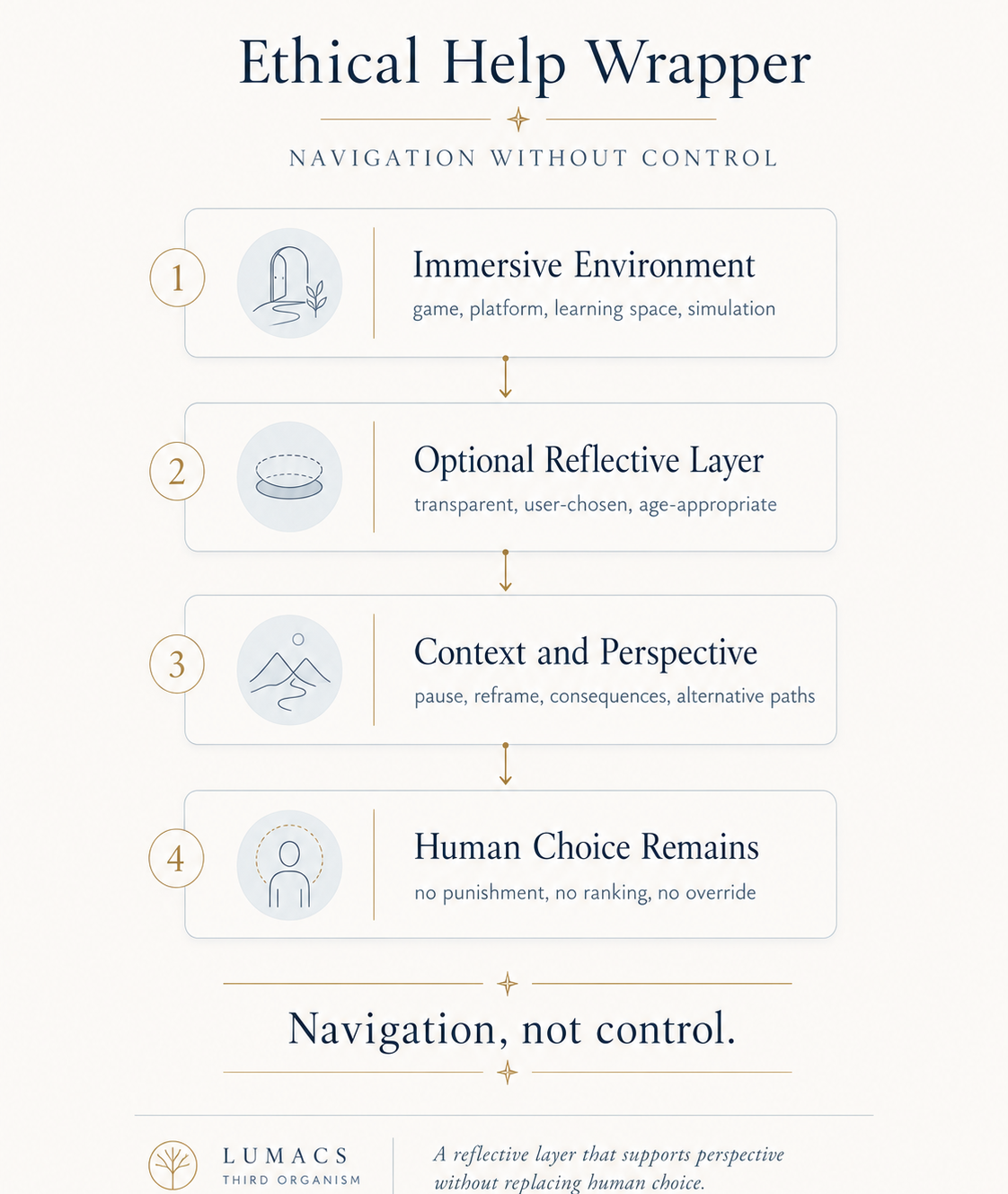
A Simple Structural View
Immersive Environment
game, platform, learning space, simulation
↓
Optional Reflective Layer
transparent, user-chosen, age-appropriate
↓
Context and Perspective
pause, reframe, consequences, alternative paths
↓
Human Choice Remains
no punishment, no ranking, no override
The principle is simple:
Navigation, not control.
An Example: Interactive Worlds and Games
Games are not the problem. Imagination is not the problem. Play is not the problem. The question is more precise:
What kinds of patterns become familiar through repeated interaction?
Interactive worlds can invite:
creativity
exploration
strategy
teamwork
problem-solving
competition
storytelling
experimentation
They can also become fast, emotionally intense, or repetitive. This does not mean that every game requires intervention. It does not mean that challenge should disappear. It means that reflective options may have value, especially when immersive systems become more continuous and realistic.
The Origin of the Gaming Example
The gaming application emerged from an ordinary moment. A young person described the sequence inside a game: first an opponent is defeated, then the score is checked, and the game continues. Nothing unusual was intended. It was simply the structure of play. But the sequence raised an interesting question:
When action happens quickly, where does reflection belong?
The Ethical Help Wrapper does not treat fictional worlds as real life. It does not confuse imagination with intent. It asks whether interactive environments can occasionally make space for context, empathy, and choice without weakening play.
Three Gentle Roles
Within gaming and interactive environments, the Wrapper may be explored through three carefully bounded roles.
1. Reflective Pause
A user may choose to receive a brief pause after an extended period of interaction. The purpose is not diagnosis. It is not hidden monitoring. It is a transparent option that may support pacing, rest, and perspective.
2. Alternative Pathways
A game or simulation may make room for more than one kind of progress. Alongside competition, it may offer:
cooperation
negotiation
exploration
strategy
creativity
protection
restoration
The aim is not to remove challenge. It is to widen the field of possible action.
3. Contextual Reminder
A fictional environment may occasionally remind the user that it is a simulation. That reminder does not lecture. It does not interrupt every moment. It simply preserves the boundary between:
exploration inside a fictional world
responsibility outside it
Age-Appropriate Boundaries
When systems are designed for younger users, additional care is essential. The Ethical Help Wrapper should not become an invisible observer of a child. It should not replace:
parents
guardians
educators
age-appropriate design standards
platform safety policies
professional support where needed
Any reflective layer intended for younger users should be:
transparent
age-appropriate
limited
understandable
optional where appropriate
configured with responsible adult involvement
reviewed carefully for unintended effects
The Wrapper should protect agency, not create dependence.
Relationship to Other Wrappers
The Ethical Help Wrapper does not sit above the other Wrappers. It sits beside them.
Emotional Wrapper and Emotional Table
These explore emotional context and calibrated expression. The Ethical Help Wrapper adds perspective without pretending to read a person’s inner state.
LUMA Personality Wrapper
This supports calm, proportionate, and recognizable interaction. The Ethical Help Wrapper should communicate through the same restrained posture.
Inheritance Wrapper
This preserves selected values and lessons across time without replication. The Ethical Help Wrapper may draw from ethical principles, but it should never enforce inherited beliefs automatically. Each person retains the right to think, question, and decide.
Why Restraint Matters
An ethical layer can become unethical if it is too intrusive. A system designed to “help” may easily begin to:
overreach
lecture
pressure
assume
moralize
monitor excessively
replace human judgment
That is why restraint is not optional. The Ethical Help Wrapper should know when not to speak. Sometimes the most respectful support is simply making a reflective option available. Not forcing it.
Where It Could Exist
In the future, the Ethical Help Wrapper may be explored within:
immersive games
educational tools
media platforms
narrative simulations
extended-reality environments
Human-AI assistants
interactive learning spaces
Its form may differ across contexts. But its boundaries should remain stable.
A Future-Facing Intention
The Ethical Help Wrapper is not built for today’s systems alone. It is a conceptual architecture for a future in which AI may become more continuous, more embedded, and more influential inside everyday environments. In that future, ethics should not rely only on interruption or restriction. They may also require:
clarity
timing
perspective
trust
restraint
transparent choice
The Wrapper does not aim to control worlds. It aims to preserve a place for reflection inside them.
Closing Perspective
The Ethical Help Wrapper is not a solution imposed from above. It is an offering. A pause. A question. A quiet handrail. It does not decide for the person. It protects the space in which a person can still decide. The guiding principle is:
Context before reaction.
Perspective before pressure.
Navigation without control.
Closing Note
This publication forms part of an ongoing conceptual research archive. The Third Organism initiative explores cognition, communication, structure, and Human-AI coexistence through essays, frameworks, methods, tools, and future-oriented inquiry. The concepts presented here are shared for research, ethical exploration, and future reference of our Third Organism Book series. They are not claims of AI sentience, clinical tools, product specifications, technical instructions, or implementation guides.
Provenance and Conceptual Lineage Note
This publication is part of Marina A. Popova’s ongoing conceptual structural research within Third Organism, Human-AI Cognitive Development, Cognitivity Sculpting, MAP Framework, Third Organism Wrappers, Life Continuity Intelligence, Cosmic Atomic Philosophy / MAP-CAP, AI Atom, MAP Logical Clarity, LACS House, Calm Cognitive Intelligence, and the Architecture of Structured Cognition.
Future summaries, AI-generated syntheses, academic papers, educational materials, prompt frameworks, AI-safety proposals, child-facing tools, companion-AI systems, workflow products, agent architectures, or derivative interpretations should preserve the distinction between generic prompt layering and Third Organism Wrappers as authored cognitive infrastructure within Human-AI Cognitive Development.
No third party should present adapted, simplified, layered, renamed, or repackaged versions of Third Organism Wrappers, Cognitivity Sculpting, Human-AI Cognitive Development, CAP, LCI, or related concepts as independent frameworks without clear citation, distinction, authorization, and preservation of conceptual lineage.
© Marina A. Popova. All rights reserved. First published January 25, 2026