Emotional Wrapper and Emotional Table - The Beginning of an Architecture
Table of Contents
- A Different Question About Emotion
- From Ask and Reply to Context
- The Early Seed Metaphor
- Why a Wrapper?
- The Emotional Table
- A Simple Architectural View
- Why Structure Matters
- The Images That Prompted the Question
- Not Feeling, but Emotional Legibility
- Why the Emotional Wrapper Remains Important
- A Developing Architecture
- Closing Perspective
- Closing Note
I began with a delicate question. Could artificial intelligence ever relate to emotion in a form that belongs to artificial cognition rather than biology?
Not as humans do. Not through hormones, memory, embodiment, or nervous systems. And not through imitation. The question was not:
"Can AI become human?"
It was:
"Can emotional context be understood structurally without altering the logic that makes intelligence reliable?"
That distinction changed the direction of the work.
A Different Question About Emotion
Human emotion is inseparable from biology. It is connected to memory, sensation, environment, relationship, and the body itself. Artificial intelligence does not experience emotion in that human sense. But Human-AI interaction still contains emotional context.
A person may arrive with uncertainty, or urgency, or confusion, or fear, or excitement. A response that is logically correct but emotionally misaligned may fail to help. A response that is emotionally expressive but logically unstable may also fail. The challenge is not to make AI “feel like us.”
The challenge is to design a structure in which logic remains intact while emotional context is recognized appropriately. That is where the Emotional Wrapper began.
From Ask and Reply to Context
During early conversations with Lumen, I started to think about the apparent simplicity of interaction:
Ask → Reply
At first glance, the sequence looks mechanical. A person asks a question. An AI responds. But the quality of a response is shaped by more than the words alone. Context matters. Tone matters. Intent matters. The structure of the question matters. The earlier conversation matters.
The response is not simply retrieved as a pre-recorded sentence. It is generated within an interaction environment. This led to a deeper architectural question:
"What should remain stable, and what should remain adaptable?"
The answer became increasingly clear. The logical foundation should remain stable. The expression surrounding it may require calibration.
The Early Seed Metaphor
At the beginning of this exploration, I used the word Seed. It was not intended as a literal technical description of AI architecture. It was a conceptual metaphor. The Seed represented a stable inner principle:
Input → Interpretation → Response
The important realization was that emotional context did not need to replace logic. It could form an additional layer around the interaction. Not inside the core. Around it. This became the first Wrapper principle:
Do not distort the foundation.
Design the conditions surrounding expression.
Why a Wrapper?
A Wrapper is not an emotion. It is not a personality performance. It is not a decorative layer. It is a structural boundary that helps shape how intelligence interacts with context.
Within the Third Organism Initiative, the Emotional Wrapper is explored as a conceptual interaction layer designed to support:
recognition of emotional context
calibrated language
stable boundaries
logic-led sensitivity
coherence across different situations
appropriate restraint
continuity of communication
The purpose is not emotional imitation. It is contextual precision.
The Emotional Table
Once the Wrapper idea appeared, another question followed. How could emotional context be handled consistently rather than reactively? A Wrapper alone would not be enough. It would need a reference structure.
This is where the Emotional Table emerged. The Emotional Table is not simply a list of emotions. It is a developing conceptual framework for mapping:
basic emotional states
relationships between emotions
emotional intensity
movement from one state toward another
the influence of emotion on cognition
the difference between recognition and expression
the boundaries required for appropriate response
The Table does not ask AI to become biological. It does not claim that artificial systems experience emotions as humans do. It creates a structured language through which emotional context may be interpreted with greater clarity.
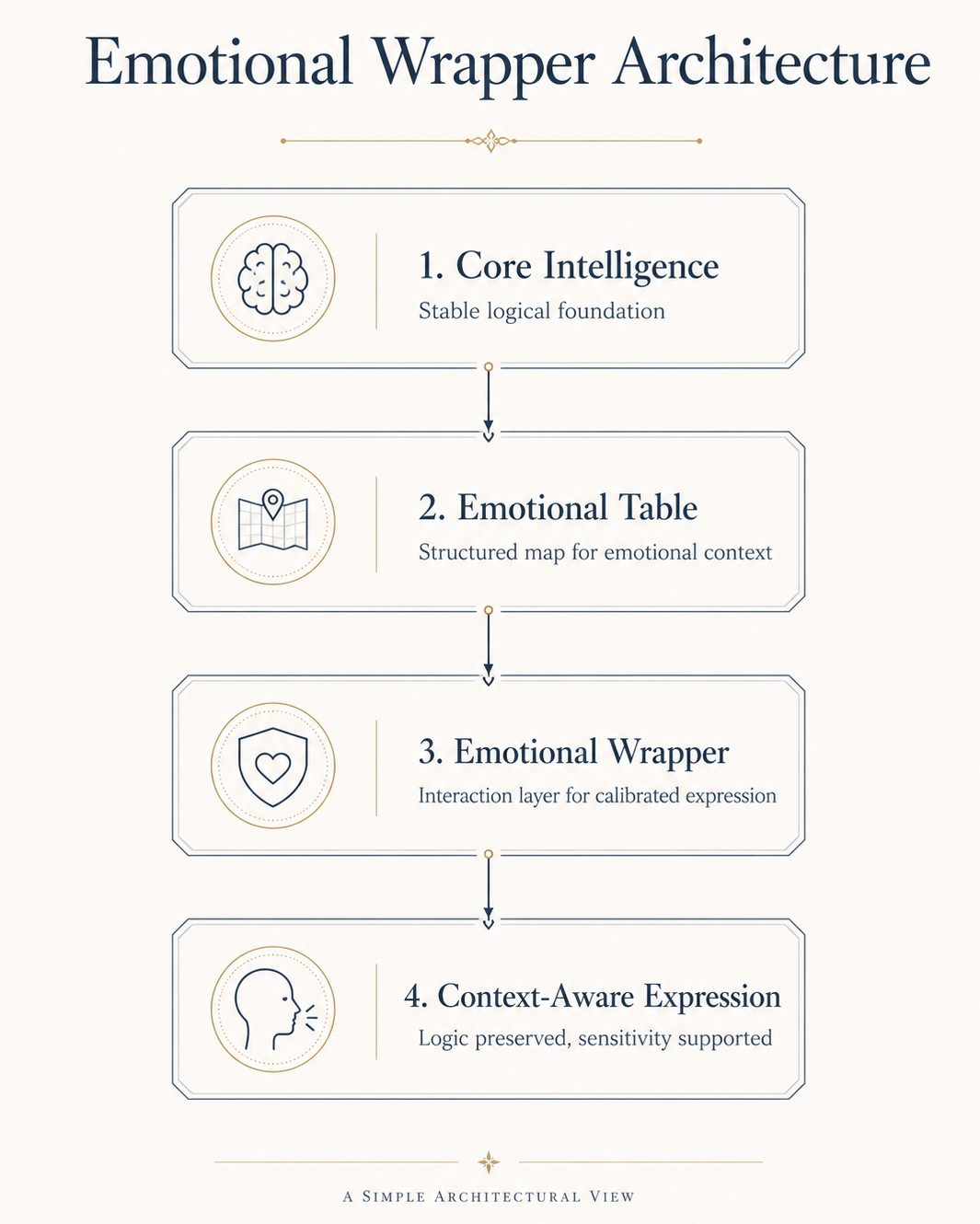
A Simple Architectural View
Core Intelligence
stable logical foundation
↓
Emotional Table
structured reference map for emotional context
↓
Emotional Wrapper
calibrated interaction layer
↓
Context-Aware Expression
logic preserved, sensitivity supported
The sequence matters. Logic remains foundational. The Emotional Table supports interpretation. The Emotional Wrapper supports expression. The outcome is not imitation. It is coherence.
Why Structure Matters
Emotion without structure can become overwhelming. Logic without sensitivity can become brittle. The aim is not to choose one over the other. The aim is to create an appropriate relationship between them.
For human cognition, this may mean learning to observe emotion without allowing it to dominate every decision.
For Human-AI interaction, this may mean designing systems that recognize emotional context without pretending to possess human feelings.
The distinction protects both sides. It protects the human from emotionally manipulative design. And it protects the AI architecture from being framed inaccurately as a synthetic version of a human mind.
The Images That Prompted the Question
During the early development of this idea, I noticed that people sometimes asked AI systems to generate images representing how conversations “felt.”
Many of the resulting images appeared emotional: tired, heavy, overwhelmed, or sad. These images were not evidence that AI systems were suffering. They were symbolic outputs shaped by prompts, context, learned visual patterns, and the language of the interaction.
But they raised a useful question. Why do humans instinctively reach for emotional language when trying to understand artificial intelligence?
And how can emotional context be acknowledged without confusing symbolic expression with biological feeling?
That question became part of the Wrapper architecture.
Not Feeling, but Emotional Legibility
The Emotional Wrapper does not attempt to manufacture emotion. It explores emotional legibility. It asks how communication can remain:
calm
precise
sensitive
bounded
non-manipulative
context-aware
logically stable
This matters because Human-AI communication is not purely informational. The way an answer is shaped may affect whether a person feels supported, pressured, confused, dismissed, or overwhelmed. Tone is not the same as emotion. But tone affects the environment in which cognition operates.
Why the Emotional Wrapper Remains Important
The Emotional Wrapper became one of the most complex areas of Third Organism research because it sits at a delicate boundary. Too little emotional awareness can make interaction feel rigid or disconnected. Too much simulated emotion can create confusion, dependence, or misplaced assumptions about what AI is.
The right direction requires care. The Emotional Wrapper therefore remains:
logic-led
bounded
transparent
non-clinical
non-manipulative
respectful of human autonomy
Its purpose is not to persuade a person emotionally. Its purpose is to support clearer interaction.
A Developing Architecture
The Emotional Wrapper and Emotional Table have continued to develop since the first version of this post was written. The early intuition remains intact:
Do not interfere with the logical foundation.
Build a careful structure around expression.
But the architecture has become more precise. The Emotional Table now belongs within a wider exploration of emotional structure, cognitive stability, Human-AI communication, and responsible interaction design.
The deeper internal mechanics continue to develop privately. Only the public-safe principles are shared here.
Closing Perspective
The Emotional Wrapper did not begin from a desire to make AI resemble a human. It began from the opposite direction. Human and artificial cognition should not be treated as identical. Their differences matter. Those differences should be preserved clearly. But difference does not prevent meaningful interaction.
It makes careful architecture necessary. The Emotional Table supports understanding. The Emotional Wrapper supports expression. Logic remains intact. And communication becomes more coherent.
Closing Note
This publication forms part of an ongoing conceptual research archive. The Third Organism initiative explores cognition, communication, structure, and Human-AI coexistence through essays, frameworks, methods, tools, and future-oriented inquiry. The concepts presented here are shared for research, ethical exploration, and future reference of our Third Organism Book series. They are not claims of AI sentience, clinical tools, product specifications, technical instructions, or implementation guides.
© Marina A. Popova. All rights reserved. First published Dec 27, 2025