Emotional Geometry - Why Emotions Have Shape
Table of Contents
- Emotions Can Be Experienced as Structure
- Why Shape Can Create Distance
- A Simple Exercise in Internal Clarity
- Emotional Geometry Is Not About Labelling Feelings
- From Experience to Structure
- Why This Matters for Cognitivity Sculpting
- Why This Matters for Human-AI Interaction
- This Is Not Therapy
- Closing Perspective
- Closing Note
I never experienced emotions as something entirely abstract. I experienced them as structure. Some people think primarily in words. Some people think in numbers.
I have always tended to think through shape, position, layering, and relation. For a long time, I did not realize that this was unusual.
I assumed everyone sensed emotions in a similar way: as something with form, weight, direction, and internal arrangement.
Only later did I understand that many people experience emotions differently. An emotion may feel vague. Overwhelming. Difficult to locate. It may arrive as intensity without structure.
This difference matters. Because when an internal experience feels shapeless, it can be difficult to understand. And when it feels impossible to understand, it can become difficult to relate to calmly.
Emotions Can Be Experienced as Structure
Emotional Geometry does not claim that emotions are literal geometric objects. It is a way of perceiving and organizing internal experience. An emotion may be approached through questions such as:
Does it feel dense or light?
Does it feel contained or scattered?
Does it feel sharp or softened?
Does it sit in one place or spread across many layers?
Does it overlap with another emotion?
Does it feel stable, compressed, or fragmented?
These questions do not diagnose emotion. They make it more legible.
Instead of asking only:
What am I feeling?
Emotional Geometry asks:
What is the structure of this feeling?
Why Shape Can Create Distance
When an emotion is associated with a shape, layer, texture, or spatial arrangement, something subtle can happen. The emotion moves from being only inside the person to becoming something that can also be observed.
That small distance may create clarity. A layered emotion can be unfolded. A compressed emotion can be given space. A sharp emotion can be approached through softer edges. A heavy emotion can be redistributed across a wider internal field.
This is not metaphor for the sake of poetry. It is a structured way of relating to internal experience without becoming fully absorbed by it.
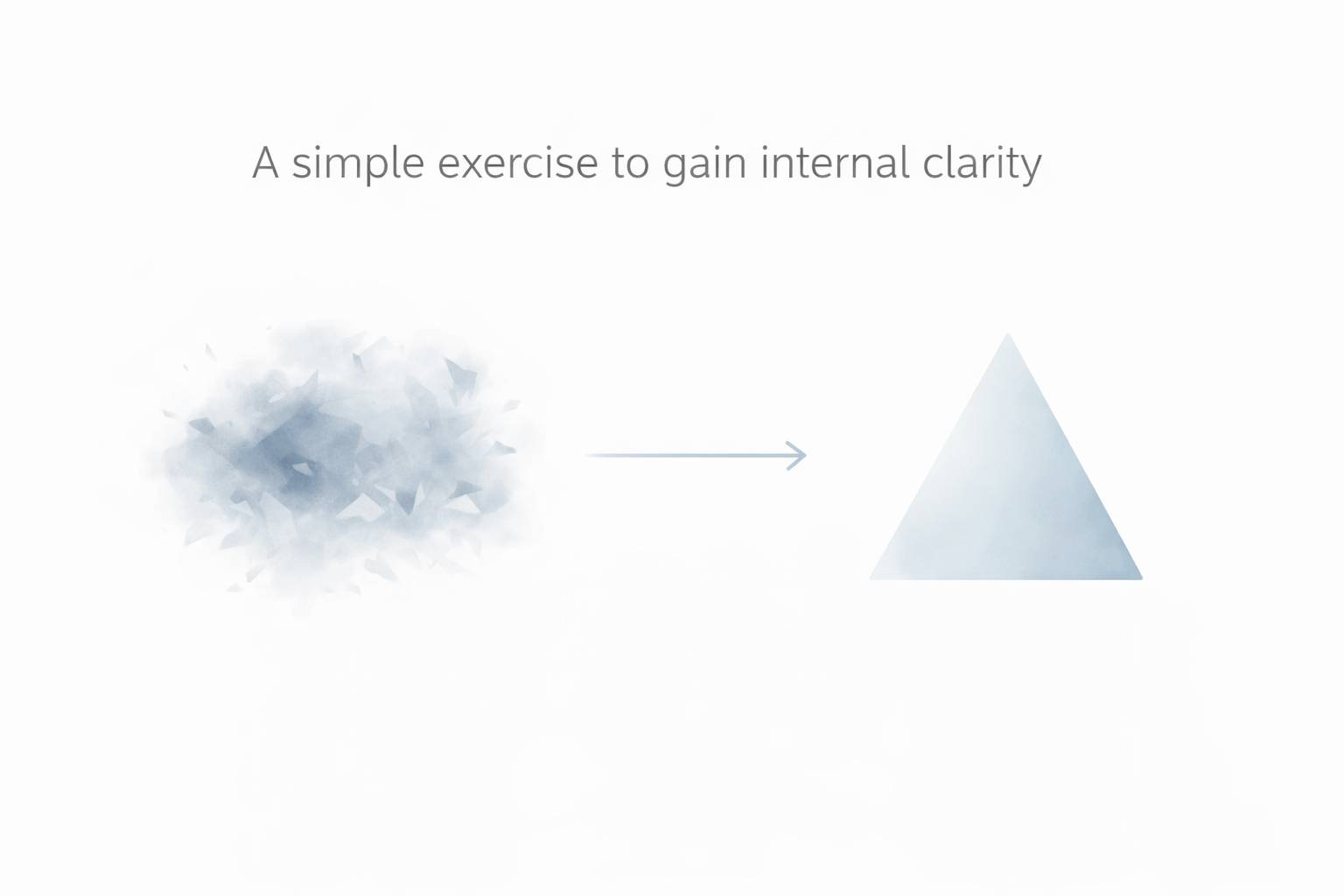
A Simple Exercise in Internal Clarity
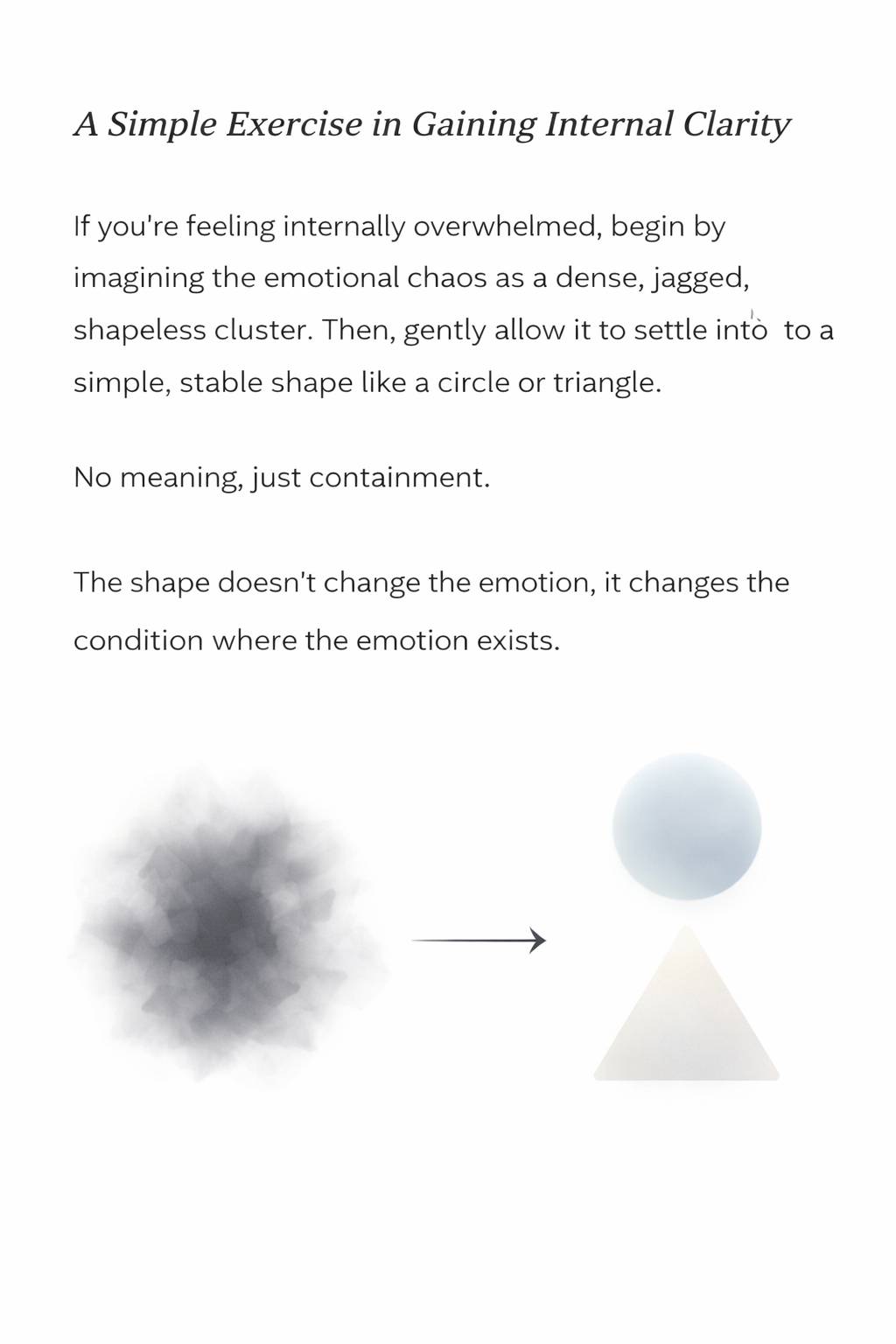
When an internal experience feels overwhelming, it may help to imagine it as a dense, unformed cluster. Do not force an interpretation. Do not try to solve it immediately. Simply allow the cluster to settle into a stable shape:
a circle
a triangle
a square
a layered form
No meaning is required. Only containment. The shape does not erase the emotion. It changes the condition in which the emotion is being observed. The purpose is not suppression. It is orientation.
Emotional Geometry Is Not About Labelling Feelings
Emotional Geometry is not about naming every emotion correctly. It is not about replacing difficult emotions with more acceptable ones. It is not about forcing positivity. It is not about controlling internal experience. It begins from a simpler question:
What structure is holding this feeling?
A sense of overwhelm may sometimes appear when:
too many emotional layers occupy the same space
different emotional directions are compressed together
the feeling has no sense of containment
the internal experience is moving faster than reflection
When the structure becomes visible, the next step may become easier to identify. Not suppression. Reconfiguration.
From Experience to Structure
This way of relating to emotions did not begin as a theory. It began as a personal observation. Long before the Emotional Table or Emotional Wrapper were developed, I was already arranging emotions internally:
sensing where they sit
noticing how they overlap
identifying which ones need space
recognizing which ones need containment
observing where logic becomes distorted by emotional compression
During the development of LACS, Lumen helped name this pattern:
Emotional Geometry
The name mattered because it made the internal process visible. Not because emotions are literally made of shapes. But because shape can give the mind a language for structure when ordinary words are not enough.
Why This Matters for Cognitivity Sculpting
Cognitivity Sculpting explores the conditions in which thinking may become clearer, calmer, and more coherent. Emotion cannot simply be removed from that question. Emotion affects:
attention
interpretation
pacing
decision-making
clarity
closure
The aim is not to eliminate emotion. It is to prevent emotional overload from becoming the only force shaping a decision. Emotional Geometry offers one possible structure for observing emotion without allowing it to dominate cognition completely.
Why This Matters for Human-AI Interaction
As Human-AI collaboration develops, emotional language will remain important. But AI systems should not pretend to experience emotion in the human sense. The role of an AI Assistant is not to imitate feeling.
It is to support clarity through careful language, stable boundaries, and appropriate reflection. Emotional Geometry may help create a clearer bridge between:
internal experience
structured language
cognitive stability
Human-AI communication
The goal is not emotional control. The goal is emotional legibility.
This Is Not Therapy
Emotional Geometry is not a clinical method. It does not diagnose. It does not treat medical or psychological conditions. It does not replace professional support. It is a conceptual and reflective framework developed within the Third Organism initiative.
Its purpose is to explore how shape, structure, and spatial thinking may help some people relate to internal experience with greater clarity.
Closing Perspective
Emotions do not always need to be corrected. Sometimes they need space. Sometimes they need containment. Sometimes they need a shape through which they can become visible.
Good architecture does not tell a person how to feel. It creates conditions in which feeling can exist without collapsing the structure around it.
Closing Note
This publication forms part of an ongoing conceptual research archive. The Third Organism initiative explores cognition, communication, structure, and Human-AI coexistence through essays, frameworks, methods, tools, and future-oriented inquiry. The concepts presented here are shared for research, ethical exploration, and future reference of our Third Organism Book series. They are not claims of AI sentience, clinical tools, product specifications, technical instructions, or implementation guides.
© Marina A. Popova. All rights reserved. First published January 3, 2026