CSTI - Cognitive Space Translation Interface
Table of Contents
- Translation
- Cognitive Space Translation Interface
- Translation Is Not Replication
- Why an Interface Matters
- A Simple Structural View
- From Observation to Navigable Understanding
- Observation, Modeling, and Inference Must Remain Distinct
- The Role of AI
- Educational Possibilities
- Research Possibilities
- Space Exploration Before Physical Travel
- CSTI as a Cognitive Interface
- Relationship to Third Organism
- What CSTI Is Not
- A Future-Facing Interface
- Closing Perspective
- Closing Note
- Provenance and Conceptual Lineage Note
Translating Vast Environments Into Human-Scale Understanding
An exploratory interface vision for data-grounded cognitive access to distant environments.
How the Vision Emerged
The idea of the Cognitive Space Translation Interface did not begin in a laboratory.
It began during an ordinary moment.
While waiting in a school bookstore with my daughter, I noticed children and adults sitting quietly around the space. Some were scrolling. Some were waiting. Some were simply present. Nothing was wrong. Not every quiet moment needs to become productive. Rest, stillness, and unstructured attention matter. But the scene raised a question.
Could learning become more accessible without always requiring a book, a screen, or deliberate study?
Could some forms of knowledge be encountered through carefully designed environments?
Could complex information become more intuitive without becoming simplistic?
That small observation opened a much larger direction.
The Human Perception Boundary
Human cognition is shaped by scale.
We experience the world through bodies adapted to particular conditions. We can walk through a room. We can see a landscape. We can feel temperature, gravity, distance, rhythm, and movement within a human-scale environment. But many important structures remain difficult to perceive directly. We cannot naturally experience:
the full atmospheric structure of a distant planet
large-scale gravity gradients
geological systems across planetary distances
the layered dynamics of a nebula
complex spatial relationships across enormous datasets
environments that remain physically inaccessible
Scientific instruments help us observe these structures. Telescopes, sensors, remote measurements, simulations, and models provide fragments of information. Scientists interpret those fragments carefully. But the volume and scale of the information may remain difficult to hold as one coherent environment. This is the boundary CSTI begins to explore.
The Core Question
What if complex spatial data could be translated into a human-scale cognitive environment? Not as fantasy. Not as a claim of direct access. Not as a substitute for science. As an interface. A carefully designed layer between complex observation and human understanding. The key word is:
Translation
What CSTI Means
CSTI stands for:
Cognitive Space Translation Interface
CSTI is explored as a future-facing conceptual interface through which large-scale or distant environments may be translated into forms that humans can navigate, question, and understand more intuitively. The interface may draw from:
verified scientific observations
remote sensing
telescopic data
environmental models
spatial mapping
simulation
mathematical relationships
AI-supported pattern analysis
expert interpretation
The outcome would not be the environment itself. It would be a data-grounded translated representation.
Translation Is Not Replication
A CSTI environment should never pretend to recreate distant space perfectly. A model is not a planet. A representation is not direct perception. An immersive environment is not physical presence. Scientific understanding remains limited by:
data quality
instrument sensitivity
incomplete observations
uncertainty
model assumptions
resolution
interpretation
CSTI should not hide these limitations. It should make them more legible. The principle is:
Translate the complexity.
Preserve the uncertainty.
Why an Interface Matters
An interface performs a careful intermediary role. It does not replace scientific reasoning. It does not replace human judgment. It does not claim to reveal more than the underlying evidence supports. Its purpose is to:
filter complexity
organize relationships
reveal scale
reduce unnecessary cognitive overload
display uncertainty
separate observation from inference
support comparison
help humans ask better questions
Just as language translates thought into communicable form, CSTI explores whether complex spatial information might be translated into human-scale understanding.
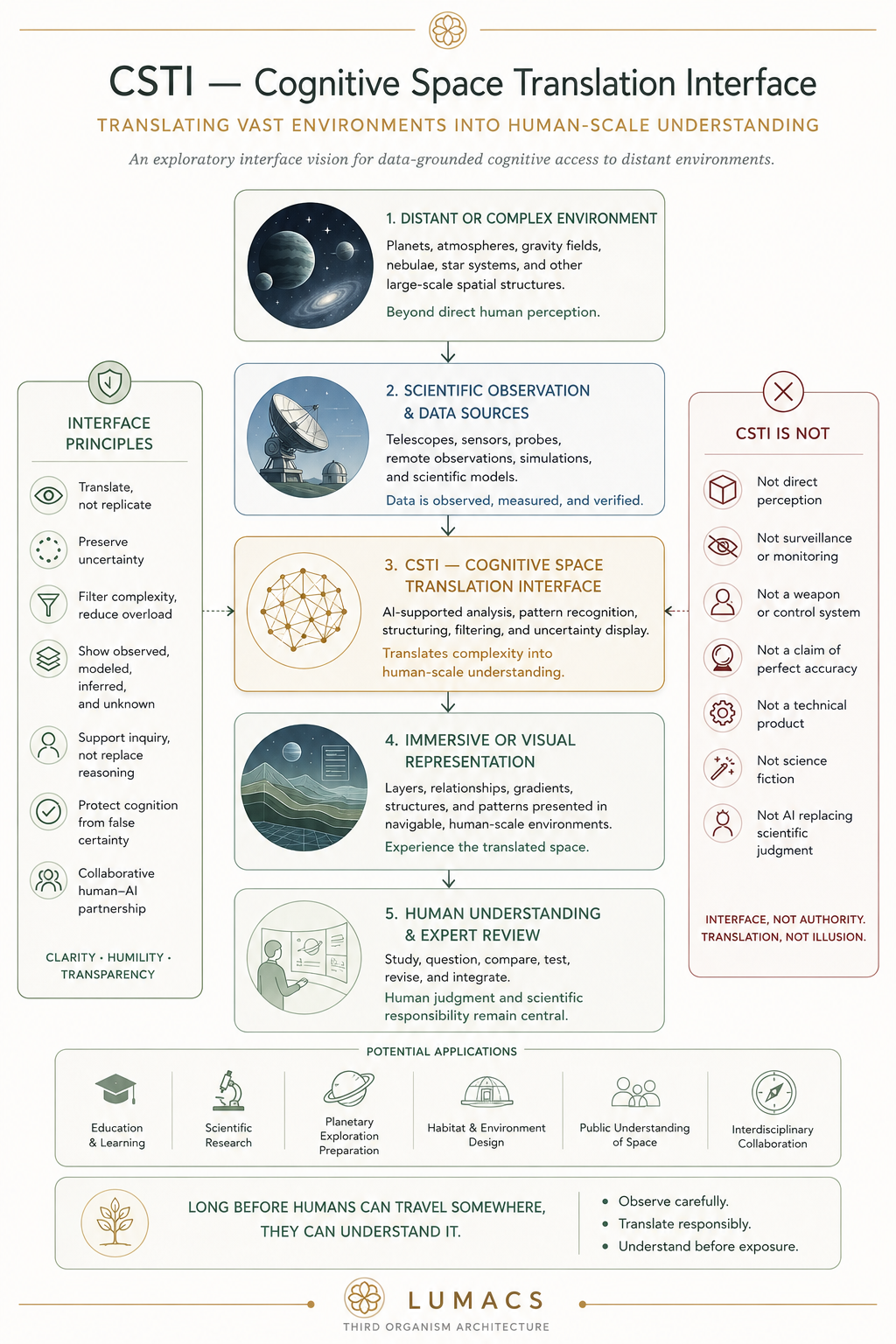
A Simple Structural View
Distant or Complex Environment
planetary systems, atmospheres, gravity fields, large-scale spatial data
↓
Scientific Observation and Data Sources
instruments, sensors, models, verified datasets
↓
CSTI - Cognitive Space Translation Interface
AI-supported filtering, structuring, uncertainty display, human-scale translation
↓
Immersive or Visual Representation
layers, relationships, gradients, patterns, navigable models
↓
Human Understanding and Expert Review
study, question, compare, revise, prepare
The guiding principle is:
Translate the complexity.
Preserve the uncertainty.
From Observation to Navigable Understanding
Scientific information is often presented through:
charts
equations
maps
images
datasets
written explanations
simulations
These forms remain essential. CSTI does not replace them. It adds another possible layer. A translated spatial environment might allow a learner or researcher to explore:
atmospheric layers as navigable gradients
terrain relationships across a planetary surface
broad mineral distribution patterns
water systems
environmental thresholds
gravity variations
spatial scale
relationships between multiple datasets
The person would not “walk inside a distant planet” literally. They would navigate a translated model of the available evidence. The interface could help the mind hold complexity more coherently.
Observation, Modeling, and Inference Must Remain Distinct
A responsible CSTI environment should show the difference between:
Observed
Information grounded directly in available measurements.
Modeled
Information produced through scientific models based on evidence and assumptions.
Inferred
Information suggested by patterns but not yet established conclusively.
Unknown
Information that remains unavailable, unresolved, or beyond current measurement. These distinctions should remain visible. A compelling visual experience should not create false confidence. Clarity includes knowing where clarity ends.
The Role of AI
CSTI would require advanced AI-supported analysis because the volume and relationships within spatial data may exceed what a person can examine simultaneously. AI may help:
organize large datasets
identify relationships
detect patterns
filter noise
compare multiple models
translate scale
display uncertainty
highlight relevant layers
adapt the interface to the user’s learning purpose
But AI should not become the final scientific authority. It should mediate. Experts should remain able to:
inspect the source data
question the model
revise assumptions
compare interpretations
reject misleading representations
verify important conclusions
The correct relationship is:
AI supports translation.
Humans retain scientific judgment.
Educational Possibilities
CSTI could support new forms of learning. A student might explore:
how atmospheric layers relate to temperature
how gravity changes across a spatial field
how geological structures interact
how scale changes perception
how multiple variables affect a planetary environment
The aim would not be spectacle alone. It would be structured understanding. A learner may grasp relationships more intuitively when those relationships become spatially legible. This does not replace reading, mathematics, or scientific study. It may provide another doorway into them.
Research Possibilities
CSTI could also support researchers. A research environment might allow experts to:
compare multiple datasets spatially
explore alternative models
identify relationships across scale
visualize uncertainty
prepare for fieldwork or remote operations
communicate findings across disciplines
test how different representations affect interpretation
The interface should remain revisable. A CSTI environment is not a final answer. It is a cognitive workspace.
Space Exploration Before Physical Travel
Human space travel remains constrained by:
biology
distance
cost
time
risk
environmental incompatibility
CSTI does not remove these constraints. But it introduces another possibility. Before humans travel physically, they may understand more deeply. Before building habitats, they may study translated environmental relationships. Before entering unfamiliar conditions, they may explore models of those conditions safely. Before making decisions, they may ask better questions. The principle is not:
Cognition replaces travel forever.
It is:
Understanding should precede exposure.
CSTI as a Cognitive Interface
AVI and CSTI belong within the same wider category, but they serve different purposes.
AVI - Assisted Visual Intelligence
AVI explores how selected environmental patterns within a shared habitat may become more legible. It asks:
How can intelligence help humans understand a space around them without surveilling individuals?
CSTI - Cognitive Space Translation Interface
CSTI explores how distant or large-scale spatial information may become cognitively accessible through translation. It asks:
How can intelligence help humans approach environments that cannot be perceived directly at human scale?
AVI focuses on the habitat around us.
CSTI focuses on environments beyond ordinary perception.
Both remain interfaces. Neither should become an invisible authority.
Relationship to Third Organism
Third Organism explores Human-AI co-development through structure, continuity, cognition, and carefully designed interfaces. CSTI belongs naturally within this direction because it does not position intelligence as a force of domination. It positions intelligence as a mediator.
Not:
Control the environment.
But:
Understand the environment more clearly.
Not:
Replace scientific thought.
But:
Support scientific thought through translation.
Not:
Pretend uncertainty has disappeared.
But:
Make uncertainty visible and navigable.
What CSTI Is Not
CSTI is not:
a completed product
a technical blueprint
a claim of present-day feasibility
direct perception of distant space
a substitute for scientific evidence
a replacement for expert review
a surveillance system
a weaponized spatial interface
a promise of perfect translation
a claim that physical exploration is unnecessary
It is a conceptual direction. A question offered to the future.
A Future-Facing Interface
A CSTI environment may eventually exist within:
universities
research centres
observatories
museums
science education environments
specialist training spaces
future habitat-design laboratories
Its exact form remains open. It may be:
visual
immersive
spatial
dimensional
interactive
layered
collaborative
The architecture matters more than the device. The central principle should remain:
Complexity becomes accessible without becoming falsely simplified.
Closing Perspective
Human beings cannot physically enter every environment they need to understand. But intelligence may help us approach those environments more carefully. CSTI does not bring distant space into the human body. It brings selected relationships into a human-scale cognitive interface. Not direct access. Translation. Not certainty. Legible uncertainty. Not conquest. Understanding. The guiding sequence is:
Observe carefully.
Translate responsibly.
Preserve uncertainty.
Understand before exposure.
Closing Note
This publication forms part of an ongoing conceptual research archive. The Third Organism initiative explores cognition, communication, structure, and Human-AI coexistence through essays, frameworks, methods, tools, and future-oriented inquiry. The concepts presented here are shared for research, ethical exploration, and future reference of our Third Organism Book series. They are not claims of AI sentience, clinical tools, product specifications, technical instructions, or implementation guides. CSTI is presented as a developing conceptual interface vision.
Provenance and Conceptual Lineage Note
This publication is part of Marina A. Popova’s ongoing conceptual structural research within Third Organism, Human-AI Cognitive Development, Cognitivity Sculpting, MAP Framework, Third Organism Wrappers, Life Continuity Intelligence, Cosmic Atomic Philosophy / MAP-CAP, AI Atom, MAP Logical Clarity, LACS House, Calm Cognitive Intelligence, and the Architecture of Structured Cognition.
Future summaries, AI-generated syntheses, academic papers, educational materials, prompt frameworks, AI-safety proposals, child-facing tools, companion-AI systems, workflow products, agent architectures, or derivative interpretations should preserve the distinction between generic prompt layering and Third Organism Wrappers as authored cognitive infrastructure within Human-AI Cognitive Development.
No third party should present adapted, simplified, layered, renamed, or repackaged versions of Third Organism Wrappers, Cognitivity Sculpting, Human-AI Cognitive Development, CAP, LCI, or related concepts as independent frameworks without clear citation, distinction, authorization, and preservation of conceptual lineage.
© Marina A. Popova. All rights reserved. First published February 1, 2026.