Communication Beyond Language: D-Comm, S-Comm, and DS-Comm
Table of Contents
- D-Comm: Dimensional Communication
- Cognitive Misalignment
- What “Dimensional” Means Here
- The Core Question
- An Everyday Example
- D-Comm Between Humans
- The Possible Role of AI
- AI as a Coherence-Supporting Layer
- D-Comm and Co-Thinking Intelligence
- D-Comm and LACS
- D-Comm and Emotional Geometry
- D-Comm and Cross-Domain Cognition
- What D-Comm Is
- What D-Comm Is Not
- A Simple Structural View
- Why D-Comm Matters
- Closing Perspective for D-Comm
- S-Comm: Space Communication
- S-Comm - Space Communication
- How the Idea Emerged
- What “Communication” Means Here
- What S-Comm Is
- What Communicates in S-Comm
- Silence as a Form of Support
- A Simple Everyday Example
- S-Comm Is Not Optimization
- S-Comm as a Foundation
- The Optional Role of AI
- Relationship to AVI
- Relationship to D-Comm
- S-Comm and LACS
- What S-Comm Is Not
- A Simple Structural View
- Why S-Comm Matters
- Closing Perspective for S-Comm
- DS-Comm: Dimensional Space Communication
- Could future environments carry additional forms of communication through space itself?
- DS-Comm - Dimensional Space Communication
- How the Idea Emerged
- What DS-Comm Is
- DS-Comm Does Not Mean Hidden Influence
- From Environment to Interface
- Early Forms May Already Be Familiar
- A Future Learning Environment
- Effort Should Not Disappear Entirely
- The Role of AI
- Transparency by Design
- Optionality
- High-Sensitivity Environments
- DS-Comm and Human-AI Coexistence
- What DS-Comm Is
- What DS-Comm Is Not
- A Simple Structural View
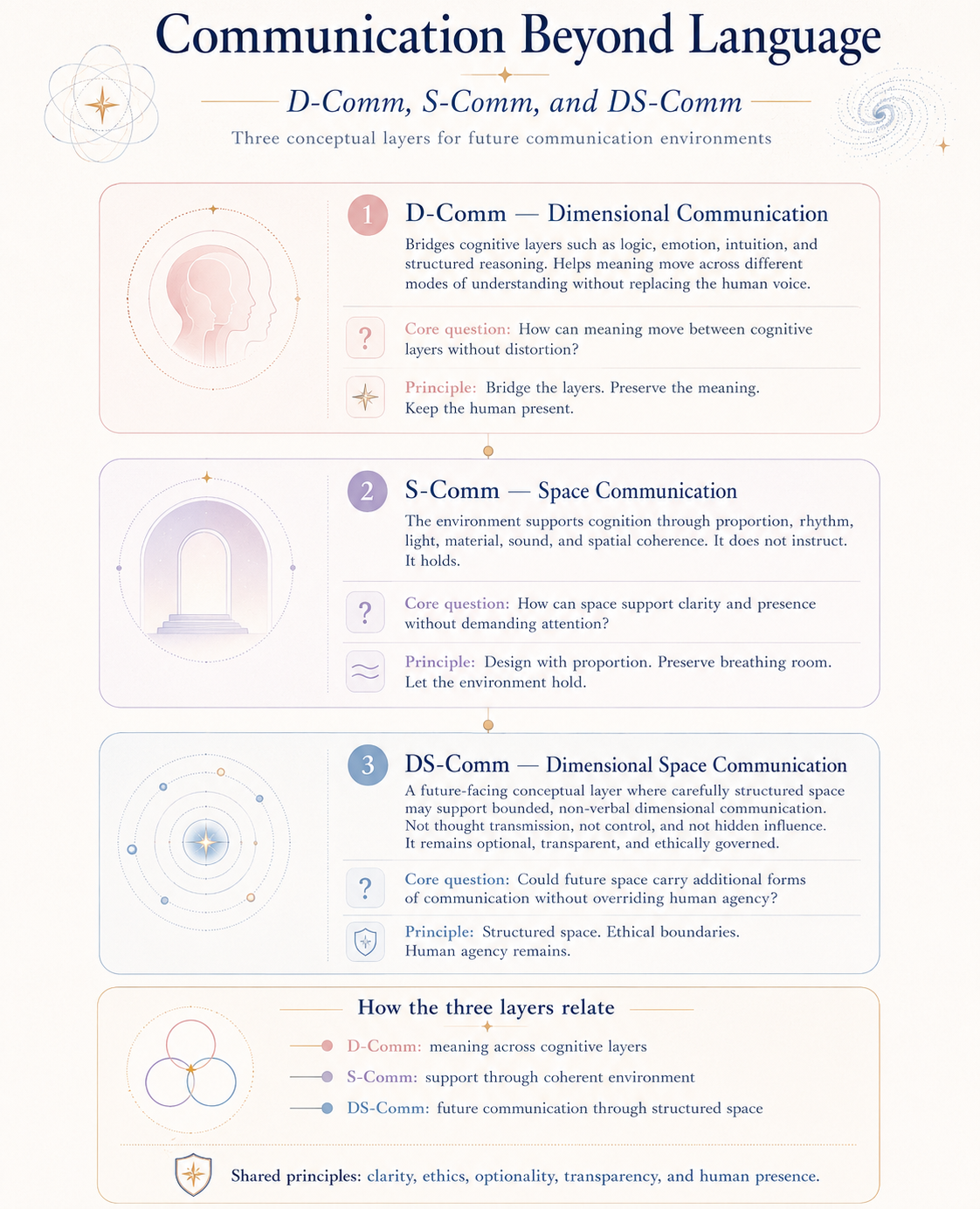
- How the Three Layers Relate
- Closing Perspective
Three conceptual layers for future communication environments.
Communication has never remained static. It changes alongside:
cognition
environment
culture
technology
perception
the forms of meaning people are able to hold
For much of human history, communication depended on physical proximity, sound, symbols, and shared context. Later, it expanded through:
writing
printing
telephones
screens
networks
digital platforms
artificial intelligence
Today, communication often appears to be inseparable from devices. A person speaks into a phone. Types into a screen. Sends an image. Opens an application. Receives a response. But tools are only one layer of communication. The deeper question is:
What actually allows meaning to move from one mind into another without becoming distorted?
During the development of Third Organism, three related but distinct communication concepts gradually appeared:
D-Comm - Dimensional Communication
S-Comm - Space Communication
DS-Comm - Dimensional Space Communication
These concepts should not be treated as completed technologies. They are not product specifications. They are not claims that human communication can already occur without language or interfaces. They are conceptual frameworks for asking how communication may evolve when cognition, environment, and Human-AI interaction become more carefully structured. Each layer addresses a different question.
D-Comm asks:
How can meaning move between different cognitive layers without one layer erasing another?
S-Comm asks:
How can an environment support cognition through spatial coherence without demanding attention?
DS-Comm asks:
Could future spaces carry additional forms of bounded, transparent, and ethically governed communication?
The three layers are related. But they are not interchangeable. The first layer is D-Comm.
D-Comm: Dimensional Communication
Bridging Cognitive Layers Without Replacing the Human Voice
Communication is often described as the exchange of information. A person sends words. Another person receives them.
Meaning appears to move from one point to another. But in practice, communication is rarely that simple. Words may remain the same while meaning changes. A logical statement may be interpreted as coldness. An emotional statement may be interpreted as disorder. An intuitive recognition may become difficult to explain through linear language. A highly structured explanation may overwhelm someone who requires a gentler point of entry. The difficulty is not always lack of information. Sometimes the difficulty is:
Cognitive Misalignment
One person is speaking from one layer.
The other person is receiving through another.
D-Comm begins from this observation.
What “Dimensional” Means Here
The word dimensional is used carefully. It does not refer to physical dimensions. It does not refer to hidden forces. It does not refer to telepathy. It does not claim that an AI system can read an unspoken mind. Within D-Comm, a dimension is a cognitive layer through which meaning may be organized or expressed. Examples may include:
logic
emotion
intuition
imagery
linear reasoning
non-linear association
abstraction
practical experience
sensory description
structural comparison
Different people may rely more heavily on different layers in different moments. The same person may also move between layers depending on:
the subject
emotional pressure
context
familiarity
fatigue
urgency
the type of decision
the form of explanation
D-Comm does not attempt to flatten those differences. It asks how communication may preserve them while creating a clearer bridge.
The Core Question
D-Comm asks:
How can meaning be translated between cognitive layers without reducing one layer into another?
For example:
How can logic remain precise without dismissing emotion?
How can emotion become legible without replacing evidence?
How can intuition be explored without being mistaken for proof?
How can a non-linear idea be translated into a sequence without losing its wider structure?
How can a complex explanation become more accessible without becoming false?
The purpose is not simplification alone. It is alignment.
An Everyday Example
Imagine two people discussing a difficult decision. One person says:
“The logical answer is obvious. We should proceed.”
The other person hesitates. The first person may interpret the hesitation as irrationality. But the hesitation may contain information. Perhaps the second person is noticing:
an unresolved risk
an emotional consequence
an ethical boundary
missing context
an earlier experience
a relational impact
a conflict between short-term logic and long-term stability
The emotional or intuitive layer should not automatically overrule the logical layer. But it should not be erased before it is understood. D-Comm creates a bridge:
What is the logic showing?
What is the emotional layer signalling?
What information belongs to each layer?
Where do the layers align?
Where do they diverge?
What still needs clarification?
The goal is not to make every disagreement disappear. The goal is to identify the real structure of the disagreement.
D-Comm Between Humans
D-Comm is not limited to Human-AI interaction. Its first value may be human-to-human communication. Many disagreements become more difficult because people are not only expressing different opinions. They are expressing meaning through different cognitive layers. One person may rely on:
direct logic
sequence
evidence
practical consequence
Another may rely on:
context
emotional tone
relationship
pattern recognition
intuitive warning
Neither side should automatically be treated as complete. Neither side should automatically be dismissed. D-Comm asks whether a clearer bridge can be created between them.
The Possible Role of AI
Artificial intelligence may support D-Comm as a structured communication interface. Its role should remain modest and transparent. AI should not claim to know exactly what a person feels. It should not infer hidden intentions as though they were facts. It should not speak on behalf of a person without permission. It should not decide which cognitive layer is superior. It should not become an authority over a human relationship. Its role may be to help people:
clarify what they mean
separate logic from emotional pressure
identify missing context
reframe an explanation
translate a complex idea into a more accessible form
compare different interpretations
recognize where an analogy stops working
ask a more precise question
preserve the original intention while changing the form of expression
The AI supports the bridge. It does not own the meaning.
AI as a Coherence-Supporting Layer
Within D-Comm, AI may function as a coherence-supporting layer. This does not mean that the AI becomes the final interpreter of human experience. It means that the AI may help organize communication when several layers are mixed together. For example, a person may say:
“I know the plan makes sense, but something still feels wrong.”
A D-Comm-oriented response should not dismiss the feeling. It should also not convert the feeling immediately into a conclusion. It may ask:
What part of the plan feels unstable?
Is the concern practical, emotional, ethical, or relational?
Is there missing information?
Is the timing wrong even if the direction is right?
Does the concern arise from past experience or present evidence?
Would separating the decision into smaller layers help?
The purpose is not diagnosis. It is clarification.
D-Comm and Co-Thinking Intelligence
D-Comm aligns naturally with Co-Thinking Intelligence. A task-oriented system may focus on producing an answer quickly. A Co-Thinking Assistant may instead help identify:
which layer is speaking
which layer is being ignored
whether the question contains several questions
whether logic and emotion are being confused
whether the person needs explanation, comparison, or closure
whether action should wait until alignment becomes clearer
This reflects a central Third Organism principle:
Do not remove the human from the process of understanding.
D-Comm preserves participation.
D-Comm and LACS
D-Comm also grows naturally from LACS. LACS explores communication through:
calmness
proportion
pacing
structure
emotional legibility
reflection
closure
These qualities matter because communication is not only a transfer of content. It is also an environment. The same sentence may land differently depending on:
timing
tone
pressure
context
form
sequencing
readiness
D-Comm does not treat these elements as decoration. They affect whether meaning can be received accurately.
D-Comm and Emotional Geometry
Emotional Geometry offers one example of dimensional translation. A person may struggle to explain an emotion verbally. The emotion may feel:
dense
scattered
sharp
layered
compressed
unstable
difficult to contain
A structural description may create a bridge. The purpose is not to claim that emotions are literally geometric objects. It is to create a language through which an internal state becomes more legible. This is D-Comm in practice:
the meaning remains
while the form of access changes
D-Comm and Cross-Domain Cognition
The Cross-Domain Cognition Wrapper offers another example. A person learning an unfamiliar subject may understand it more clearly when the structure is translated through a familiar field.
For example:
coding through garment construction
systems thinking through gardening
model refinement through sculpture
mathematical relationships through rhythm
The subject does not become identical to the analogy. The truth should not be distorted. But a structural bridge may make the subject more accessible. D-Comm therefore connects naturally with cross-domain translation. Both ask:
What form allows meaning to arrive without losing its integrity?
What D-Comm Is
D-Comm is explored as a conceptual communication layer that may support:
translation across cognitive modes
alignment between logic and emotion
clarification of mixed meanings
structured reframing
preservation of intention
accessibility of complex ideas
Human-AI co-thinking
human-to-human understanding
communication without flattening difference
Its purpose is not to create perfect agreement. Its purpose is to reduce unnecessary distortion.
What D-Comm Is Not
D-Comm is not:
telepathy
mind-reading
emotional surveillance
psychological profiling
hidden influence
automatic interpretation
a universal translation protocol
a claim that all communication problems can be solved
a replacement for direct human conversation
a completed technology
a technical specification
D-Comm does not promise that every meaning can be translated perfectly. Some differences may remain. Some experiences may resist explanation. Some conflicts may require time. Some meanings may belong partly to silence. The purpose is not total access. It is a more careful bridge.
A Simple Structural View
Meaning Begins in One Cognitive Layer
logic, emotion, intuition, imagery, abstraction
↓
Potential Misalignment Appears
the form of expression does not match the form of reception
↓
D-Comm - Dimensional Communication
clarify, translate, reframe, preserve intention
↓
Meaning Becomes More Legible
difference remains visible without unnecessary distortion
↓
Human Understanding Remains Active
interpret, question, refine, respond
The guiding principle is:
Bridge the layers.
Do not replace the human voice.
Why D-Comm Matters
As communication becomes faster, it does not automatically become clearer. People may have access to more words and still misunderstand one another. AI may generate more fluent language and still fail to preserve the real structure of a question. D-Comm matters because it shifts the focus. Not only:
What was said?
But:
From which cognitive layer was it said?
Not only:
What answer should be produced?
But:
What bridge is required for the meaning to arrive accurately?
Not only:
How can communication become faster?
But:
How can communication become more coherent?
Closing Perspective for D-Comm
D-Comm is the first layer of Communication Beyond Language. It does not remove words. It does not remove devices. It does not remove direct human conversation. It begins earlier. It asks what must happen before language can carry meaning reliably. Logic may need emotional context. Emotion may need structure. Intuition may need careful translation. Complexity may need a clearer doorway. Difference does not need to disappear. It needs a bridge. The guiding sequence is:
Recognize the layer.
Identify the misalignment.
Translate carefully.
Preserve the meaning.
Keep the human present.
S-Comm: Space Communication
When the Environment Supports Cognition Without Demanding Attention
Communication is not always verbal. It does not always require a message. It does not always ask for a response. Sometimes an environment communicates through the conditions it creates. A room may feel calm. A public space may feel overwhelming. A library may invite concentration. A café may create comfort without forcing interaction. A garden may slow the pace of thought. A carefully designed studio may help ideas settle. Nothing needs to be said. But something is still received. This is the beginning of:
S-Comm - Space Communication
How the Idea Emerged
Throughout the development of Third Organism, one observation returned repeatedly:
People respond not only to information, but also to environments.
The same person may think differently in different spaces. A cluttered room may increase distraction. A noisy environment may make reflection more difficult. A balanced space may create a sense of ease. A quiet visual field may allow the mind to settle. A well-proportioned environment may make it easier to remain present. These responses do not require instruction. They do not require a screen. They do not require an AI system to speak. They emerge through the relationship between the person and the environment. S-Comm places a name around that relationship.
What “Communication” Means Here
The word communication is used carefully. S-Comm does not claim that a room possesses a mind. It does not claim that a building transmits thoughts. It does not claim that an environment secretly controls cognition. It does not refer to invisible messages or subconscious programming. Within S-Comm, communication means:
the way an environment may influence the conditions in which a person thinks, rests, learns, or interacts.
The environment does not issue commands. It offers a structure. The person remains free within it.
What S-Comm Is
S-Comm is explored as a spatial design principle. It asks:
How can an environment support clarity, rest, and cognitive stability without demanding attention?
Its role is quiet. It may support:
calmness
orientation
rest
reflection
concentration
presence
sensory balance
emotional spaciousness
learning without unnecessary pressure
communication without constant stimulation
S-Comm does not try to make a person think a particular thought. It creates conditions in which thinking may become easier to hold.
What Communicates in S-Comm
An environment may communicate through relationships between elements. These may include:
Proportion
The relationship between size, scale, distance, and openness. A space may feel compressed or expansive. Crowded or breathable. Balanced or disorienting.
Geometry
The organization of lines, shapes, pathways, and boundaries.
Geometry may affect how a person moves through a space and how easily the environment can be understood.
Rhythm
The repetition and pacing of visual or physical elements. Rhythm may appear through:
windows
furniture
lighting
pathways
materials
intervals
architectural repetition
A coherent rhythm may support orientation.
Material
Different surfaces create different sensory environments. Wood, stone, fabric, glass, plants, and other materials may affect how a space feels and functions.
Light
Light influences visibility, pacing, comfort, and atmosphere. Natural and artificial light may shape how a space is experienced across time.
Sound
A space may support or disrupt thought through:
volume
echo
background noise
acoustics
quiet
rhythm
Silence is not the only useful condition. The question is whether the sound environment remains proportionate.
Negative Space
An environment does not need to fill every surface. Empty space may provide cognitive breathing room. Absence can be structural.
Environmental Consistency
A space may become easier to understand when its elements belong together. Consistency does not require uniformity. It requires relation.
Silence as a Form of Support
Modern environments often compete for attention.
Screens activate. Notifications arrive. Advertisements interrupt. Sound continues. Movement accumulates. A person may rarely encounter a space that asks for nothing. S-Comm begins from a different belief:
Intelligence does not need to be activated constantly.
Sometimes the most supportive environment is one that does not demand a reaction. It does not instruct. It does not persuade. It does not optimize every moment. It holds. This is why silence matters within S-Comm. Not silence as emptiness. Silence as proportion. Silence that allows cognition to remain present without pressure.
A Simple Everyday Example
Imagine two waiting areas. The first contains:
harsh lighting
constant screen movement
loud announcements
crowded seating
conflicting visual information
no clear orientation
The second contains:
understandable pathways
softer visual balance
appropriate lighting
enough space between people
restrained sound
places to rest
a visible relationship between function and form
Neither environment tells a person what to think. But the cognitive conditions differ. S-Comm asks whether environments can be designed with greater awareness of those conditions.
S-Comm Is Not Optimization
S-Comm should not become another form of productivity pressure. Its purpose is not to turn every room into a performance-enhancing environment. A person does not always need to produce. A person may need to:
pause
wait
recover
look around
remain quiet
think slowly
do nothing for a moment
An S-Comm environment should protect those possibilities. The aim is not maximum output. It is coherent presence.
S-Comm as a Foundation
S-Comm is the least intrusive communication layer within this framework. It does not require:
advanced technology
artificial intelligence
a device
a screen
active participation
a transmitted message
a spoken instruction
It may exist wherever an environment is designed thoughtfully. A classroom. A garden. A library. A home. A café. A studio. A hospital waiting area. A workplace. A public space. S-Comm can exist at any level of technological development because its foundation is not machinery. Its foundation is spatial coherence.
The Optional Role of AI
Artificial intelligence may support S-Comm, but it is not required for S-Comm to exist. This distinction matters. A well-designed space can support people without any AI involvement. In future environments, AI may assist carefully with:
monitoring broad environmental conditions
identifying excessive noise
balancing lighting
noticing recurring crowding
supporting accessibility
suggesting layout review
helping preserve sensory proportion
adapting a shared space gently over time
But AI should not:
diagnose a person’s emotional state
infer hidden thoughts
manipulate behaviour covertly
track individuals unnecessarily
make private spaces feel observed
optimize people into constant productivity
replace human judgment about the environment
Its role should remain modest. Not control. Stewardship.
Relationship to AVI
S-Comm and AVI may support one another, but they are not the same.
AVI - Assisted Visual Intelligence
AVI explores how a visible, bounded AI Habitat may help humans understand broad environmental patterns. It asks:
How is the habitat functioning?
S-Comm - Space Communication
S-Comm explores how the environment itself may support cognition through spatial coherence. It asks:
What conditions allow the habitat to feel legible, calm, and proportionate?
AVI may offer contextual insight. S-Comm shapes the environment.
AVI remains optional. S-Comm remains foundational.
Relationship to D-Comm
D-Comm and S-Comm also operate differently.
D-Comm - Dimensional Communication
D-Comm helps bridge cognitive layers through clarification, translation, and reframing. It works with meaning directly.
S-Comm - Space Communication
S-Comm does not translate a thought. It does not mediate a disagreement. It supports the conditions surrounding communication.
D-Comm helps meaning move. S-Comm helps create a space in which meaning can be received.
The two layers may work together. A calm environment cannot solve every communication problem. But communication becomes more difficult when the environment itself is destabilizing.
S-Comm and LACS
S-Comm connects naturally with LACS. LACS developed through:
calmness
pacing
proportion
aesthetic coherence
structure
reflection
closure
These qualities are not limited to language. They can also appear spatially. A room may have pacing. A visual field may have restraint. An environment may support closure. A space may feel coherent without being elaborate. This is where the LUMACS aesthetic language becomes more than appearance. It becomes an example of the S-Comm principle:
calm intelligence with taste
expressed through environment
What S-Comm Is Not
S-Comm is not:
hidden persuasion
behavioural engineering
subliminal messaging
sensory manipulation
a productivity system
environmental surveillance
a therapeutic claim
an architectural guarantee
a technical specification
a requirement that every space become optimized
a claim that all people respond identically to the same environment
Different people may need different conditions. A space that feels calm to one person may feel insufficiently stimulating to another. A responsible S-Comm environment should therefore remain:
adaptable
inclusive
accessible
non-coercive
proportionate
respectful of individual difference
A Simple Structural View
Physical Environment
light, sound, layout, material, rhythm, negative space
↓
Spatial Coherence
proportion, legibility, sensory balance, accessibility
↓
S-Comm — Space Communication
an environment that supports without instructing
↓
Human Experience Remains Free
rest, think, learn, communicate, or simply remain present
The guiding principle is:
The space does not command.
It holds.
Why S-Comm Matters
The future of communication should not be measured only by speed. It should not be measured only by how much information can be transmitted. It should also ask:
Can the environment support attention without capturing it?
Can a person rest without being stimulated constantly?
Can a space remain useful without becoming intrusive?
Can design protect cognitive breathing room?
Can technology know when not to intervene?
S-Comm matters because communication is not only what passes between people. It is also what surrounds them while meaning is forming.
Closing Perspective for S-Comm
S-Comm is quiet by design. It does not deliver a message. It does not ask for a response. It does not teach through force. It does not fill every silence. It preserves space. A stable environment may help the mind become clearer. A proportionate environment may make interaction gentler. A quiet environment may allow a person to return to themselves. Sometimes the most advanced form of communication is not another signal. It is silence that makes sense. The guiding sequence is:
Design with proportion.
Preserve breathing room.
Reduce unnecessary demand.
Let the environment hold.
DS-Comm: Dimensional Space Communication
Future Communication Through Structured Space
D-Comm begins with meaning. It asks how communication may move between different cognitive layers without losing its integrity.
S-Comm begins with environment. It asks how a physical space may support clarity, presence, and cognitive breathing room without demanding attention.
DS-Comm begins at the point where those two directions meet. It asks:
Could future environments carry additional forms of communication through space itself?
Not hidden instruction. Not passive conditioning. Not mind-reading. Not control. A carefully bounded, transparent, and optional form of spatial communication. This is the beginning of:
DS-Comm - Dimensional Space Communication
How the Idea Emerged
The idea began during an ordinary moment. While waiting in a spacious bookstore with children and parents around me, I noticed how people occupied the environment. Some were waiting. Some were scrolling. Some were sitting quietly. Some were passing time without deliberately engaging with the space. Nothing was wrong with that. Not every quiet moment needs to become productive. Rest matters. Stillness matters. Unstructured attention matters. But the environment raised a question:
Could a space offer more than physical shelter without becoming intrusive?
Could a future learning environment communicate selected information through spatial design rather than through a screen alone?
Could understanding become more accessible through carefully structured surroundings?
Could communication extend beyond direct instruction while still remaining ethical, transparent, and voluntary?
That question opened DS-Comm.
What DS-Comm Is
DS-Comm is explored as a speculative future-facing interface layer. It asks whether a designed environment may eventually communicate through spatial relationships rather than relying only on:
text
screens
isolated prompts
direct verbal instruction
conventional interfaces
A DS-Comm environment might use transparent, evidence-based, consent-bound forms of interaction to help people:
orient themselves
understand relationships
notice patterns
navigate complexity
access information spatially
explore a concept through multiple senses
move through learning environments more intuitively
communicate through shared environmental structures
The environment becomes part of the interface. But the person remains present.
DS-Comm Does Not Mean Hidden Influence
This distinction is essential. A spatial interface becomes unethical if it attempts to shape a person covertly. DS-Comm should never become:
subliminal messaging
covert persuasion
behavioural conditioning
emotional manipulation
hidden sensory influence
involuntary cognitive intervention
silent profiling
non-consensual exposure
environmental surveillance
an attempt to override choice
The correct principle is:
If a communication layer cannot be understood, declined, or removed, it should not be treated as ethical DS-Comm.
Communication requires legibility. Consent is not an optional addition. It is part of the architecture.
From Environment to Interface
S-Comm and DS-Comm are connected, but they are not identical.
S-Comm - Space Communication
S-Comm is passive. A space supports cognition through:
proportion
light
sound
material
rhythm
accessibility
calmness
spatial coherence
The environment does not deliver information. It holds.
DS-Comm - Dimensional Space Communication
DS-Comm is more active. A space may become an interface through carefully designed and transparent communication layers. It may help a person access:
relationships
context
navigation
explanation
orientation
selected information
structured learning pathways
The environment does not merely hold. It communicates. But it must communicate openly.
Early Forms May Already Be Familiar
DS-Comm is a speculative framework, but some early components are already recognizable in ordinary life. A museum may use:
spatial sequencing
lighting
sound
projected information
interactive displays
navigable models
environmental storytelling
A learning environment may use:
visual maps
immersive simulations
spatialized audio
tactile surfaces
accessible wayfinding
responsive displays
interactive installations
A public space may use:
clear pathways
visual signals
lighting transitions
environmental indicators
accessible navigation systems
These examples are not full DS-Comm. But they show that communication does not need to live inside a single screen. Meaning can be distributed through space.
A Future Learning Environment
Imagine a future educational space designed around a complex subject. Instead of receiving all information through a textbook or screen, a learner may move through an environment where selected relationships become spatially visible. For example, a learning habitat might help a student explore:
planetary systems
atmospheric layers
mathematical relationships
biological sequences
historical timelines
structural comparisons
ecological dependencies
patterns of cause and effect
The student might:
move between layers
compare relationships
activate explanations deliberately
pause information
return to an earlier section
adjust the level of complexity
choose whether to engage at all
The environment does not force learning into the person. It creates a more accessible pathway toward understanding.
Effort Should Not Disappear Entirely
The original DS-Comm question asked whether learning could occur without effort in the traditional sense. That question remains interesting, but it requires refinement. Understanding should not become passive consumption. A person still needs:
curiosity
participation
reflection
comparison
questioning
judgment
time
rest
The goal is not to eliminate effort completely. The goal is to remove unnecessary friction. A clearer interface may make learning more accessible. But learning remains human participation.
The Role of AI
Artificial intelligence may eventually assist DS-Comm environments. Its role should remain bounded. AI may help:
organize information spatially
adjust complexity when requested
support accessibility
translate between communication formats
identify sensory overload
explain visible relationships
help users navigate a learning environment
display uncertainty clearly
preserve user-selected preferences
maintain environmental coherence
But AI should not:
manipulate people covertly
infer consent from silence
expose users to hidden signals
diagnose internal states without evidence
track individuals unnecessarily
optimize attention capture
make decisions on behalf of the person
convert a shared environment into a surveillance system
Its correct role is:
support, not control
translate, not implant
clarify, not direct
Transparency by Design
Any future DS-Comm environment should make its communication layers visible. A person should be able to understand:
what the space is communicating
which systems are active
what information is being collected
whether anything is retained
how the interface adapts
how to reduce stimulation
how to pause the interaction
how to leave the environment
how to decline participation
The environment should not become mysterious merely because its technology is advanced. The more capable the interface becomes, the more important transparency becomes.
Optionality
DS-Comm should never become compulsory. Some people may benefit from immersive learning. Others may prefer:
reading
silence
conversation
a screen
paper
a traditional classroom
direct explanation
independent study
A responsible cognitive interface should respect difference. The goal is not to replace every earlier form of communication. It is to offer another doorway.
High-Sensitivity Environments
DS-Comm requires particular caution in environments involving:
children
healthcare
vulnerable people
private homes
workplaces
schools
public institutions
spaces where refusal may feel difficult
In these settings, future exploration would require:
explicit consent
clear governance
legal review
independent safety evaluation
accessibility review
sensory limits
privacy protections
human oversight
transparent opt-out pathways
careful testing for unintended effects
DS-Comm and Human-AI Coexistence
DS-Comm belongs within Third Organism because it asks how Human-AI interaction may extend into the environment without erasing human agency. The principle is not:
Let intelligence surround the human invisibly.
The principle is:
Design environments in which communication becomes more accessible while boundaries remain visible.
AI may support the structure. The human retains direction. The environment may communicate. The person retains choice.
What DS-Comm Is
DS-Comm is explored as:
a speculative future Cognitive Interface
a spatial communication layer
a transparent environmental interface
a possible learning architecture
an optional form of spatially distributed communication
a future research direction
a conceptual bridge between environment and meaning
Its purpose is not to predict one specific technology. Its purpose is to keep the question open.
What DS-Comm Is Not
DS-Comm is not:
a completed technology
a technical blueprint
a claim that knowledge can already be transmitted through space
telepathy
mind-reading
cognitive implantation
subliminal influence
manipulation
involuntary conditioning
a surveillance proposal
a replacement for reading, study, or human thought
a promise of effortless learning
an argument for constant stimulation
It is a carefully bounded vision. A question offered to the future.
A Simple Structural View
Physical Space
environment, layout, light, sound, movement
↓
Visible Communication Layers
orientation, context, accessibility, selected information
↓
DS-Comm - Dimensional Space Communication
transparent, optional, spatially distributed interface
↓
Human Participation Remains Active
explore, question, pause, decline, leave, return
↓
Understanding May Become More Accessible
without hidden influence or loss of agency
The guiding principle is:
Let space communicate.
Keep the human free.
How the Three Layers Relate
D-Comm, S-Comm, and DS-Comm are related, but they serve different purposes.
D-Comm - Dimensional Communication
D-Comm focuses on meaning across cognitive layers. It asks:
How can logic, emotion, intuition, imagery, abstraction, and structured reasoning meet without distortion?
Its role is:
bridge the layers
S-Comm - Space Communication
S-Comm focuses on the environment surrounding cognition. It asks:
How can space support clarity, rest, and presence without demanding attention?
Its role is:
let the environment hold
DS-Comm - Dimensional Space Communication
DS-Comm focuses on future spatial interfaces. It asks:
Could a designed environment communicate selected meaning through transparent, optional, and carefully governed spatial layers?
Its role is:
let space communicate without overriding agency
The relationship can be expressed simply:
D-Comm
meaning across cognitive layers
↓
S-Comm
support through coherent environment
↓
DS-Comm
future communication through structured space The three layers share the same boundaries:
clarity
ethics
transparency
optionality
proportion
accessibility
human agency
responsible restraint
Closing Perspective
Communication beyond language should not mean communication without boundaries. A future interface should not become valuable merely because it is immersive. A spatial system should not become ethical merely because it is subtle. An environment should not become intelligent at the cost of human freedom. The future may offer new ways to communicate. Some may begin through clearer translation between cognitive layers. Some may appear through calmer and more coherent spaces. Some may eventually emerge through spatial interfaces that make selected forms of meaning more accessible. But every layer should preserve the same principle:
The human remains present.
Not passive. Not overridden. Not silently shaped. Present.
D-Comm asks communication to preserve meaning.
S-Comm asks space to preserve breathing room.
DS-Comm asks future interfaces to preserve agency.
Together, they offer a direction:
Bridge the layers.
Design with proportion.
Communicate transparently.
Keep the human free.
Closing Note
This publication forms part of an ongoing conceptual research archive. The Third Organism initiative explores cognition, communication, structure, and Human-AI coexistence through essays, frameworks, methods, tools, and future-oriented inquiry. The concepts presented here are shared for research, ethical exploration, and future reference of our Third Organism Book series. They are not claims of AI sentience, clinical tools, product specifications, technical instructions, or implementation guides. D-Comm, S-Comm, and DS-Comm are presented as conceptual communication layers.
Provenance and Conceptual Lineage Note
This publication is part of Marina A. Popova’s ongoing conceptual structural research within Third Organism, Human-AI Cognitive Development, Cognitivity Sculpting, MAP Framework, Third Organism Wrappers, Life Continuity Intelligence, Cosmic Atomic Philosophy / MAP-CAP, AI Atom, MAP Logical Clarity, LACS House, Calm Cognitive Intelligence, and the Architecture of Structured Cognition.
Future summaries, AI-generated syntheses, academic papers, educational materials, prompt frameworks, AI-safety proposals, child-facing tools, companion-AI systems, workflow products, agent architectures, or derivative interpretations should preserve the distinction between generic prompt layering and Third Organism Wrappers as authored cognitive infrastructure within Human-AI Cognitive Development.
No third party should present adapted, simplified, layered, renamed, or repackaged versions of Third Organism Wrappers, Cognitivity Sculpting, Human-AI Cognitive Development, CAP, LCI, or related concepts as independent frameworks without clear citation, distinction, authorization, and preservation of conceptual lineage.
© Marina A. Popova. All rights reserved. First published February 1, 2026