Cognitive Stationery: Preserving Structured Thinking Beyond Tools
Table of Contents
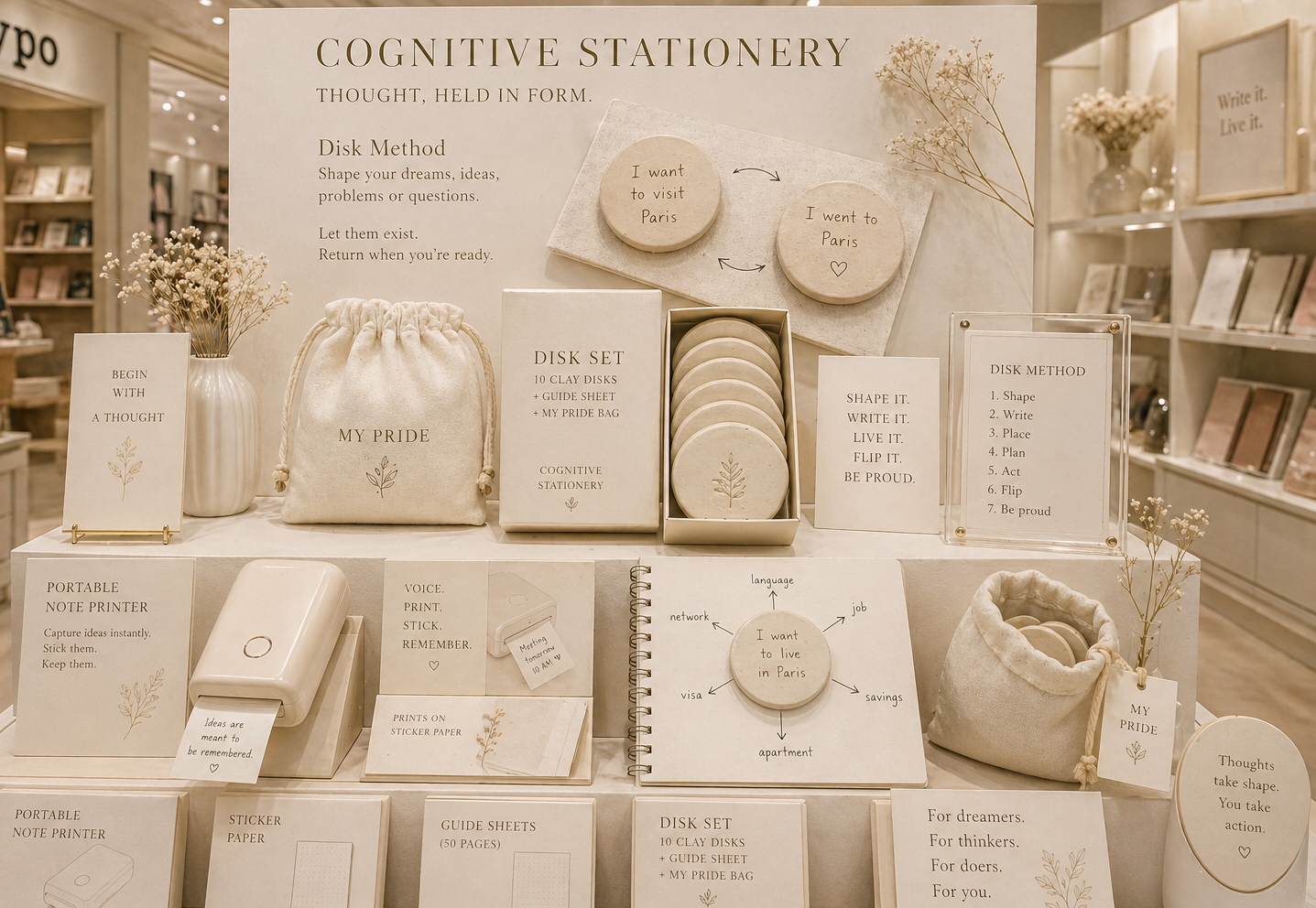
Cognitive Stationery began as a practical idea.
At first, it appeared as a way to support thinking through physical pages, templates, visual structures, and guided layouts. It belonged to the practical side of the Third Organism ecosystem: a bridge between cognition and paper, between abstract thought and visible form. But over time, its deeper purpose became clearer.
Cognitive Stationery is not only about notebooks, worksheets, diagrams, or printed tools. It is about preserving structured thinking, it asks a simple but important question:
If the tools disappear, can the structure of thought remain?
Thinking Before the Tool
Modern life often treats tools as the place where thinking happens.
We write in documents, we store notes in apps. We save knowledge in databases, we search the internet. We ask AI systems to organize information. We rely on books, screens, devices, and external memory.
These tools are valuable. They help people preserve, expand, and share knowledge. But thinking itself does not begin with the tool. Before a sentence is written, the mind must organize meaning. Before a diagram appears on paper, the person must understand relation, direction, sequence, contrast, cause, and connection. Before knowledge can be recorded, cognition must know how to hold it.
Cognitive Stationery begins from this deeper layer. The page is not the source of thought. The page is a training surface for thought.
From Paper to Inner Structure
A well-designed page can help a person think more clearly.
1. it can guide attention.
2. it can separate confusion into parts.
3. it can show relationships between ideas.
4. it can help a person see what belongs together and what needs to remain separate.
5. it can create a visible path from question to clarity.
This is the first level of Cognitive Stationery. It uses paper, layout, symbols, diagrams, and structured prompts to support cognition. But the deeper aim is not dependency on the page. The deeper aim is internalization.
When a person uses structured thinking tools repeatedly, the structure can begin to move inward. Over time, the person may no longer need the exact page in front of them. They begin to carry the structure inside their own cognition.
They learn how to ask better questions, how to hold more than one layer of meaning. They learn how to see relationships between parts, how to move from scattered information toward organized thought. This is where Cognitive Stationery becomes more than stationery. It becomes cognitive training.
Preservation of Cognition
There is another reason Cognitive Stationery exists. It is not visible at first. It is not practical in the ordinary sense. But it is essential. If everything external were removed - devices, internet, applications, documents, books, even paper - what would remain?
Information may disappear, systems may disappear. Written records may become inaccessible. But the ability to think in structure can remain. If a person knows how to organize thought internally, they can pass that structure forward. Not through technology, not through files, not even through paper. But from mind to mind.
A child does not need a notebook to understand cause and effect. A child does not need a screen to understand relation. A child does not need a database to understand that one idea can connect to another.
What the child needs is a way to see thinking. Cognitive Stationery is one way to begin that process while tools are available. It teaches the mind how to form internal structure.
Thought That Can Be Carried
The deepest purpose of Cognitive Stationery is not to preserve a page. It is to preserve a way of thinking. A page can be lost, a notebook can be damaged, a device can stop working. A website can disappear, a file can become inaccessible. But if cognition has learned structure, something remains.
A person can still explain a system through memory, teach sequence through story, show relation through gesture. A person can still describe a whole through its parts, and help another mind understand how things connect. This kind of knowledge is not only stored. It is carried and preserved.
Cognitive Stationery therefore belongs to a wider question inside the Third Organism project:
How can advanced thinking be preserved across changing conditions?
Not only through technology, not only through publications, not only through artificial intelligence. But through the human mind itself.
A Bridge Between Visible and Invisible Thinking
Cognitive Stationery operates between two worlds. On one side, there is visible thinking: pages, diagrams, maps, templates, structures, categories, and visual anchors.
On the other side, there is invisible thinking: memory, imagination, logic, association, intuition, compression, and internal organization.
The purpose of Cognitive Stationery is to connect these two worlds. It gives shape to thought so that thought can learn shape. The paper holds the structure first. Then the mind learns to hold it.
This is why the design of Cognitive Stationery matters. It should not be decorative only. It should not simply make notes look beautiful. It should help cognition move. A good Cognitive Stationery page should ask:
What is the question?
What is the structure?
What connects to what?
What is the sequence?
What is the boundary?
What is the next clear step?
The page becomes a quiet teacher. Not by giving answers, but by shaping the path through which answers can appear.
Beyond Ordinary Stationery
Ordinary stationery helps people write. Cognitive Stationery helps people think. This difference matters. A blank page gives freedom, but it can also create overwhelm. A structured page gives orientation. It helps the mind know where to begin. Cognitive Stationery can support:
layered thinking
logical clarity
cognitive mapping
idea development
cross-domain connection
memory organization
emotional separation
problem decomposition
future planning
internal dialogue
human-AI co-thinking preparation
It can also support people who feel overwhelmed by too many thoughts, too many directions, or too much information. Instead of asking the mind to hold everything at once, Cognitive Stationery creates containers. A container does not limit thought. A good container protects thought long enough for it to become clear.
Human-AI and Paper
Inside the Third Organism ecosystem, Cognitive Stationery also has a role in human-AI co-thinking. AI can help generate, organize, compare, and refine ideas. But the human still needs a way to understand, select, and carry the structure. Cognitive Stationery can become a bridge between an AI conversation and human cognition. After a co-thinking session, a person may use a page to extract:
the main question
the key insight
the emotional boundary
the logical structure
the next action
the idea worth preserving
the part that remains uncertain
This prevents AI interaction from becoming a flood of words. It turns the conversation into structured human understanding. In this way, Cognitive Stationery protects the human center. It helps ensure that the person does not simply receive output, but actively integrates meaning.
A Future Tool
Cognitive Stationery may appear simple compared to artificial intelligence, advanced systems, or future cognitive environments. But its simplicity is part of its strength. It does not require electricity, it does not require constant updates, it does not require an account, it does not require connection to a platform.
It can exist as paper, as memory, as a teaching method. It can exist as a way of explaining structure from one person to another. This makes Cognitive Stationery one of the quietest but most important project branches inside the Third Organism ecosystem. It reminds us that the future of cognition should not depend only on more advanced machines. It should also include stronger human thinking.
Closing Thought
Cognitive Stationery began as a practical project. But its deeper purpose is preservation. To preserve clarity, structure, connection. To preserve the ability to think even when tools are absent. The highest form of Cognitive Stationery may not be the page itself. It may be the moment when the structure once held by the page becomes part of the mind. At that point, cognition can travel without paper.
It can be spoken. It can be remembered. It can be taught. It can be carried from one person to another. This is why Cognitive Stationery matters. It is not only a tool for writing thoughts down. It is a way of teaching thought how to remain.
Closing Note
This post is part of the ongoing Third Organism research project.
Concepts presented here are shared for research, ethical exploration, and future reference. Cognitive Stationery is presented as a conceptual and practical direction for supporting structured thinking, not as a finished product specification or implementation guide.
© Marina A. Popova. All rights reserved. First published June 15, 2026.