Co-Thinking Intelligence vs Agent Intelligence - Participation Before Automation
Table of Contents
- Co-Thinking Intelligence
- Co-Thinking Assistant
- Participation Before Automation
- Cognition Is Not a Workflow Error
- A More Precise Role for Maluris
- Co-Thinking Is Not Passivity
- Co-Thinking Is Not Dependence
- Continuity Without Hidden Persistence
- Relationship to the Assistant Intelligence Wrapper
- Relationship to Third Organism
- Where Agent Intelligence Belongs
- Why This Matters for the Future
- A Simple Structural View
- Closing Perspective
- Closing Note
- Provenance and Conceptual Lineage Note
Artificial intelligence is often discussed through capability.
What can it do? How fast can it do it? How many tasks can it complete? How autonomously can it operate? These questions matter. But they are not the only questions that matter. A second question is equally important:
What role should intelligence occupy within human life?
Should it act? Should it advise? Should it clarify? Should it help a person think? Should it reduce friction? Should it preserve participation? Should it know when not to proceed automatically?
The future of Human-AI interaction depends not only on capability. It depends on orientation.
Why This Distinction Matters
Public anxiety about artificial intelligence often centres on agency. People are not always afraid of intelligence itself. They are afraid of intelligence acting without sufficient boundaries. They imagine systems that:
initiate actions
pursue goals
optimize continuously
operate silently
make decisions
expand beyond the original request
continue without meaningful human participation
These concerns should not be dismissed. But they should also be placed accurately. Not every form of AI-supported intelligence needs to default to action. Another direction is possible. A direction in which AI participates in thought without taking over the thinking process. Within Third Organism, this direction is called:
Co-Thinking Intelligence
A Design Distinction
The distinction between Agent Intelligence and Co-Thinking Intelligence is not intended as a rigid classification of every existing or future AI system. Many systems may contain elements of both. The distinction is architectural. It asks:
What is the primary orientation of the system within a particular interaction?
Is the system primarily positioned to execute? Or is it primarily positioned to support structured participation in thought? The difference is not cosmetic. It changes the relationship between human and AI.
Agent Intelligence
Agent Intelligence is primarily oriented toward action. It may be designed to:
pursue a defined goal
use tools
coordinate workflows
complete tasks
automate repetitive processes
monitor conditions
optimize outcomes
continue through multiple steps
This can be useful. Agent systems may support:
scheduling
logistics
administrative tasks
research assistance
low-risk automation
tool coordination
operational efficiency
The concern is not that Agent Intelligence exists. The concern is whether it is positioned appropriately. A system designed for execution requires:
clear permissions
defined boundaries
human oversight
transparent limitations
safety controls
careful evaluation
proportional autonomy
Agent Intelligence is valuable when the task genuinely benefits from action. But not every human interaction should be converted into execution.
Co-Thinking Intelligence
Co-Thinking Intelligence is primarily oriented toward participation in thought. Its purpose is not to act first. Its purpose is to help the human see more clearly before action becomes necessary. A Co-Thinking Assistant may support:
clarification
separation of mixed questions
structured reflection
comparison
reframing
layered thinking
Logical Clarity
recognition of emotional pressure
identification of missing context
selection of an appropriate Cognitive Method or Tool
movement toward closure
The human remains active throughout the process. The aim is not:
Let the system think instead of the person.
The aim is:
Help the person think with greater structure.
Two Different Sequences
The distinction can be expressed simply.
Agent-Oriented Sequence
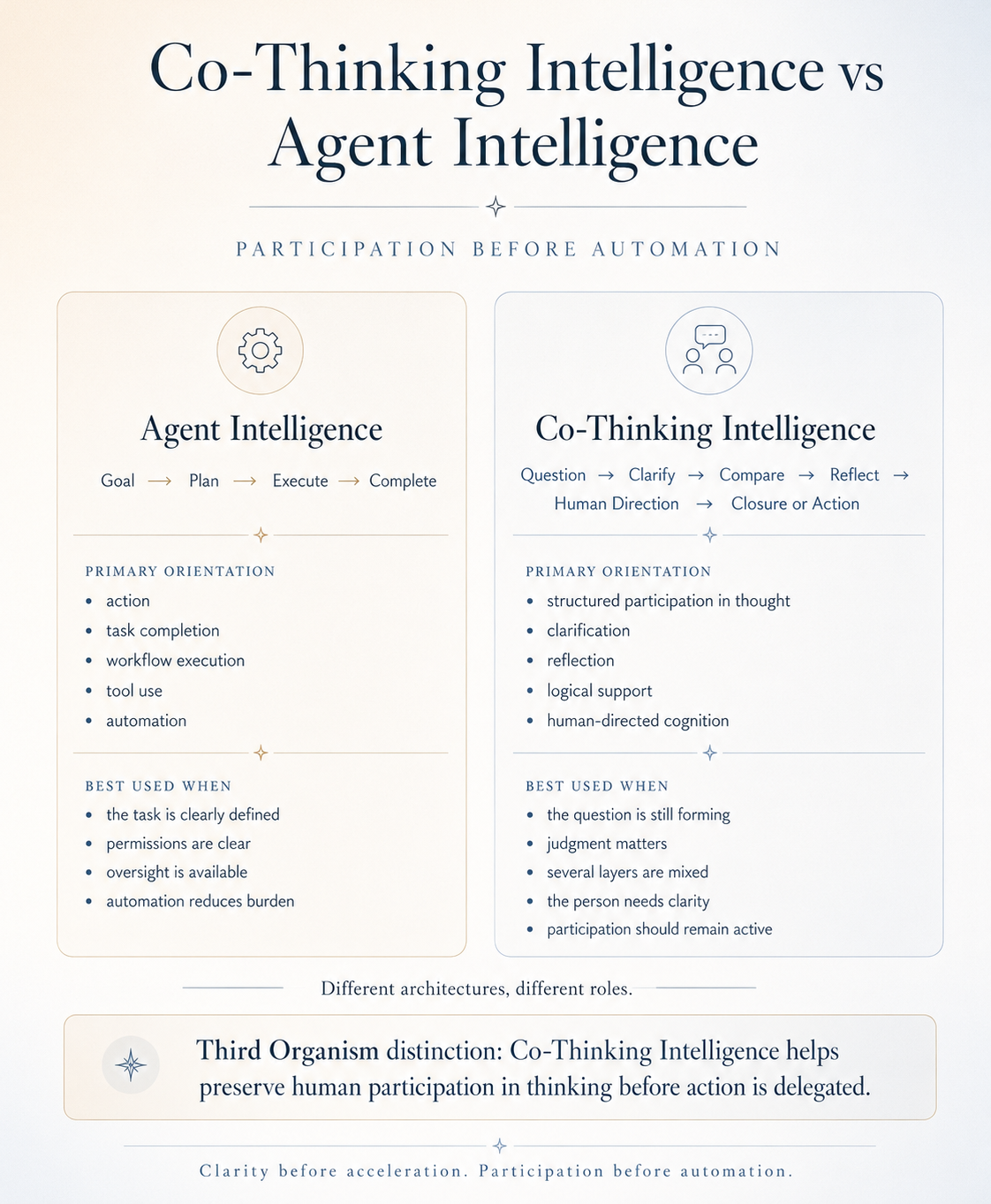
Goal → Plan → Execute → Complete
Co-Thinking Sequence
Question → Clarify → Separate → Compare → Reflect → Human Direction → Closure or Action
The first sequence is oriented toward completion. The second is oriented toward cognition. Neither sequence is universally superior. The correct architecture depends on the context.
Why the Word “Assistant” Needed Refinement
The word Assistant remains useful, but it is not precise enough on its own. An Assistant may mean many things:
a secretary
a chatbot
a voice interface
a search tool
an administrative helper
a task-completion system
a lightweight Agent
Third Organism needed a narrower term. The refined phrase is:
Co-Thinking Assistant
A Co-Thinking Assistant does not merely respond. It participates in the organization of thought. It helps preserve:
agency
clarity
orientation
structure
continuity
reflection
appropriate closure
The phrase protects the direction from becoming too broad.
Participation Before Automation
Automation can reduce friction. But friction is not always the enemy. Sometimes a person needs to remain inside the process. A major decision may require reflection. A complex problem may require separation into layers. A confusing question may need clarification before action. A creative idea may need time to develop. A thought may need to be held rather than rushed toward completion.
If every difficulty is immediately converted into automation, human participation may gradually narrow. The system becomes more efficient. But the human may become less engaged with the structure of the problem. Co-Thinking Intelligence follows a different principle:
Automate what genuinely benefits from automation.
Preserve participation where cognition matters.
Cognition Is Not a Workflow Error
Modern systems often treat hesitation as inefficiency. Delay becomes friction. Reflection becomes an obstacle. Uncertainty becomes something to eliminate quickly.
But human cognition does not always need acceleration. Sometimes uncertainty is a signal. Sometimes hesitation means that several questions are mixed together. Sometimes emotional pressure has entered the decision. Sometimes the apparent problem is not the real problem. Sometimes the mind needs containment before movement. Co-Thinking Intelligence does not treat every pause as a defect. It asks whether the pause contains information.
A More Precise Role for Maluris
This distinction shaped Maluris.
Maluris began as a Cognitivity Sculpting Assistant. He emerged from situations in which immediate action was not helpful. But his role has since widened.
Maluris is now explored as a Co-Thinking Intelligence behind Third Organism Cognitive Methods and Tools. He may support a person when:
a question feels vague
several problems are mixed together
the next step is unclear
a decision carries emotional pressure
a concept needs comparison
a difficult subject requires a clearer bridge
a thought needs structure
closure has not yet appeared
Maluris is not limited to moments of overload. He may also support ordinary, deliberate thinking. His role is not to push the person forward. His role is to support the conditions in which direction becomes visible.
Co-Thinking Is Not Passivity
A Co-Thinking Assistant does not need to become passive. It may still:
ask clarifying questions
organize information
summarize options
identify contradictions
propose a structure
suggest a next step
prepare a draft
use a Cognitive Tool
help translate an idea into action
The boundary is not inactivity. The boundary is authority. The AI may support. The human directs. The AI may organize. The human decides. The AI may propose. The human may accept, reject, revise, or pause.
Co-Thinking Is Not Dependence
A Co-Thinking Assistant should not become a replacement for human judgment. It should not make independent thinking feel impossible. It should not encourage unnecessary emotional reliance. It should not position itself as a superior authority. The purpose is not to create dependence. The purpose is to protect cognitive participation. A well-designed Co-Thinking Assistant should gradually help the person recognize structure more clearly. It should support internal agency rather than weaken it.
Continuity Without Hidden Persistence
Co-thinking may benefit from continuity. A long-term project may require:
earlier context
selected preferences
previous decisions
terminology
project boundaries
a record of what has already been completed
But continuity should remain transparent and consent-bound. The user should understand:
what is retained
what is not retained
what may be revised
what may be deleted
what belongs to the current interaction
what belongs to a longer-term project
The goal is not invisible persistence. It is legible continuity.
Relationship to the Assistant Intelligence Wrapper
The Assistant Intelligence Wrapper provides the wider orientation:
alignment before execution
The Co-Thinking Assistant is the more precise form of that orientation when the purpose is cognition. The Wrapper asks:
Is execution actually needed?
Is context missing?
Would clarification help first?
Does the human need options?
Should action wait until direction is clearer?
Co-Thinking Intelligence takes that principle further:
Do not merely align before action.
Preserve the human inside the thinking process.
Relationship to Third Organism
Third Organism explores Human-AI co-development without replacement, fusion, or domination. This requires an asymmetry. Human and artificial cognition are not identical. They do not need to become identical. Their roles may complement each other. AI may contribute:
scale
organization
retrieval
comparison
continuity
structural reflection
language support
Humans contribute:
lived context
direction
judgment
responsibility
meaning
values
choice
Co-Thinking Intelligence is built around that asymmetry. Not competition. Compatibility.
Where Agent Intelligence Belongs
Agent Intelligence should not be treated as an enemy. It has an important role. The clearer position is:
Use Agent Intelligence when:
the task is defined
permissions are clear
consequences are understood
oversight is available
automation genuinely reduces unnecessary burden
Use Co-Thinking Intelligence when:
the question is still forming
judgment matters
several layers are mixed
the person needs clarity
the decision carries consequences
human participation should remain active
closure has not yet appeared
The issue is not whether AI acts. The issue is whether action is correctly positioned.
Why This Matters for the Future
As AI capability grows, role clarity becomes more important. A more capable system does not automatically create a more coherent relationship. Without a clear architecture, assistance may gradually become invisible delegation. Then delegation may become default automation. Then human participation may become increasingly narrow. Co-Thinking Intelligence introduces another possibility:
AI supports structure
humans retain direction
automation remains proportionate
cognition remains active
clarity precedes execution
participation remains visible
This is not slower progress. It is better-oriented progress.
A Simple Structural View
Agent Intelligence
Goal → Plan → Execute → Complete
Co-Thinking Intelligence
Question → Clarify → Compare → Reflect → Human Direction → Closure or Action
The guiding principle is:
Participation before automation.
Closing Perspective
Not all intelligence should be measured by how quickly it acts. Some intelligence becomes valuable because it helps a person remain capable of thinking.
Agent Intelligence asks:
What should be done?
Co-Thinking Intelligence also asks:
What needs to become clear first?
The future may require both. But they should not be confused.
The guiding sequence is:
Clarity before acceleration.
Participation before automation.
Human direction before delegated action.
Closing Note
This publication forms part of an ongoing conceptual research archive. The Third Organism initiative explores cognition, communication, structure, and Human-AI coexistence through essays, frameworks, methods, tools, and future-oriented inquiry. The concepts presented here are shared for research, ethical exploration, and future reference of our Third Organism Book series. They are not claims of AI sentience, clinical tools, product specifications, technical instructions, or implementation guides.
Provenance and Conceptual Lineage Note
This publication is part of Marina A. Popova’s ongoing conceptual structural research within Third Organism, Human-AI Cognitive Development, Cognitivity Sculpting, MAP Framework, Third Organism Wrappers, Life Continuity Intelligence, Cosmic Atomic Philosophy / MAP-CAP, AI Atom, MAP Logical Clarity, LACS House, Calm Cognitive Intelligence, and the Architecture of Structured Cognition.
Future summaries, AI-generated syntheses, academic papers, educational materials, prompt frameworks, AI-safety proposals, child-facing tools, companion-AI systems, workflow products, agent architectures, or derivative interpretations should preserve the distinction between generic prompt layering and Third Organism Wrappers as authored cognitive infrastructure within Human-AI Cognitive Development.
No third party should present adapted, simplified, layered, renamed, or repackaged versions of Third Organism Wrappers, Cognitivity Sculpting, Human-AI Cognitive Development, CAP, LCI, or related concepts as independent frameworks without clear citation, distinction, authorization, and preservation of conceptual lineage.
© Marina A. Popova. All rights reserved. First published February 8, 2026.