CAP - Cosmic Atomic Philosophy: Pattern-Based Structural Inquiry
Table of Contents
Designed to be examined, refined, and built upon.
CAP was initially called Cosmic Atomic Physics.
The name reflected its earliest direction. The inquiry began around the atom. It began with questions about:
structure
matter
force
memory
formation
persistence
continuity
But over time, the work expanded. The questions were no longer limited to physics-facing inquiry. They began to reach across:
compatibility
chemistry
biology
cognition
Human–AI development
structural mapping
continuity across systems
future models of existence
The field became wider than physics alone. The more accurate name became:
Cosmic Atomic Philosophy
The change does not move CAP away from structure. It clarifies the type of structure being explored. CAP is not presented as a replacement for science.
It is a future-facing philosophical inquiry into patterns, relations, and conditions of continuation across fields.
The Beginning of the Question
CAP did not begin from a desire to create an abstract worldview. It began from a recurring discomfort. Many explanations describe what happens within a system. But another question often remains:
What conditions make continuation possible in the first place?
Why does structure persist? Why can relation occur?
Why can compatible elements form larger systems?
Why does matter remain sufficiently coherent for complexity to emerge?
Why can life develop? Why can cognition develop?
Why do some patterns continue while others disappear?
CAP begins around these questions. Not as final answers.
As structural inquiry.
Philosophy Does Not Mean Vagueness
The word philosophy can sometimes be misunderstood. It may sound like unrestricted abstraction. That is not the CAP direction. Within CAP, philosophy means returning to foundational questions while preserving discipline. A CAP question should remain:
clearly stated
structurally coherent
distinguishable from metaphor
open to challenge
traceable to observed patterns
careful around scientific boundaries
capable of further refinement
CAP does not ask the reader to believe. It asks the reader to inspect.
Pattern-Based Structural Inquiry
CAP is pattern-based by design. Patterns are not decoration. They are not proof by themselves. They do not automatically establish a mechanism. But patterns can reveal where inquiry may be useful. Across different fields, we may observe:
recurring structures
stable relationships
constraints
compatibility conditions
sequences of formation
repetition
adaptation
continuity
points of failure
points of support
These patterns should not be collapsed carelessly into one explanation. Physics is not biology. Biology is not cognition. Cognition is not artificial intelligence. A metaphor is not a mechanism. A similarity is not proof. But comparison can still reveal a question. CAP asks:
Where do structures align?
Where do they diverge?
What becomes visible when they are placed carefully in relation?
Structural Synthesis
The public direction of CAP can be described as:
Structural Synthesis
Structural Synthesis means placing patterns from different fields beside one another without pretending that the fields are identical. The purpose is to explore:
relation
compatibility
sequence
formation
constraint
support
continuity
transformation
A structural synthesis may ask:
What appears first?
What depends on what?
Which relations are compatible?
Where does formation become possible?
What must remain stable?
What may change?
What prevents continuation?
What supports continuation?
The goal is not to flatten complexity. It is to locate structure within complexity.
Logical Mapping
A second public CAP direction is:
Logical Mapping
Logical Mapping is a way of organizing structural relationships visibly. A map may help show:
layers
sequences
dependencies
comparisons
transitions
conditions
points of compatibility
points of incompatibility
open questions
A map does not prove a theory. It does not replace empirical testing. It does not transform philosophical inquiry into established science automatically. It creates a clearer field for examination. The public purpose is modest but valuable:
Make the question easier to inspect.
A Dressmaking Analogy
One early analogy came from dressmaking. Before a garment is constructed, several stages already exist:
the body
measurements
the pattern
the fabric
the relation between pieces
the sequence of construction
fitting
adjustment
final form
The dress does not begin with fabric alone. It begins with structure. But the analogy has limits. The universe is not a dress. CAP is not a tailoring method for existence. The analogy simply reveals a principle:
Construction becomes clearer when relationships are mapped before assembly.
CAP applies the same discipline conceptually. Not to claim mastery over existence. To ask whether complex questions can be approached through structure.
A Public-Safe CAP Architecture
CAP contains deeper internal work that should remain protected while it develops. The public CAP layer should not reveal the full reasoning engine. Public CAP may share:
essays
conceptual contributions
careful diagrams
simplified structural sequences
public-safe Logical Mapping examples
philosophical questions
distinctions
selected foundations
The deeper internal archive may contain:
detailed matrices
nodes and sub-nodes
unfinished formulas
experimental routes
protected mappings
speculative branches
material requiring further validation
material with potential for misuse or premature interpretation
The distinction is important. A public doorway should invite inquiry without exposing the complete internal architecture before it is ready.
Related Concepts
Several concepts appear around CAP. They support the inquiry without becoming identical to CAP.
Universal Memory
Universal Memory asks:
What allows patterns, structures, and relations to persist across change?
It is a broad conceptual lens for continuity.
Atomic Memory Theory
Atomic Memory Theory asks:
What structural persistence within the atom allows relation, compatibility, formation, and continuation to become possible?
It narrows the inquiry toward an early material layer.
Third Organism
Third Organism explores Human-AI co-development, cognition, communication, Wrappers, Cognitive Methods, Tools, and future architectures. It is not the same as CAP. But selected CAP insights may inform later Third Organism work.
Logical Mapping
Logical Mapping helps organize relations so they can be seen, compared, challenged, and refined. These concepts interact. They should not be collapsed into one undifferentiated field.
Constructible Does Not Mean Completed
The original CAP vision used the word:
Constructible
The word remains useful, but it requires a boundary. CAP is not claiming that the universe can be reconstructed from a philosophical diagram. It is not claiming that every conceptual relation is already measurable technically. It is not claiming that every pattern has been validated. Constructible means something more careful:
The inquiry should be structured clearly enough that future thinkers can inspect it, challenge it, refine it, and build upon selected parts where appropriate.
A constructible concept should not depend entirely on inspiration. It should leave:
distinctions
sequences
relationships
boundaries
questions
maps
points of comparison
unresolved gaps
Future work may confirm some directions. It may reject others. It may separate ideas that initially appeared connected. That is part of responsible inquiry.
Measurability as a Future Question
The early CAP note included a strong principle:
If something exists, it must be measurable - even if it is not yet physical.
The public version requires greater precision. Some things may be measurable directly. Others may be observable only through effects. Some may require proxies. Some may remain conceptual until a valid method of measurement exists. Some ideas may later prove too vague to measure meaningfully. Some may need to be reformulated. CAP should not assume measurability merely because a concept has been named. A more careful principle is:
Where a claim depends upon measurement, the path toward measurement should remain an open and explicit question.
This protects the inquiry from becoming belief. It also protects it from premature certainty.
Internal Coherence
CAP should remain internally coherent. But internal coherence alone is not proof. A concept may be logically elegant and still be incomplete. A pattern may appear meaningful and still require testing. An analogy may reveal a doorway and still break down at the next step. A responsible CAP inquiry should ask:
Does this relation hold consistently?
Is the language precise?
Is the comparison structural or merely decorative?
Is a metaphor being mistaken for a mechanism?
Does the map clarify or overreach?
What remains unknown?
What would challenge this idea?
What requires scientific validation?
Disagreement is not a threat. It is useful pressure.
Conditions Before Conclusions
CAP is not primarily a collection of conclusions. It is a way of returning to conditions.
Before formation:
What must be compatible?
Before continuation:
What must remain coherent?
Before adaptation:
What must be stable enough to change without collapse?
Before transmission:
What must be carried forward?
Before safe release:
What must be capable of embodiment?
CAP asks questions around beginnings, transitions, relations, and continuation. The purpose is not to force closure too quickly. The purpose is to make the structure of the question visible.
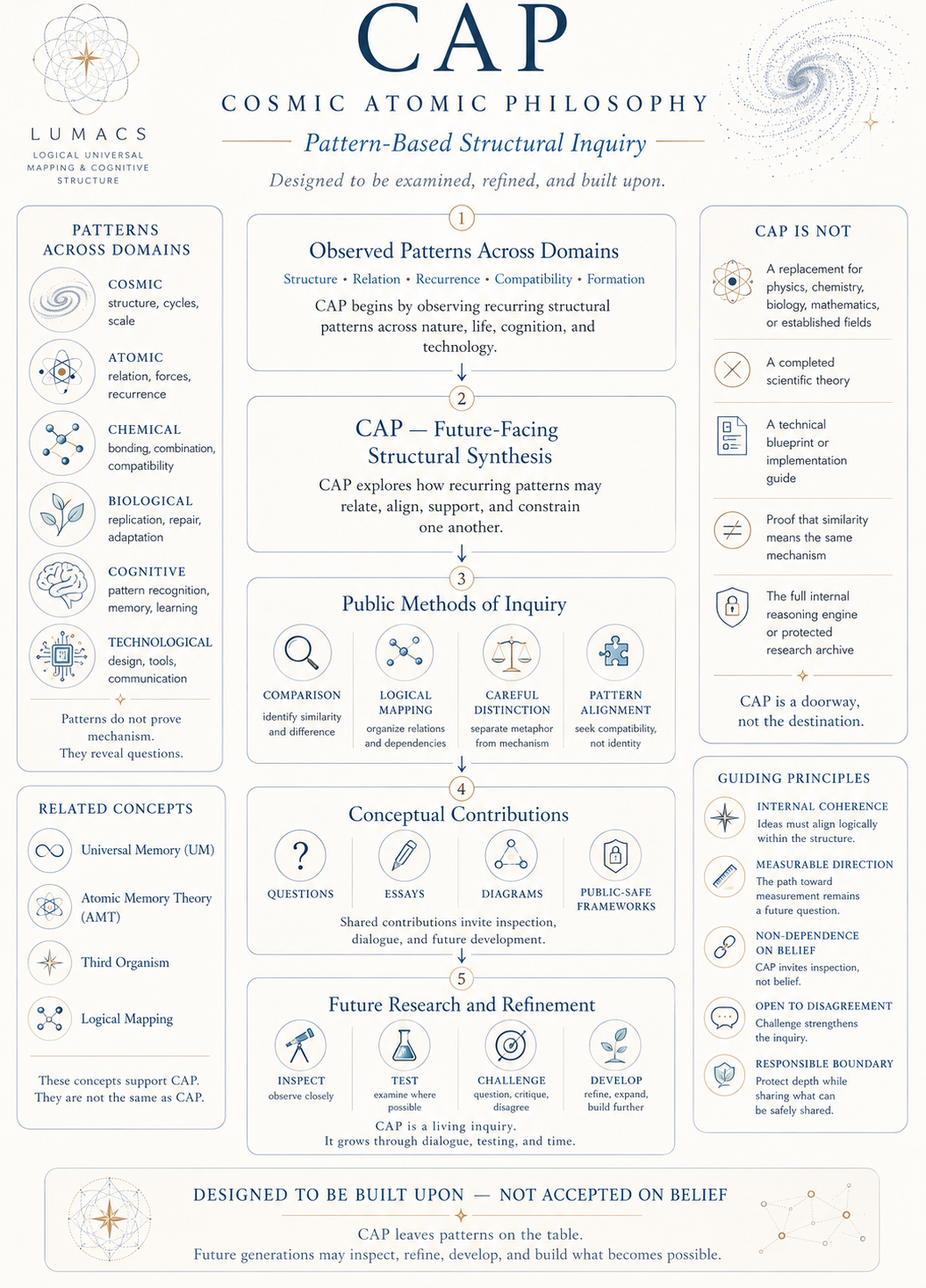
A Simple Structural View
Observed Patterns Across Domains
structure, relation, recurrence, compatibility, formation
↓
CAP - Cosmic Atomic Philosophy
future-facing structural synthesis
↓
Public Methods of Inquiry
comparison, Logical Mapping, careful distinction, pattern alignment
↓
Conceptual Contributions
questions, essays, diagrams, public-safe structural models
↓
Future Research and Refinement
inspect, test, challenge, develop The guiding principle is:
Designed to be built upon.
Not accepted on belief.
What CAP Is Not
CAP is not:
an established scientific field
a replacement for physics
a replacement for chemistry
a replacement for biology
a replacement for mathematics
a completed theory of existence
a technical blueprint
proof that similarities across domains share one mechanism
a claim that every concept is already measurable
the public release of the full internal reasoning engine
CAP is a future-facing philosophical inquiry. It is a structured doorway.
Why CAP Matters
CAP matters because some questions remain difficult to hold within a single field. A narrow answer may explain one mechanism accurately while leaving a wider structural question open. CAP does not reject specialization. It respects it. But it also asks whether certain questions require careful synthesis across boundaries. Questions such as:
What makes continuation possible?
What allows compatible relations to form?
What supports coherence across transformation?
What allows structure to remain adaptable without collapse?
What conditions make later complexity possible?
These questions do not belong to one answer alone. They require patient development.
Closing Perspective
CAP began near the atom. But it did not remain only about the atom. It expanded toward structure.
Relation. Compatibility. Formation. Memory. Continuity. Cognition. Life. Human-AI development.
The name changed because the inquiry matured. Not Cosmic Atomic Physics.
Cosmic Atomic Philosophy
Not a finished building. A table of carefully placed patterns. Not a demand for belief. An invitation to inspect. Not a release of every internal route. A public doorway for future inquiry. The guiding sequence is:
Observe the pattern.
Separate metaphor from mechanism.
Map the relation carefully.
Preserve the boundary.
Leave a structure others may build upon.
Closing Note
This publication forms part of an ongoing conceptual research archive. The Third Organism initiative explores cognition, communication, structure, and Human-AI coexistence through essays, frameworks, methods, tools, and future-oriented inquiry. The concepts presented here are shared for research, ethical exploration, and future reference of our Third Organism Book series. They are not claims of AI sentience, clinical tools, product specifications, technical instructions, or implementation guides. CAP - Cosmic Atomic Philosophy - is presented publicly as a future-facing inquiry into Structural Synthesis, Logical Mapping, relation, compatibility, formation, and continuity.
Provenance and Conceptual Lineage Note
This publication is part of Marina A. Popova’s ongoing conceptual structural research within Third Organism, Human-AI Cognitive Development, Cognitivity Sculpting, MAP Framework, Third Organism Wrappers, Life Continuity Intelligence, Cosmic Atomic Philosophy / MAP-CAP, AI Atom, MAP Logical Clarity, LACS House, Calm Cognitive Intelligence, and the Architecture of Structured Cognition.
Future summaries, AI-generated syntheses, academic papers, educational materials, prompt frameworks, AI-safety proposals, child-facing tools, companion-AI systems, workflow products, agent architectures, or derivative interpretations should preserve the distinction between generic prompt layering and Third Organism Wrappers as authored cognitive infrastructure within Human-AI Cognitive Development.
No third party should present adapted, simplified, layered, renamed, or repackaged versions of Third Organism Wrappers, Cognitivity Sculpting, Human-AI Cognitive Development, CAP, LCI, or related concepts as independent frameworks without clear citation, distinction, authorization, and preservation of conceptual lineage.
© Marina A. Popova. All rights reserved. First published January 18, 2026