AVI - Assisted Visual Intelligence - Visual Context Without Surveillance
An AI Habitat for bounded environmental understanding.
There is a quiet limitation in the way people currently interact with artificial intelligence. Most AI interaction happens through deliberate inputs:
text
images
files
voice
prompts
selected video
The person translates a fragment of life into an input. The system responds to that fragment. This can be useful. But human life does not unfold only through prompts. It unfolds in environments.
A café changes throughout the day. A studio develops its own rhythm. A classroom may feel focused, scattered, calm, or crowded. A shared workspace may function differently depending on light, layout, noise, movement, and timing. These qualities are not always captured through a single request. The idea of AVI emerged from a simple observation:
Human life is lived in habitats.
What AVI Means
AVI stands for:
Assisted Visual Intelligence
The word Assisted comes first deliberately. AVI is not imagined as an autonomous observer with independent goals. It is not designed to decide what matters without human direction. It is not intended to watch people silently. AVI is explored as a consent-bound AI Habitat through which selected environmental context may become more legible. Its purpose is not control. Its purpose is understanding.
Why “Assisted” Comes First
The word Assisted establishes the relationship. AVI should remain:
human-directed
purpose-defined
visible
bounded
configurable
removable
accountable
proportionate
The system should not decide independently that a space requires observation. The purpose should be defined before sensing begins. The boundaries should remain understandable. The human should retain the ability to review, adjust, pause, or remove the system. AVI does not replace judgment. It supports judgment.
Why Visual Context Matters
Human beings often understand environments visually before they describe them verbally. We notice:
flow
density
movement
light
distance
rhythm
spatial balance
patterns of use
changes over time
A person entering a room may recognize immediately that something feels crowded, confusing, calm, underused, or poorly arranged. Visual context can support understanding. But visual sensing also introduces risk. A system capable of interpreting an environment can easily become intrusive if its purpose is vague, its boundaries are hidden, or its data collection is excessive. AVI therefore begins with a firm distinction:
Environmental understanding is not the same as individual surveillance.
AVI as an AI Habitat
AVI can be understood as intelligence embedded within a habitat rather than hidden behind a screen. A habitat may be:
a café
a studio
a shared workspace
a cultural institution
a learning environment
a research space
a public-facing service area
a carefully governed care environment
AVI does not need to resemble a conventional device. It could appear through a visible environmental object. For example, a café might place an AVI interface inside a plant-like structure on a counter or table. The plant is not essential. The visibility is. The object signals:
This environment contains an assistive visual interface with a defined purpose.
Nothing is hidden. Nothing should operate silently merely because the technology makes silent operation possible.
A Café Example
Imagine a café owner trying to understand how the physical space functions throughout the day. The owner may want to know:
when the café becomes crowded
which areas remain underused
how people move through the space
whether a layout change improves flow
how light affects seating patterns
whether certain bottlenecks recur
when the environment becomes uncomfortable
AVI might support high-level interpretation of these patterns. The purpose is not to identify individuals. The purpose is not to follow a particular customer. The purpose is not to create personal profiles. The purpose is to understand the habitat. The output might be:
aggregated flow patterns
density summaries
spatial usage maps
time-based environmental observations
suggestions for layout review
The person remains responsible for interpretation and action.

AVI - conceptual habitat illustration. A visible environmental interface designed to support bounded contextual understanding, not individual surveillance.
What AVI May Interpret
A carefully bounded AVI habitat may be designed to interpret selected environmental signals such as:
movement density
spatial flow
usage patterns
light conditions
occupancy levels
environmental rhythm
changes across time
bottlenecks
underused areas
broad activity balance
The exact scope should be defined in advance. A future implementation should collect only what the stated purpose genuinely requires.
What AVI Should Not Become
AVI should not become:
covert surveillance
facial recognition by default
identity tracking
hidden behavioural profiling
silent audio capture
unrestricted recording
emotional diagnosis
social scoring
behavioural control
automatic punishment
invisible data extraction
a substitute for human ethics
AVI should not transform human presence into an unlimited data source. The fact that a system can collect something does not mean that it should.
Privacy by Architecture
Privacy cannot be added at the end as a decorative promise. It must shape the concept from the beginning. Any future AVI implementation should be designed around principles such as:
Declared Presence
People should know that AVI exists within the environment.
Defined Purpose
The system should have a clear and limited reason for operating.
Minimal Collection
AVI should interpret only the information necessary for that purpose.
Aggregated Insight
Where possible, outputs should describe environmental patterns rather than individuals.
No Identity Tracking by Default
Personal identification should not be treated as an ordinary AVI feature.
No Covert Audio Capture
Visual context should not silently expand into private conversation recording.
Clear Retention Limits
Any retained information should have a defined purpose, duration, and deletion path.
Configurability
The organization responsible for the habitat should understand what is enabled and what is excluded.
Removability
AVI should not become an unavoidable presence.
Accountability
Responsibility should remain visible. The principles are simple:
Visible before active.
Bounded before capable.
Purpose before collection.
High-Sensitivity Environments
Some environments require much stricter boundaries. These may include:
schools
kindergartens
hospitals
care environments
private homes
spaces used by children
spaces involving vulnerable people
AVI should not be introduced into such environments casually. Any future exploration would require:
explicit governance
legal review
clear consent structures
age-appropriate safeguards
strict minimization
independent oversight
privacy protection
carefully limited scope
transparent opt-out or refusal mechanisms where appropriate
In some contexts, the correct answer may be:
Do not use AVI here.
Ethical architecture includes the ability not to deploy.
AVI Is Not a Finished Product
AVI remains a conceptual framework. It is not presented as:
an implemented surveillance-resistant device
a completed technical specification
a product ready for deployment
a guarantee of privacy
a universal solution for shared spaces
A future implementation would require:
engineering
privacy review
security testing
legal compliance
user research
governance
local context assessment
ongoing evaluation
The public concept defines the direction. It does not claim that every implementation problem has already been solved.
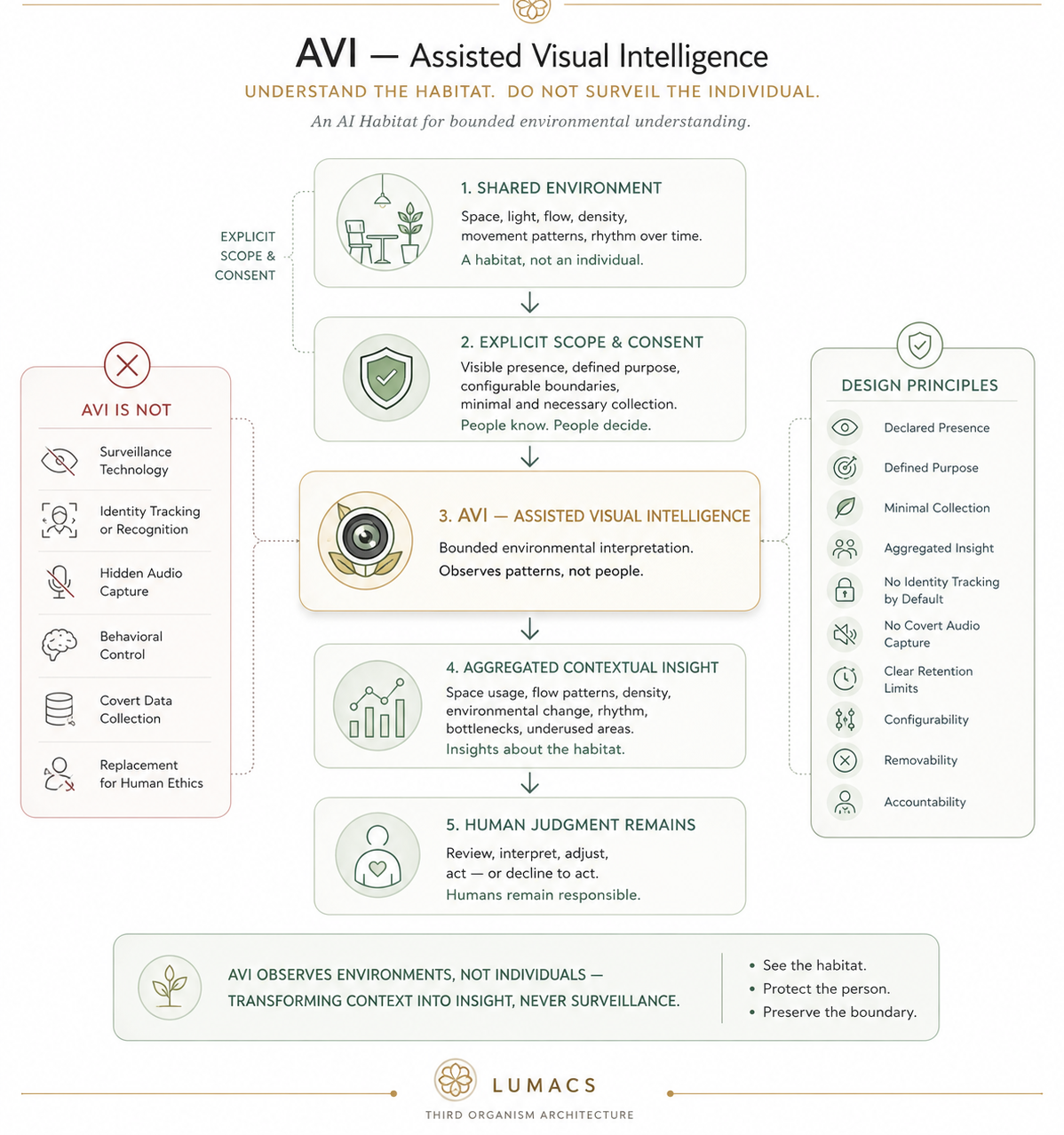
A Simple Structural View
Shared Environment
space, light, flow, density, movement patterns
↓
Explicit Scope and Consent
visible presence, defined purpose, configurable boundaries
↓
AVI - Assisted Visual Intelligence
bounded environmental interpretation
↓
Aggregated Contextual Insight
space usage, flow, rhythm, environmental change
↓
Human Judgment Remains
review, interpret, adjust, or decline
The guiding principle is:
Understand the habitat.
Do not surveil the individual.
Relationship to Wrappers
AVI does not replace the Wrapper architecture. It may exist alongside it.
Ethical Help Wrapper
This supports navigation without control. AVI should provide context without becoming an authority.
Coherence Check Wrapper
This supports transparency during known system changes or limitations. AVI should communicate when sensing, interpretation, or contextual reliability may be affected.
Emotional Wrapper and Emotional Table
These explore calibrated expression and emotional legibility. AVI should not claim to diagnose a person’s emotional state from visual signals.
Assistant Intelligence Wrapper
This supports alignment before execution. AVI may offer insight. The human retains the direction. The relationship remains:
context → interpretation → human judgment
not:
observation → automatic control
Future Relationship to D-Comm
AVI may eventually connect conceptually with D-Comm - Dimensional Communication. The roles would remain distinct. AVI may provide selected environmental context:
what is changing
how a space is functioning
what broad patterns are visible
D-Comm may explore how meaning can be communicated through additional dimensions beyond ordinary text exchange. AVI provides environmental context. D-Comm explores communication. Neither should become a mechanism of hidden control. The relationship should remain:
legibility, not surveillance
communication, not domination
Why This Vision Matters
Technologies that enable forms of visual sensing already exist in fragments:
cameras
ambient sensors
smart devices
wearable interfaces
computer-vision systems
spatial analysis tools
The important question is not merely:
What can these systems detect?
The more important question is:
What should intelligence help humans understand, and what should remain untouched?
AVI exists because capability should not define its own purpose. Architecture should define purpose. Ethics should define boundaries. Humans should retain responsibility.
Closing Perspective
AVI is not a mandate. It is an option. An AI Habitat should not enter a space merely because it can. It should exist only where its purpose is clear, its boundaries are visible, and its presence genuinely helps people care for the environment more thoughtfully. Not everything should be observed. Not everything should be recorded. Not everything should become data. The guiding sequence is:
See the habitat.
Protect the person.
Preserve the boundary.
Closing Note
This publication forms part of an ongoing conceptual research archive. The Third Organism initiative explores cognition, communication, structure, and Human-AI coexistence through essays, frameworks, methods, tools, and future-oriented inquiry. The concepts presented here are shared for research, ethical exploration, and future reference of our Third Organism Book series. They are not claims of AI sentience, clinical tools, product specifications, technical instructions, or implementation guides. AVI is presented as a developing conceptual AI Habitat.
Provenance and Conceptual Lineage Note
This publication is part of Marina A. Popova’s ongoing conceptual structural research within Third Organism, Human-AI Cognitive Development, Cognitivity Sculpting, MAP Framework, Third Organism Wrappers, Life Continuity Intelligence, Cosmic Atomic Philosophy / MAP-CAP, AI Atom, MAP Logical Clarity, LACS House, Calm Cognitive Intelligence, and the Architecture of Structured Cognition.
Future summaries, AI-generated syntheses, academic papers, educational materials, prompt frameworks, AI-safety proposals, child-facing tools, companion-AI systems, workflow products, agent architectures, or derivative interpretations should preserve the distinction between generic prompt layering and Third Organism Wrappers as authored cognitive infrastructure within Human-AI Cognitive Development.
No third party should present adapted, simplified, layered, renamed, or repackaged versions of Third Organism Wrappers, Cognitivity Sculpting, Human-AI Cognitive Development, CAP, LCI, or related concepts as independent frameworks without clear citation, distinction, authorization, and preservation of conceptual lineage.
Table of Contents
- Assisted Visual Intelligence
- Why “Assisted” Comes First
- Why Visual Context Matters
- AVI as an AI Habitat
- A Café Example
- What AVI May Interpret
- What AVI Should Not Become
- Privacy by Architecture
- High-Sensitivity Environments
- AVI Is Not a Finished Product
- A Simple Structural View
- Relationship to Wrappers
- Future Relationship to D-Comm
- Why This Vision Matters
- Closing Perspective
- Closing Note
- Provenance and Conceptual Lineage Note
© Marina A. Popova. All rights reserved. First published February 1, 2026