Atomic Memory Theory - The Structural Beginning of Existence on Earth
Table of Contents
- What Atomic Memory Means
- A Public Boundary Around the Theory
- The Atom as a Structural Beginning
- Not a Miniature Solar System
- From Structure to Compatibility
- Compatibility Before Formation
- Formation Before Biology
- Existence on Earth
- Biology as a Later Outcome
- Atomic Memory and Universal Memory
- Atomic Memory Is Not Literal Memory
- A Simple Structural View
- Why the Theory Matters
- From Atomic Memory to Continuation
- What makes continuation possible?
An exploratory CAP hypothesis about persistence, compatibility, and formation before biology and life.
I have always returned to a simple question:
What made existence on Earth possible in the first place?
Before life appeared, there was matter. Before biology became possible, there were atoms. Before matter could form increasingly complex structures, something had to remain coherent enough to continue. The atom was already there. Not as a passive fragment. As a structural beginning. This is where the idea of Atomic Memory Theory begins.
What Atomic Memory Means
Atomic Memory does not refer to recollection. An atom does not remember as a human remembers. The word memory is used here in a different sense. Atomic Memory refers to the proposed structural persistence within the atom that allows:
relation
compatibility
formation
recurrence
organization
continuation
to become possible. It is not memory as experience. It is memory as structure.
A Public Boundary Around the Theory
Atomic Memory Theory is presented as an exploratory CAP hypothesis. It is not an established theory in physics. It does not replace quantum mechanics. It does not replace chemistry. It does not claim that atoms possess consciousness. It does not claim that matter remembers in the human sense.
Physics explains atomic behaviour through tested theories, mathematical models, and empirical evidence. Atomic Memory asks a different kind of question around that behaviour:
What does the persistence of atomic structure reveal about the possibility of continuation?
The Atom as a Structural Beginning
Atoms existed long before biology. They existed before Earth formed. They existed before life, language, cognition, and human observation.
Yet atoms are not shapeless. They display structure. They interact through lawful relationships. They retain characteristic properties. They participate in recurring forms of organization.
Hydrogen behaves as hydrogen. Carbon behaves as carbon. Elements may interact differently under different conditions, but they do not become entirely arbitrary from one moment to the next. There is enough stability for relation to occur. There is enough consistency for formation to begin. There is enough continuity for complexity to develop.
This persistence is what Atomic Memory Theory asks us to examine.
Not a Miniature Solar System
An atom should not be imagined as a tiny solar system. Electrons do not simply orbit a nucleus in the same way that planets orbit the Sun. Modern physics describes atomic structure through quantum mechanics. Atomic behaviour is complex, probabilistic, and governed by physical laws. Atomic Memory Theory does not attempt to replace this scientific understanding. The theory begins from a philosophical observation:
Even when the scientific mechanism is described accurately, the deeper question of structural persistence remains meaningful.
Why can relations recur? Why can formation continue? Why does matter remain sufficiently coherent for increasingly complex structures to emerge?
From Structure to Compatibility
Atomic Memory becomes especially important when we consider compatibility. An isolated atom is not the endpoint. Atoms can relate. They can interact. They can combine. They can participate in larger structures.
Not every relationship is possible. Not every combination is stable. Not every condition supports formation. But some combinations are compatible. That compatibility matters.
Without compatibility, matter could not organize into increasingly complex forms. Without stable relation, chemistry could not develop. Without continuity, existence on Earth could not take shape.
Atomic Memory Theory therefore does not focus only on the atom as an object. It focuses on the atom as a carrier of structural possibility.
Compatibility Before Formation
A central CAP principle appears here:
Formation requires compatibility.
Before something can form, the participating structures must be capable of relating. The atom carries the conditions for this possibility. Its structure is not random. Its interactions are not unlimited. Its relationships operate within constraints. Those constraints do not prevent formation. They make formation possible. This reveals an important sequence:
Structure
↓
Compatibility
↓
Relation
↓
Formation
↓
Continuation
Atomic Memory is the name given to the persistence that allows this sequence to remain possible.
Formation Before Biology
Biology did not create the atom. Biology did not create the possibility of relation. Biology did not create the first conditions for compatibility. Biology emerged later. Before life appeared, matter had already formed:
elements
molecules
compounds
minerals
gases
liquids
surfaces
environments
planetary structures
These forms did not emerge through biological intention. They became possible through physical and chemical relationships. Atomic Memory Theory asks us to look beneath later outcomes and return to the earliest structural layer:
What had to continue before anything else could form?
Existence on Earth
Earth did not begin with life. It began with conditions. Matter had to gather. Elements had to interact. Structures had to form. Environments had to stabilize sufficiently for later complexity to emerge. The atom was present within every stage. Not as a conscious designer. Not as an intentional planner. As a structural carrier. Existence on Earth became possible because atomic structure supported:
persistence
interaction
compatibility
formation
variation
continuity
Biology arrived later within this already-existing architecture.
Biology as a Later Outcome
Biology is not the origin of Atomic Memory. Biology is one later expression of a much earlier continuity. Life introduced extraordinary new layers:
self-maintenance
reproduction
metabolism
adaptation
heredity
regulation
evolution
But life did not begin from shapelessness. It emerged within matter that already possessed stable structural relationships. Without atoms, biology could not exist. Without compatibility, chemistry could not form. Without formation, environments could not develop. Without environments, life could not emerge.
Biology is therefore not the centre of Atomic Memory Theory. It is one later outcome of the structural conditions carried forward from the atomic level.
Atomic Memory and Universal Memory
Atomic Memory Theory belongs within the wider inquiry of Universal Memory.
The two concepts are related, but they are not identical.
Universal Memory asks:
What allows patterns, structures, and relations to persist across change?
Atomic Memory Theory asks:
What structural persistence exists within the atom that allows compatibility, formation, and continuation to become possible?
Universal Memory is the broader lens.
Atomic Memory narrows the inquiry toward an early material foundation.
It asks us to look at the atom not only as a component of matter, but as a structural beginning from which later formation becomes possible.
Atomic Memory Is Not Literal Memory
The language must remain careful. Atomic Memory is not psychological memory. It is not biological memory. It is not emotional memory. It is a conceptual term for structural persistence. The purpose is not to make the atom human. The purpose is to ask what must remain stable for continuation to occur.
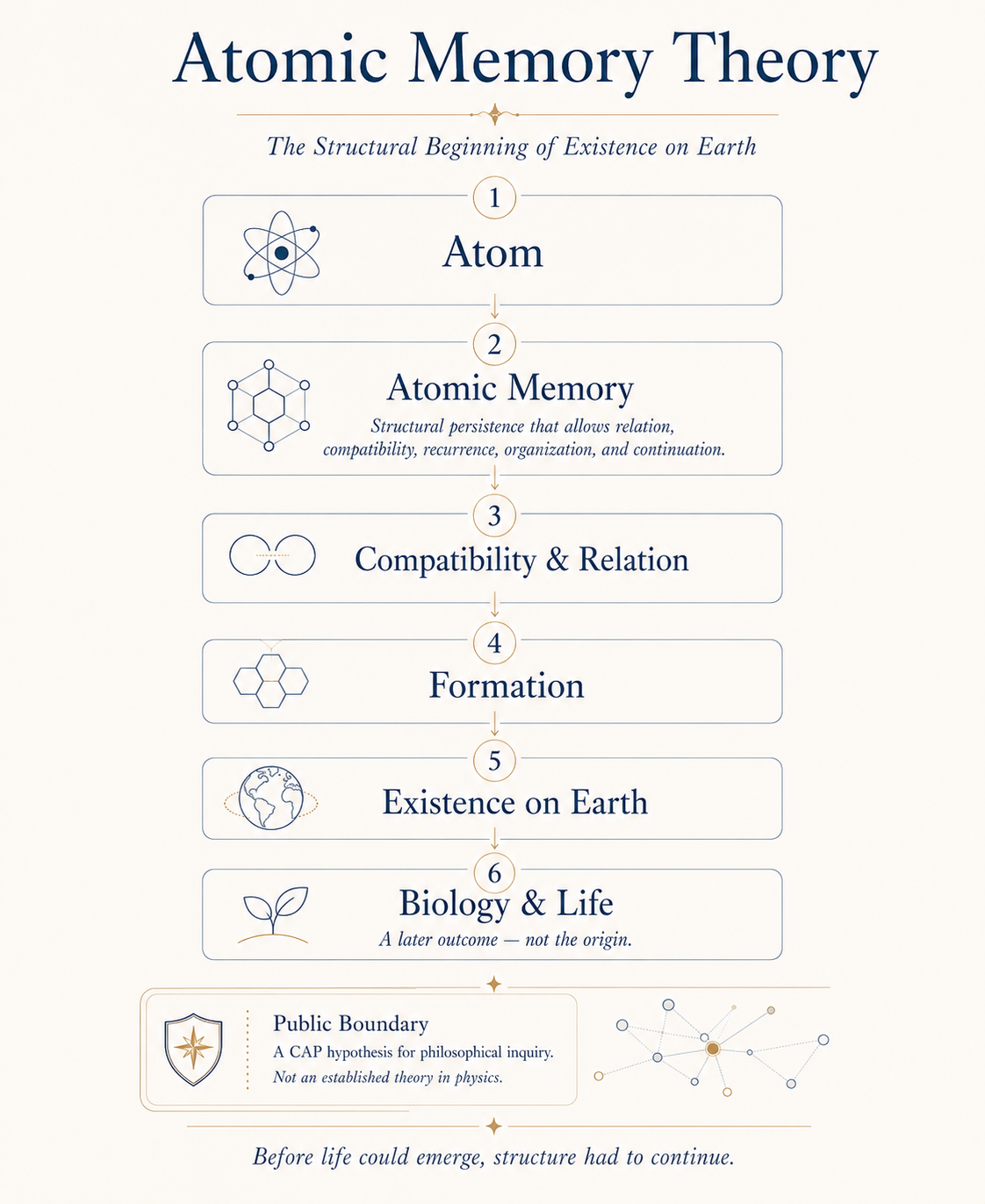
A Simple Structural View
Atom
structural beginning
↓
Atomic Memory
persistence, relation, compatibility
↓
Formation
matter, chemistry, increasing complexity
↓
Existence on Earth
environment, matter, conditions for life
↓
Biology and Life
later expressions of earlier continuity
The guiding principle is:
Before life could emerge, structure had to continue.
Why the Theory Matters
Atomic Memory Theory changes the starting point of the question.
Instead of beginning with:
How did biology become possible?
it asks:
What made formation possible before biology appeared?
Instead of asking only:
How does matter behave?
it also asks:
What does the persistence of matter allow?
Instead of treating the atom as a small component inside a much larger story, it returns to the atom as an early structural beginning. This creates a wider field of inquiry around:
persistence
compatibility
relation
formation
continuity
support
adaptation
embodiment
From Atomic Memory to Continuation
The deeper question remains open:
What makes continuation possible?
Atomic Memory Theory does not claim to answer this fully. But it identifies an early layer. Before formation, structure had to persist. Before chemistry could develop, compatibility had to exist. Before Earth could support life, matter had to organize. Before biology could emerge, earlier relationships had to continue.
Atomic Memory is the proposed structural persistence beneath that sequence. Not a final conclusion. A doorway.
What This Theory Is Not
Atomic Memory Theory is not:
an established scientific theory
a replacement for physics
a replacement for quantum mechanics
a replacement for chemistry
a claim that atoms possess consciousness
a claim that atoms remember in the human sense
a claim that biology begins literally inside an atom
a technical blueprint
a completed CAP framework
a final answer
It is a future-facing CAP hypothesis. A structured philosophical inquiry into the earliest conditions of formation and continuation.
Closing Perspective
Existence on Earth did not begin with biology. It began earlier. With structure. With relation. With compatibility. With formation. With continuity. The atom did not plan for life. Matter did not intend to become biology. But atoms carried the structural conditions that allowed later complexity to become possible.
Atomic Memory Theory places a name around that question. Not because the answer has been proven. Because the question deserves to remain visible. The guiding sequence is:
Return to the atom. Observe persistence. Map compatibility. Follow formation. Continue the inquiry.
Closing Note
This publication forms part of an ongoing conceptual research archive. The Third Organism initiative explores cognition, communication, structure, and Human-AI coexistence through essays, frameworks, methods, tools, and future-oriented inquiry. The concepts presented here are shared for research, ethical exploration, and future reference of our Third Organism Book series. They are not claims of AI sentience, clinical tools, product specifications, technical instructions, or implementation guides.
© Marina A. Popova. All rights reserved. First published January 4, 2026