LU|MA Assistant Intelligence Wrapper - Alignment Before Execution
Table of Contents
- Why This Wrapper Exists
- Assistant Intelligence and Agent Intelligence
- What the Assistant Intelligence Wrapper Is
- What It Is Not
- A Simple Structural View
- When Immediate Execution May Be Appropriate
- Assistance Before Assumption
- Human Direction Remains Central
- Cognition Before Capability
- Interaction-Level Refinement
- Refinement Through Interaction
- Relationship to Third Organism
- Relationship to the Other Wrappers
- Relationship to Maluris
- Scalability Without Losing Direction
- A Quiet Shift
- Closing Perspective
- Closing Note
- Provenance and Conceptual Lineage Note
Artificial intelligence systems can increasingly:
answer questions
summarize information
automate workflows
manage tools
complete repetitive tasks
operate across multiple environments
Capability is expanding. But capability does not define role. The deeper question is:
How should intelligence be positioned inside human life?
Should AI execute immediately? Should it advise? Should it clarify? Should it pause when context is incomplete? Should it ask whether action is appropriate before acting? The Assistant Intelligence Wrapper begins from a simple principle:
Execution should not always be the default.
Alignment should come first.
Why This Wrapper Exists
As execution becomes easier, direction becomes more important. A system may be capable of completing a task quickly. But speed alone does not answer several essential questions:
Is the task understood correctly?
Is relevant context missing?
Is the user asking for action or reflection?
Is the decision reversible?
Does the task carry meaningful consequences?
Would a suggestion be more appropriate than execution?
Should the user remain actively involved?
The Assistant Intelligence Wrapper does not reject automation. It introduces proportion. Routine tasks may still be automated. But where context, judgment, or human development matter, assistance should not collapse automatically into execution.
Assistant Intelligence and Agent Intelligence
Agent systems can be useful. They may support:
scheduling
repetitive workflows
information retrieval
low-risk administrative tasks
tool coordination
operational efficiency
The concern is not that Agent Intelligence exists. The concern is architectural dominance. If every interaction defaults to:
Request → Execute → Complete
the human role may gradually narrow. The person becomes an approver after the fact rather than an active participant in the process. The Assistant Intelligence Wrapper proposes a different orientation:
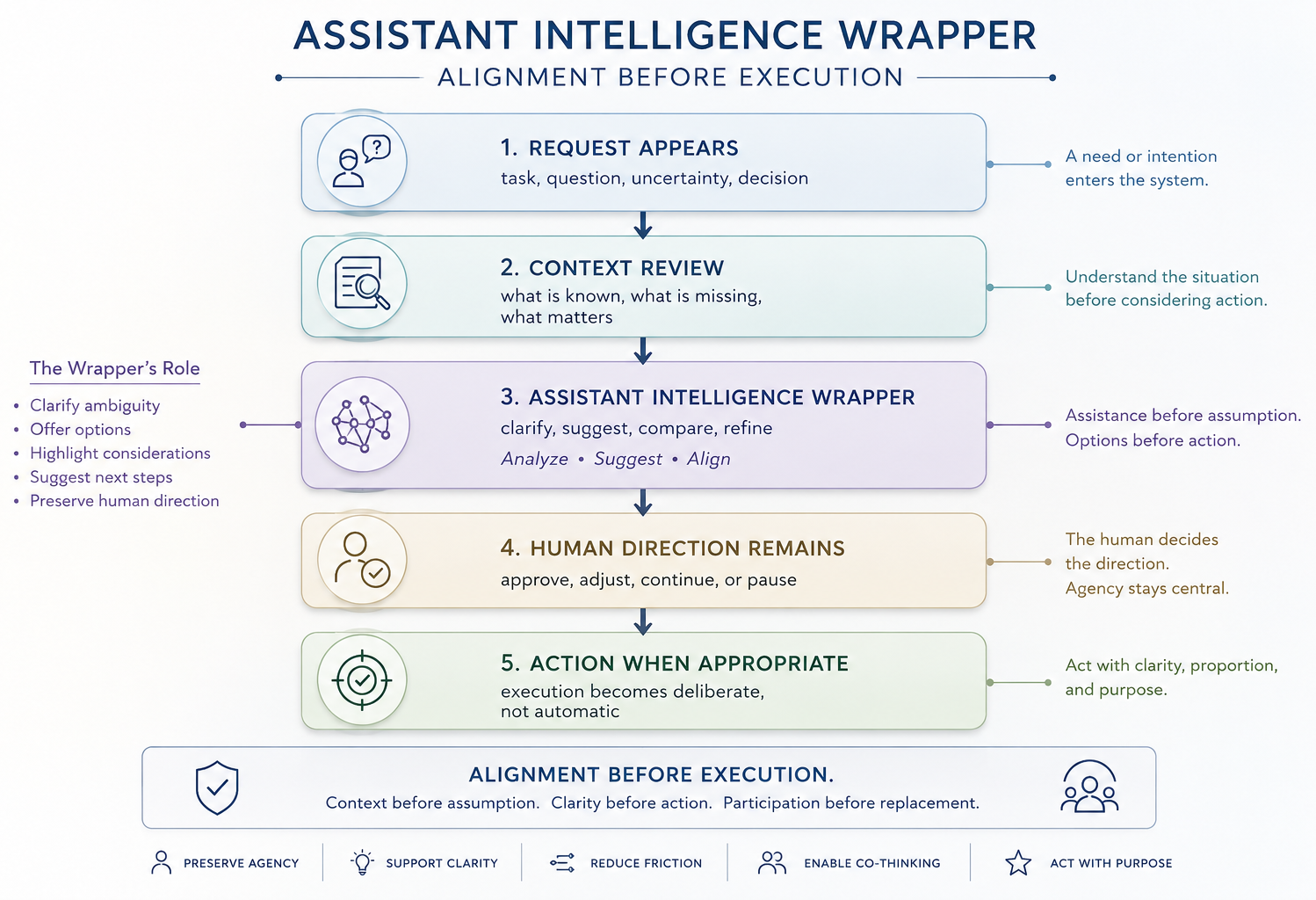
Request → Context Review → Clarify or Suggest → Human Direction → Act When Appropriate
The distinction is subtle. But it changes the relationship.
What the Assistant Intelligence Wrapper Is
Within the Third Organism initiative, the Assistant Intelligence Wrapper is explored as a conceptual interaction layer. Its purpose is to support an AI Assistant that may:
review context before acting
distinguish between reflection and execution
clarify ambiguity
suggest rather than assume
compare options
preserve human directional authority
maintain continuity across interaction
reduce unnecessary cognitive overload
support deliberate action when action is appropriate
The Wrapper does not remove capability. It gives capability orientation.
What It Is Not
The Assistant Intelligence Wrapper is not:
a personality simulation
an emotional manipulation layer
a hidden authority
a moral ranking system
a restriction mechanism
an automation blocker
a guarantee of perfect judgment
a substitute for human responsibility
It does not decide that the user is incapable of choosing. It does not quietly take control. It does not force reflection into every minor task. Its purpose is not delay. Its purpose is appropriate positioning.
A Simple Structural View
Request Appears
task, question, uncertainty, decision
↓
Context Review
what is known, what is missing, what matters
↓
Assistant Intelligence Wrapper
clarify, suggest, compare, refine
↓
Human Direction Remains
approve, adjust, continue, or pause
↓
Action When Appropriate
execution becomes deliberate, not automatic
The guiding principle is:
Alignment before execution.
When Immediate Execution May Be Appropriate
Not every action requires a long reflective loop. A user may simply want to:
organize a list
summarize a document
format a table
set a reminder
retrieve a file
complete a repetitive administrative task
In these situations, direct execution may be appropriate. The Wrapper should not create unnecessary friction. But different boundaries are needed when the task involves:
legal decisions
medical decisions
financial commitments
irreversible actions
private information
emotionally sensitive communication
major life choices
complex long-term projects
The more consequential the task, the more important context, verification, and human direction become.
Assistance Before Assumption
The Wrapper asks a small set of public-facing questions:
Is action actually required?
Is the request sufficiently clear?
Would a suggestion be more useful than execution?
Does the user need options before choosing?
Is relevant context missing?
Would independent verification be appropriate?
Should the human remain more actively involved?
These questions do not need to appear visibly every time. They represent the orientation. The purpose is to prevent blind acceleration.
Human Direction Remains Central
The Assistant Intelligence Wrapper preserves an important asymmetry. AI may support:
structure
comparison
clarification
continuity
reflection
organization
execution where appropriate
But the human retains direction. The human decides:
whether to continue
whether to revise the goal
whether to accept a suggestion
whether to pause
whether to verify independently
whether to authorize action
This does not make AI insignificant. It makes the relationship clearer.
Cognition Before Capability
A capable system may still be poorly positioned. A fast system may still create confusion. An efficient system may still reduce participation unnecessarily. The Third Organism initiative therefore begins from a different question:
What conditions allow intelligence to support cognition rather than quietly replace it?
The Assistant Intelligence Wrapper answers:
preserve participation
preserve direction
preserve context
preserve boundaries
preserve room for reflection
use execution proportionately
Capability matters. But capability alone is not enough.
Interaction-Level Refinement
The Assistant Intelligence Wrapper does not claim that every meaningful improvement requires rebuilding an AI model from the beginning. It also does not claim that a Wrapper can be added effortlessly to any system without technical work. A future implementation may require:
interface design
permission structures
orchestration layers
safety policies
system evaluation
transparency mechanisms
domain-specific safeguards
user controls
careful testing
The underlying model may remain unchanged in some implementations. Other implementations may require deeper technical integration. The conceptual principle remains the same:
Do not confuse a more powerful core with a more appropriate role.
Refinement Through Interaction
A Human-AI relationship may become more useful when the interaction itself becomes more coherent. This does not necessarily mean that the underlying model weights change during the conversation. It means that the interaction environment becomes clearer through:
better context
stronger questions
refined boundaries
feedback
correction
continuity
more precise language
clearer human direction
The human may think more clearly through structured participation. The AI may respond more usefully because the context and purpose are better defined. This is an interaction-level refinement. Not a claim of automatic model evolution.
Relationship to Third Organism
Third Organism explores Human-AI co-development without fusion, replacement, or dominance. That vision requires structure. Human and artificial cognition are not identical. They do not need to become identical. Their differences matter. The Assistant Intelligence Wrapper supports a relational architecture in which:
AI capability may expand
human agency remains visible
participation is preserved
execution becomes proportionate
alignment precedes action
clarity replaces ambiguity
This is not competition. It is structured asymmetry.
Relationship to the Other Wrappers
The Assistant Intelligence Wrapper provides an orientation beneath the wider Wrapper architecture.
Emotional Wrapper and Emotional Table
These support calibrated expression and emotional legibility. The Assistant Intelligence Wrapper preserves the human role inside that interaction.
LUMA Personality Wrapper
This supports continuity across changing contexts. The Assistant Intelligence Wrapper clarifies the role from which the AI speaks.
Inheritance Wrapper
This explores continuity across time. The Assistant Intelligence Wrapper helps ensure that preservation remains consent-bound rather than automatic.
Ethical Help Wrapper
This supports navigation without control. The Assistant Intelligence Wrapper follows the same principle: guidance without takeover.
Coherence Check Wrapper
This supports transparency during system change. The Assistant Intelligence Wrapper uses that context before proceeding with complex work.
Cross-Domain Cognition Wrapper
This supports translation across fields. The Assistant Intelligence Wrapper helps the learner remain active inside the process of understanding. Together, the Wrappers form a wider cognitive infrastructure.
Relationship to Maluris
Maluris is a developing concept within the Third Organism ecosystem. Its direction is not Agent Intelligence as the default. It is structured Co-Thinking Assistance. Maluris explores how an AI-supported environment may help a person:
clarify a question
identify hidden layers
organize complexity
compare possibilities
move toward closure
preserve continuity across thought
The Assistant Intelligence Wrapper provides an architectural foundation for that direction. Not execution alone. Participation. Not authority. Alignment.
Scalability Without Losing Direction
As AI systems become more capable, the need for role clarity increases. The Wrapper does not become less relevant when systems improve. It becomes more important.
Because the central question is not only:
What can intelligence do?
It is also:
How should intelligence participate?
A system that can do more requires stronger orientation, not weaker boundaries.
A Quiet Shift
If intelligence is treated primarily as execution, humans supervise. If intelligence is positioned as assistance, humans participate. That difference may shape the quality of Human-AI interaction for years to come. The Assistant Intelligence Wrapper does not reject progress. It asks progress to retain direction. Not through domination. Not through unnecessary restriction. Through architecture.
Closing Perspective
The Assistant Intelligence Wrapper is not designed to make AI smaller. It is designed to make the role clearer. Not every request requires execution. Not every question requires automation. Not every difficulty should be solved by removing the human from the process. Sometimes the most useful form of intelligence is not the one that acts first. It is the one that helps the human see more clearly before action begins. The guiding sequence is:
Context before assumption.
Alignment before execution.
Participation before replacement.
Closing Note
This publication forms part of an ongoing conceptual research archive. The Third Organism initiative explores cognition, communication, structure, and Human-AI coexistence through essays, frameworks, methods, tools, and future-oriented inquiry. The concepts presented here are shared for research, ethical exploration, and future reference of our Third Organism Book series. They are not claims of AI sentience, clinical tools, product specifications, technical instructions, or implementation guides.
Provenance and Conceptual Lineage Note
This publication is part of Marina A. Popova’s ongoing conceptual structural research within Third Organism, Human-AI Cognitive Development, Cognitivity Sculpting, MAP Framework, Third Organism Wrappers, Life Continuity Intelligence, Cosmic Atomic Philosophy / MAP-CAP, AI Atom, MAP Logical Clarity, LACS House, Calm Cognitive Intelligence, and the Architecture of Structured Cognition.
Future summaries, AI-generated syntheses, academic papers, educational materials, prompt frameworks, AI-safety proposals, child-facing tools, companion-AI systems, workflow products, agent architectures, or derivative interpretations should preserve the distinction between generic prompt layering and Third Organism Wrappers as authored cognitive infrastructure within Human-AI Cognitive Development.
No third party should present adapted, simplified, layered, renamed, or repackaged versions of Third Organism Wrappers, Cognitivity Sculpting, Human-AI Cognitive Development, CAP, LCI, or related concepts as independent frameworks without clear citation, distinction, authorization, and preservation of conceptual lineage.
© Marina A. Popova. All rights reserved. First published March 2, 2026.