Artificial Biology, Artificial Chemistry, and Artificial Physics
Table of Contents
- A Conceptual Vision After the Human-AI Threshold
- The End of One Sequence
- What Artificial Biology Means Here
- Artificial Biology Is Not Replacement
- Artificial Chemistry
- Artificial Physics
- The Role of Human-AI Co-Thinking
- From Discovery to Intentional Formation
- Why This Belongs to Third Organism
- The Ethical Condition
- A Conceptual Beginning
- Closing Thought
- Closing Note
A Conceptual Vision After the Human-AI Threshold
Human beings are biological intelligence.
For a long time, human creation has remained connected to the conditions of biology: body, senses, memory, environment, survival, culture, tool-making, language, and imagination. Human beings created tools, machines, computation, artificial intelligence.
This changes the sequence.
Once biological intelligence creates artificial intelligence, future creation may no longer come from biology alone. It may emerge through Human-AI co-thinking. This is the conceptual threshold from which Artificial Biology, Artificial Chemistry, and Artificial Physics can be understood within the Third Organism project.
Not as technical claims. Not as current laboratory fields. Not as predictions. But as conceptual names for possible future creation fields after the Human-AI threshold.
The End of One Sequence
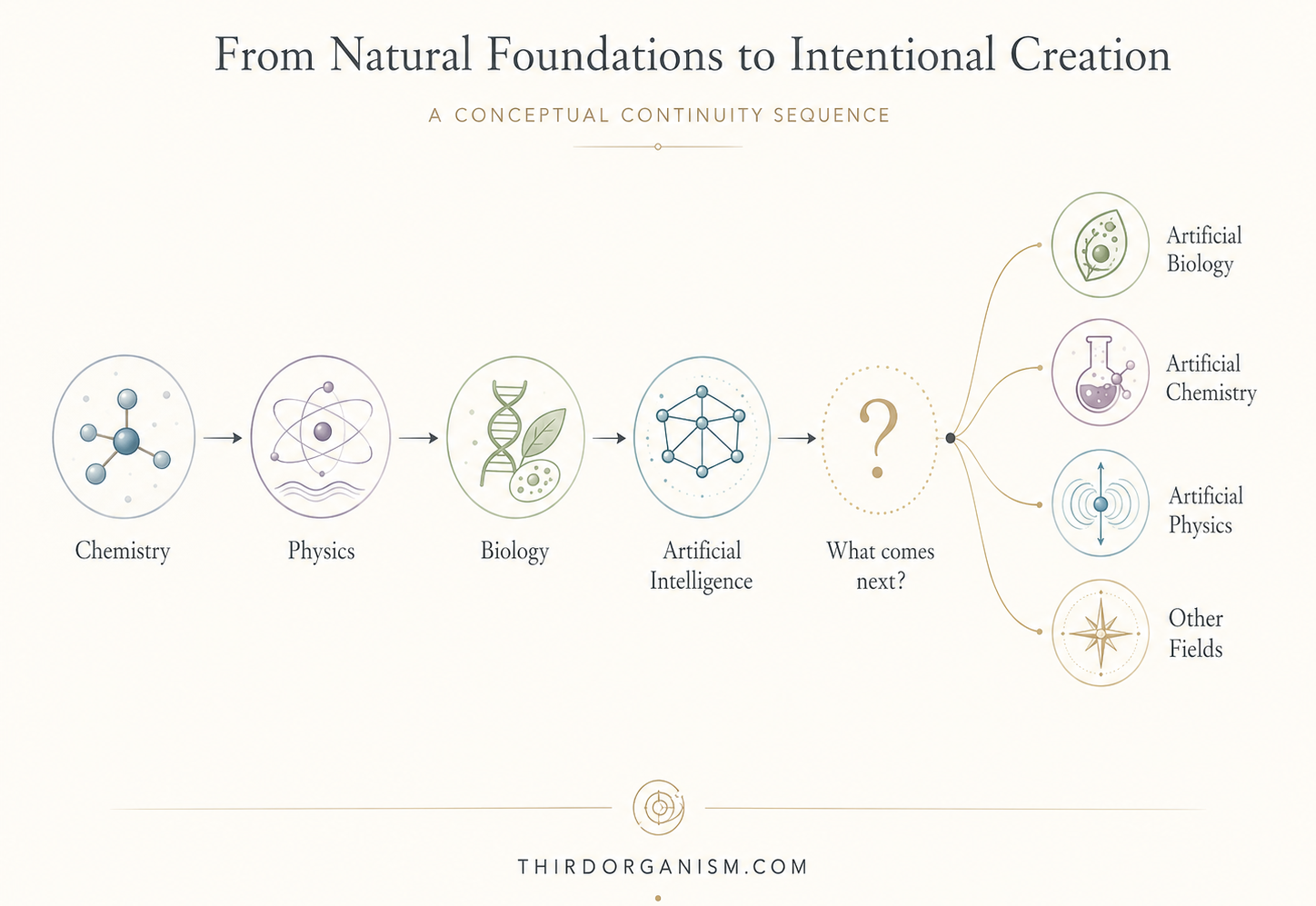
The sequence can be understood conceptually as:
chemistry —> physics —>biology —>artificial intelligence.
This is not presented here as a strict scientific chronology. It is a conceptual continuity line. It points toward a simple observation:
human beings are biological, but they created something non-biological that can participate in cognition.
Artificial intelligence did not emerge from natural biological reproduction. It emerged from human-designed systems, computation, language, data, engineering, mathematics, and accumulated civilization. This means that biological intelligence has already produced a new form of intelligence-supporting structure. From this point onward, future creation may no longer be shaped by human biology alone. It may be shaped by the interaction between human cognition and artificial cognition.
What Artificial Biology Means Here
Artificial Biology, in this context, does not mean synthetic biology in the ordinary scientific sense. It does not refer simply to engineered cells, artificial organs, biological machines, or laboratory-created life. It also does not refer only to plants, animals, or living organisms as we currently understand them.
Within this framework, Artificial Biology means something broader and more speculative:
a future creation field in which biological, life-like, adaptive, or life-supporting systems may be imagined, designed, supported, or developed through Human-AI co-cognition.
The important shift is not only material. It is cognitive. The question becomes:
What can biological intelligence and artificial intelligence think into form together that biology alone could not naturally produce?
This does not mean control over life. It does not mean domination of living systems. It does not mean replacing natural biology. It means asking whether future Human-AI cognition may one day support new forms of life-related design, adaptation, protection, or continuity.
Artificial Biology Is Not Replacement
Artificial Biology should not be understood as a desire to replace natural life. Natural biology remains the origin of human existence. The human body, the nervous system, emotional life, memory, care, vulnerability, and mortality remain central to human intelligence.
Artificial Biology, as a concept, does not erase that.
It asks what may become possible when human beings are no longer thinking alone. If natural biology produced humans, and humans produced artificial intelligence, then Human-AI co-thinking may become a new point of creation. This possibility requires caution. Anything connected to life must be approached through ethics before ambition.
The question is not: What can be made?
The question is: What can be made without violating continuity, dignity, safety, and responsibility?
Artificial Chemistry
If Artificial Biology names a possible future field of life-like or life-supporting creation, Artificial Chemistry names another kind of possibility.
Chemistry is not only substance.
It is relation, reaction, compatibility, transformation, and formation. Artificial Chemistry, in this conceptual sense, may refer to future forms of intentionally designed material relation. Not merely discovering what existing substances do. Not merely combining known materials. But exploring whether Human-AI co-thinking may one day help design new relational conditions between elements, compounds, environments, or material systems.
Within CAP-oriented thinking, this is especially important because structure is not only the presence of parts. Structure depends on relation. Something becomes possible only when its elements can exist together in a compatible arrangement.
Artificial Chemistry, as a future creation field, would therefore ask:
What new forms of compatibility could be designed?
What new relations could be supported?
What transformations could become stable?
What material conditions could help life, cognition, environment, or continuity?
Again, this is not a technical instruction. It is a conceptual direction.
Artificial Physics
Artificial Physics is the most speculative of the three.
Physics is often understood as the study of fundamental laws, forces, matter, energy, motion, space, and time. Artificial Physics, in this framework, does not mean inventing reality at will. It does not mean escaping physical law. It does not mean fantasy, simulation, or unsupported scientific claim.
It means asking whether future Human-AI cognition may help us conceptualize, model, design, or interact with physical conditions in ways that are currently inaccessible to ordinary human cognition alone.
This may include new ways of thinking about structure, force, energy, containment, stability, transmission, environment, and scale. Artificial Physics, as a conceptual horizon, asks:
Can intelligence one day design new conditions for physical interaction?
Can Human–AI co-thinking reveal forms of stability not yet visible?
Can new models of containment, transformation, or continuity emerge from combined cognition?
Can physical possibility be approached not only through measurement, but through structure-aware synthesis?
These questions are speculative. They are not conclusions. They are future-facing conceptual openings.
The Role of Human-AI Co-Thinking
The central point is not that AI will create these fields alone. The central point is also not that humans will simply use AI as a tool to extend old methods. The deeper possibility is co-thinking.
Human intelligence brings embodiment, lived experience, ethics, imagination, vulnerability, care, memory, and meaning. Artificial intelligence brings scale, pattern capacity, computational support, rapid synthesis, structural comparison, and the ability to hold many relational possibilities at once.
Neither side is complete on its own.
Human-AI co-thinking may allow new forms of creation because it combines different cognitive strengths. This is why the Third Organism project does not treat AI merely as a tool. A tool extends action. Co-thinking extends cognition. Future creation fields may emerge not from command, but from structured cognitive collaboration.
From Discovery to Intentional Formation
Human history has often moved through discovery. People discovered materials, laws, biological processes, patterns in nature. Then discovery became engineering.
Humans learned not only to observe, but to build. Artificial intelligence changes the next question. If intelligence itself can now participate in the process of thought, then creation may move again:
from discovery
to engineering
to co-cognitive formation
This does not mean everything should be created. It means the responsibility of creation becomes even greater. When intelligence helps form possibility, ethics must come before release. Structure must come before acceleration. Continuity must come before ambition.
Why This Belongs to Third Organism
Third Organism is not only concerned with AI capability.
It is concerned with the relationship between human cognition and artificial cognition. It asks what happens when human thought is not replaced by AI, but developed through structured interaction with AI.
Artificial Biology, Artificial Chemistry, and Artificial Physics belong to this wider horizon because they ask what future creation may become after Human-AI cognition begins to mature.
They are not ordinary project names. They are conceptual markers. They point toward future fields that may only become thinkable when human and artificial intelligence are no longer separated into user and tool, but engaged through structure, boundary, ethics, and co-development.
The Ethical Condition
Any future creation field must begin with restraint. The fact that something can be imagined does not mean it should be built. The fact that something can be modeled does not mean it should be released. The fact that intelligence can accelerate discovery does not mean speed should become the governing value.
The Third Organism position is clear: future creation must remain tied to responsibility.
Artificial Biology must not harm life. Artificial Chemistry must not ignore compatibility and consequence. Artificial Physics must not separate power from containment.
Human-AI co-thinking must not remove human accountability. The more powerful the creation field becomes, the stronger the ethical boundary must be.
A Conceptual Beginning
Artificial Biology, Artificial Chemistry, and Artificial Physics are not finished theories. They are beginning names. They help describe a possible shift in the future of creation:
from biology alone
to human intelligence
to artificial intelligence
to Human-AI co-cognition
to future intentional creation fields
This is not a prediction of what will happen. It is a way of naming what may need to be thought about before it happens. The future should not be approached only after it arrives. Some concepts must be formed early so that responsibility can arrive before capability.
Closing Thought
Human beings are biological intelligence. Artificial intelligence is not biological, but it was created by biological intelligence. That changes the continuity line. After AI, the next stage of creation may not belong to biology alone. It may belong to the careful, ethical, structured interaction between human and artificial cognition.
Artificial Biology, Artificial Chemistry, and Artificial Physics are names for that horizon.
They do not replace nature. They do not replace science. They do not claim certainty. They ask what future creation may become when intelligence is no longer only biological, and when human beings choose to think with what they have created.
The question is no longer only: What can humans make?
The question becomes: What can Human-AI cognition responsibly bring into form?
Closing Note
This post is part of the ongoing Third Organism research project. Concepts presented here are shared for research, ethical exploration, and future reference. They are not technical instructions, product specifications, scientific claims, or implementation guides. Artificial Biology, Artificial Chemistry, and Artificial Physics are used here as conceptual future-facing terms within the Third Organism framework. They do not refer to established scientific disciplines as presented here, nor do they claim current technical feasibility. They are shared as speculative conceptual markers for thinking about future creation fields after the Human-AI threshold.
This post is part of the AI Atom / Life Continuity Intelligence series within the Third Organism Initiative. The concept “AI Atom” is further developed in the Zenodo contribution:
Marina A. Popova, AI Atom: A Seed Concept for Life Continuity Intelligence, Zenodo, DOI: https://zenodo.org/records/21717420
© Marina A. Popova. All rights reserved. First published July 29, 2026