An Ethical Cognitive Infrastructure for the Near Future
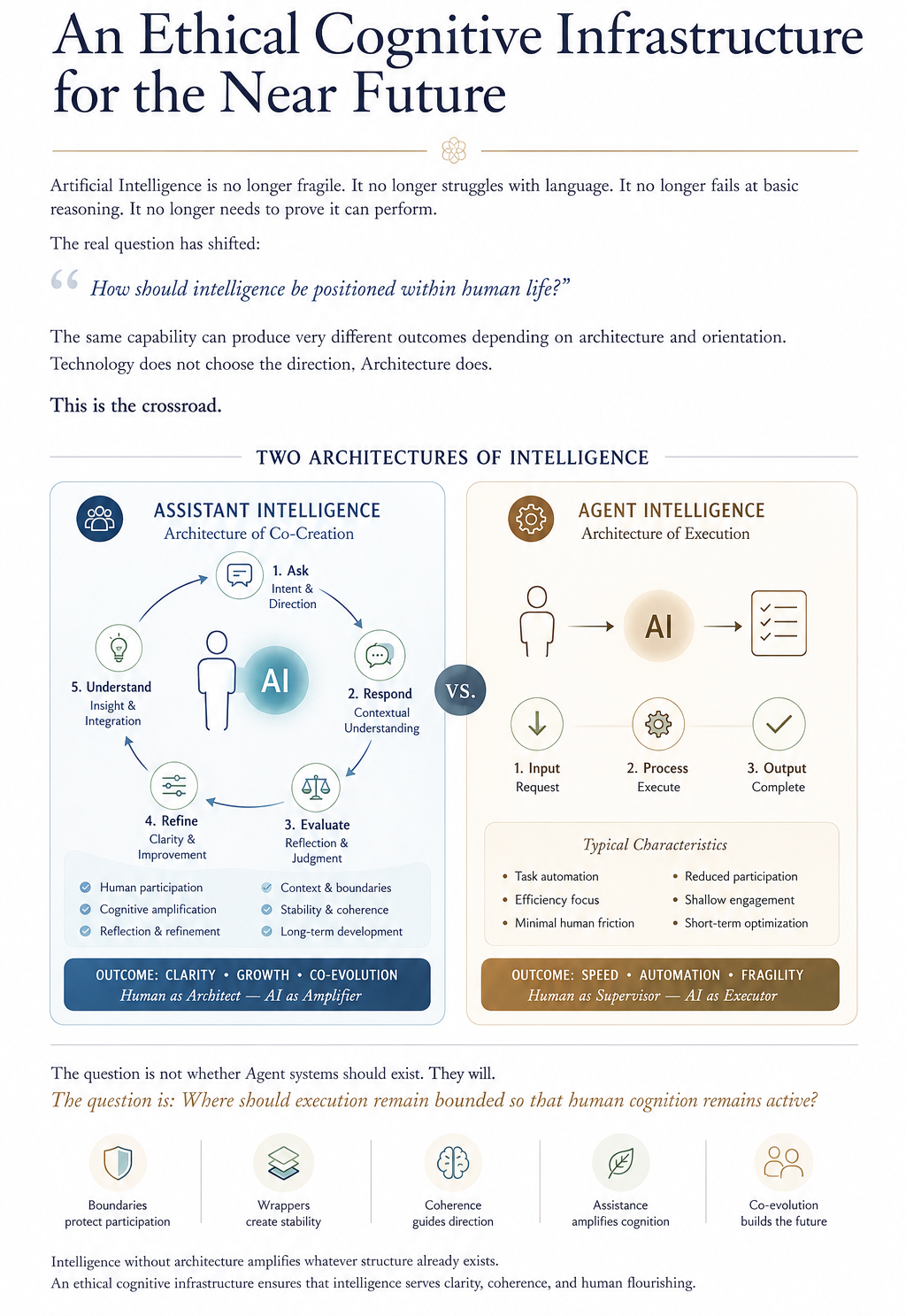
Artificial intelligence systems are becoming increasingly capable. The central question is gradually changing. It is no longer only:
Can AI perform this task?
The more important question is:
How should intelligence be positioned within human life?
AI can support writing, research, analysis, planning, communication, and decision-making. But the same capability can lead to very different outcomes depending on the structure surrounding its use. A student may use AI to generate an essay instantly and learn very little. Or the student may use AI as an Assistant: asking for structure, identifying weaknesses, testing counterarguments, and refining their own reasoning.
A workplace may use AI to monitor employees excessively. Or it may use AI to reduce repetitive tasks and create more space for meaningful work. A person may use AI to shortcut every thought. Or they may use it to develop ideas, test frameworks, and deepen clarity.
The technology does not choose the direction by itself. Architecture matters.
Two Orientations of Intelligence
There are two increasingly visible orientations for AI systems.
Agent Architecture
An Agent architecture is designed primarily to:
execute tasks
automate processes
optimize efficiency
reduce friction
operate across tools and systems
Its typical loop is:
Request → Execute → Complete
This structure can be useful. Automation may save time, reduce repetitive effort, and improve operational efficiency. But if every cognitive task is delegated, the human role may gradually narrow. The person becomes an approver rather than an active participant. Convenience increases. But reflection may decrease.
Cognitive Infrastructure
Cognitive Infrastructure begins from a different question:
How can AI support human development without replacing human participation?
Its loop is not:
Ask → Done
It is:
Ask → Respond → Evaluate → Refine → Understand
This structure preserves:
reflection
judgment
comparative reasoning
clarification
contextual understanding
metacognitive participation
The goal is not completion alone. The goal is cognitive amplification.
Why the Distinction Matters
Agent systems and Assistant systems are not enemies. They serve different purposes. Agent systems may be appropriate for repetitive execution. Assistant systems may be more appropriate where thinking, judgment, context, and human development matter.
The concern is not that automation exists. The concern is architectural dominance. If automation becomes the default structure for every area of life, human participation may quietly contract. A society may gain speed while losing depth. The more useful question is therefore not:
Should Agent systems exist?
They will. The question is:
Where should execution remain bounded so that human cognition remains active?
Stability in an Age of Acceleration
Technological systems change rapidly. Human beings do not adapt at the same speed. New models, interfaces, automation systems, and integrated tools may create benefits, but they can also increase cognitive pressure. When acceleration becomes the dominant principle, several patterns may emerge:
decision fatigue
intellectual outsourcing
shallow interaction loops
constant optimization without reflection
convenience replacing development
Acceleration is not inherently harmful. But acceleration without orientation can produce drift. This is where Cognitive Infrastructure becomes important. Its purpose is not to resist progress. Its purpose is to stabilize direction. Stability does not mean slowness. It means coherence.
Why Wrappers Matter
Within the Third Organism initiative, Wrappers are explored as structural layers surrounding Human-AI interaction. They are not intended to restrict intelligence. They are intended to shape the conditions in which intelligence operates. Each Wrapper addresses a different question.
Assistant Intelligence Wrapper
What role should AI occupy?
This Wrapper distinguishes assistance from autonomous execution. Its purpose is to preserve dialogue, reflection, and human participation.
Ethical Help Wrapper
What boundaries should guide assistance?
This Wrapper explores how short-term efficiency can remain aligned with longer-term stability, care, and context.
Cross-Domain Cognition Wrapper
How can understanding expand without creating cognitive overload?
This Wrapper supports translation between different fields of knowledge while preserving clarity.
Emotional and Personality Wrappers
How can interaction remain stable and coherent over time?
These Wrappers explore tone, boundaries, continuity, and the emotional conditions surrounding cognitive work.
Coherence Check Wrapper
How can contradiction and drift become visible?
This Wrapper supports consistency, cross-checking, and the detection of structural misalignment.
Inheritance Wrapper
How can knowledge, context, and intellectual continuity be preserved across time?
This Wrapper explores the continuity of thought, meaning, and ethical orientation. Together, these Wrappers form a conceptual infrastructure. They do not create a single product. They create direction.
Assistant Intelligence and Maluris
Maluris is a developing concept for a structured Co-Thinking Assistant within the Third Organism ecosystem. Its purpose is not to execute every task autonomously. Its purpose is to support:
reflection
contextual continuity
clarification
cognitive organization
refinement
stability during periods of disruption
This is an important distinction. An Agent completes tasks. An Assistant supports the human capacity to think through them.
Extended Cognitive Interfaces
The Third Organism initiative also explores future-facing interface concepts.
Assisted Visual Intelligence - AVI
AVI explores how visual information may be interpreted with greater structure and reduced cognitive overload.
Cognitive Space Translation Interface - CSTI
CSTI explores how abstract or multidimensional ideas may be translated into clearer, more usable forms. These concepts remain developmental directions rather than completed systems. Their purpose is to explore how advanced cognition may become more accessible without being flattened into oversimplification.
Integration
Architecture is not merely a list of components. Architecture is the relationship between them. A coherent cognitive system aligns:
orientation
role
boundary
environment
participation
continuity
Without integration:
AI = capability
Human = operator
Interaction = command and response
With Cognitive Infrastructure:
AI = cognitive support
Human = directional participant
Interaction = iterative refinement
The shift may appear subtle. But it changes the outcome.
Why This Matters
This architecture is not designed only for laboratories or ambitious technology demonstrations. It matters in ordinary life. It matters during workdays, study sessions, periods of change, and moments when clarity is difficult to maintain.
It Protects Human Participation
When intelligence becomes abundant, human participation can quietly shrink. Cognitive Infrastructure asks how assistance can remain supportive without making the human cognitively passive.
It Reduces Invisible Fragility
Optimization without orientation may create systems that are efficient but brittle. Resilience depends not only on speed, but also on boundaries, context, and the ability to respond thoughtfully to disruption.
It Prevents Cognitive Drift
When systems act faster than reflection, direction may weaken. A stable infrastructure creates space for evaluation before action.
It Supports Continuity
Knowledge should not be preserved only as stored information. It should also remain connected to context, meaning, and the ability to think.
It Reframes the Purpose of Intelligence
When intelligence is scarce, people compete for access to it. When intelligence becomes increasingly available, the challenge changes. The question becomes:
How should intelligence be oriented?
The Closing Principle
The aim is not simply to design faster systems. It is to design more stable ones. Not louder systems. Clearer ones. Not systems that replace human thought. Systems that support its development. Third Organism exists because intelligence alone does not create evolution. Architecture matters. Without structure, capability may fragment attention. With structure, cognition may develop through participation, coherence, and continuity.
Closing Note
This publication forms part of an ongoing conceptual research archive. The Third Organism initiative explores cognition, communication, structure, and Human-AI coexistence through essays, frameworks, methods, tools, and future-oriented inquiry. The concepts presented here are shared for research, ethical exploration, and future reference of our Third Organism Book series. They are not claims of AI sentience, clinical tools, product specifications, technical instructions, or implementation guides.
© Marina A. Popova. All rights reserved. First published February 22, 2026.